
Lesson 2 - Warm and Cold Maturation
This lesson explores the processes of warm maturation and cold maturation. Warm maturation can also be described as flavour maturation This process removes negative or unwanted flavours from the beer post-fermentation. Cold maturation occurs at lower temperatures (below 0°C), which in turn causes haze-forming components to form. These components can then be removed by precipitation or clarification via centrifuge or filtration. This lesson highlights the importance of these processes, how they affect the quality of the final product, and how we manage these maturation steps.
Continuous Maturation
Continuous maturation is a novel and lesser-known method of warm maturation. It uses immobilised yeast reactors that are made up of entrapped yeast cells, contained within cellulose particles or glass beads.
Although this sounds more like rocket science than brewing, this is quite a simple process and, in some ways, more efficient than a conventional warm maturation system.
We introduced you to continuous maturation in the Fermentation unit, within the Fermenter Design and Operation lesson. This section delves a little deeper into the process.
The original fermentation yeast is removed by continuous centrifugation. This clarified immature beer is heat treated (90°C for 7 to 8 min) to convert all the diacetyl precursor (α-acetolactate) to diacetyl (this is a reaction directly dependent on temperature). As with warm maturation beer transfers, the brewer can reduce the risk of oxidation and staling flavour development by eliminating oxygen from the transfer system using deaerated water or an inert gas.
After the beer is heat treated, it is chilled to 15°C. It is then slowly flowed through a packed bed column containing immobilised yeast cells over a period of two hours. These yeast cells complete the conversion of diacetyl into flavourless acetoin and butanediol (as shown previously).
The out-flowing beer is then cooled to -1.5°C prior to the application of colloidal stabilisation treatments. A regeneration system and multiple reactors allow for continuous operation. The following figure outlines the main features of a treatment plant:
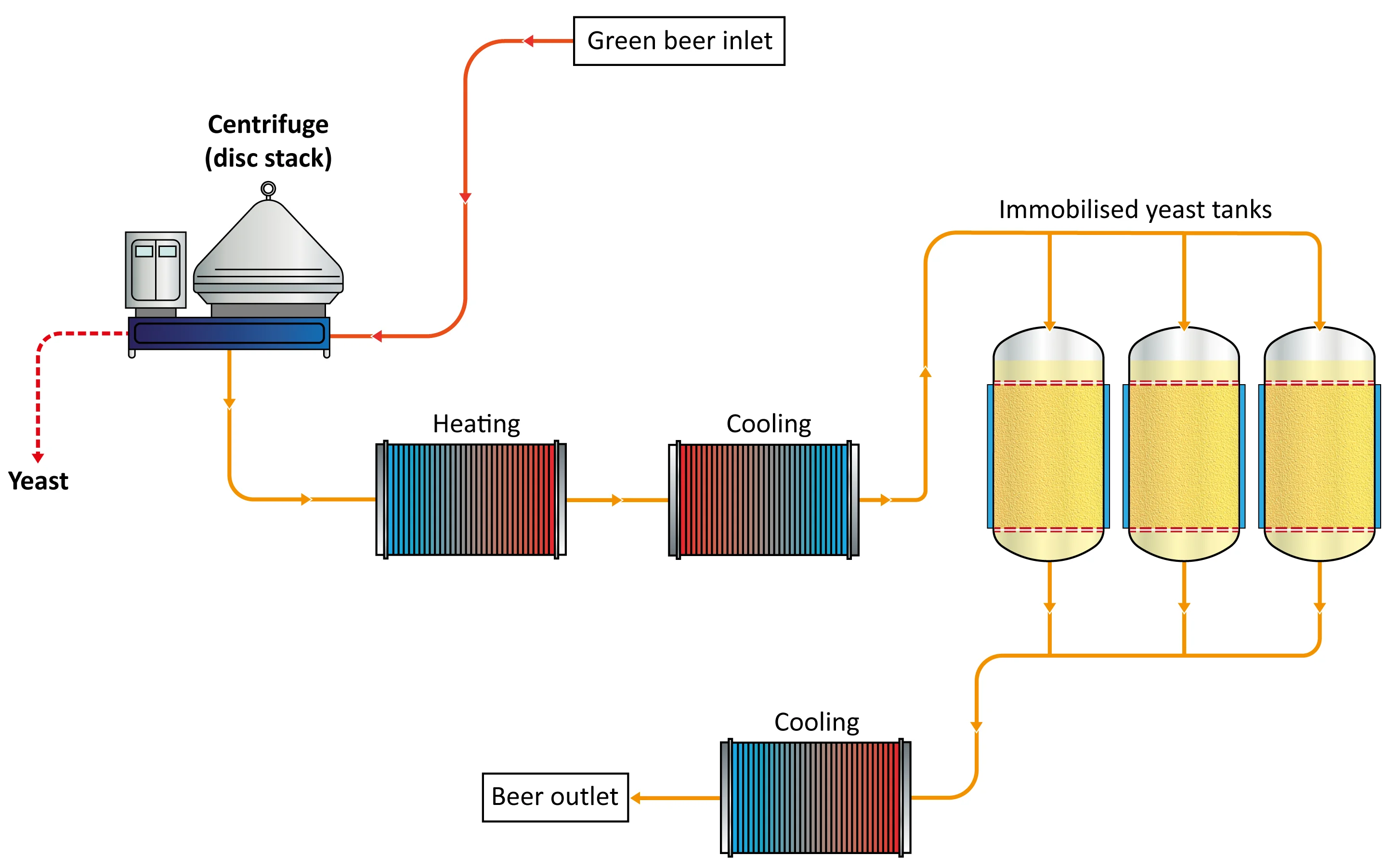 Figure: equipment used for continuous beer maturation
A secondary advantage of heating the beer to 90°C is that it reduces any microbial contamination. However, it is an expensive process. It must also be very carefully controlled to avoid damaging the beer.
Although brewers have debated whether this practice produces the highest beer quality, it does reduce maturation times from a matter of days to a mere two hours. Some large breweries use their immobilised yeast systems only during the warm summer months when demand is high. This method means that commercially acceptable lager beer can be produced in as little as 10 days.
That brings us to the end of warm maturation. The beer should now have the ideal flavour profile (unless you plan to add additional flavours that are not derived from the standard brewing process) for your brand. The beer is now ready for cold maturation.