
Lesson 2 - Warm and Cold Maturation
This lesson explores the processes of warm maturation and cold maturation. Warm maturation can also be described as flavour maturation This process removes negative or unwanted flavours from the beer post-fermentation. Cold maturation occurs at lower temperatures (below 0°C), which in turn causes haze-forming components to form. These components can then be removed by precipitation or clarification via centrifuge or filtration. This lesson highlights the importance of these processes, how they affect the quality of the final product, and how we manage these maturation steps.
Maturation Vessel Selection
As previously mentioned, vessels may be designed as vertical, horizontal, and in some cases, even square. Our design choice may be influenced by a number of factors. Let us explore this in a bit more detail.
Vertical vessels can be located outside or in ambient temperature cellars. They are externally clad and fitted with cooling jackets. Depending on the cooling systems on site, the cooling jackets may be supplied with brine, propylene glycol, ammonia, or industrial methylated spirit.
Horizontal vessels are normally built inside warm or cold conditioning rooms where the cellar air temperature is kept constant. These vessels are usually built in areas of the brewery that cannot accommodate vertical vessels, for example they may be located at basement level or may be stacked on individual floor levels in existing buildings.
Our choice of maturation system is not only defined by shape. We have to also consider how the system meets production demands and allows for brand mix flexibility.
For example, some breweries may just produce a handful of brands. They will therefore have vessel farms (collection of vessels) made up of large vessels. However, many breweries produce a range of brands and require flexibility and production agility to produce large batches alongside smaller volume one-offs or seasonal brands.
Dual-vessel systems
Traditional brewery designs use separate fermentation and maturation vessels. This set-up is called a dual-vessel system. To allow flexibility in the brewing operation, some breweries have dual purpose vessels or unitanks where the same vessel can be used for either fermentation or maturation. A dual-vessel system must include a beer chiller between the fermentation and maturation vessels, to drop the temperature from about 5°C to -1.5°C, which is a more effective and time efficient process than cooling purely through vessel cooling jackets.
Modern maturation system designs
As discussed above, some breweries use unitanks where fermentation, warm maturation, and cold maturation can take place in the same vessel, as shown in the figure below (we will discuss continuous maturation later in this lesson):
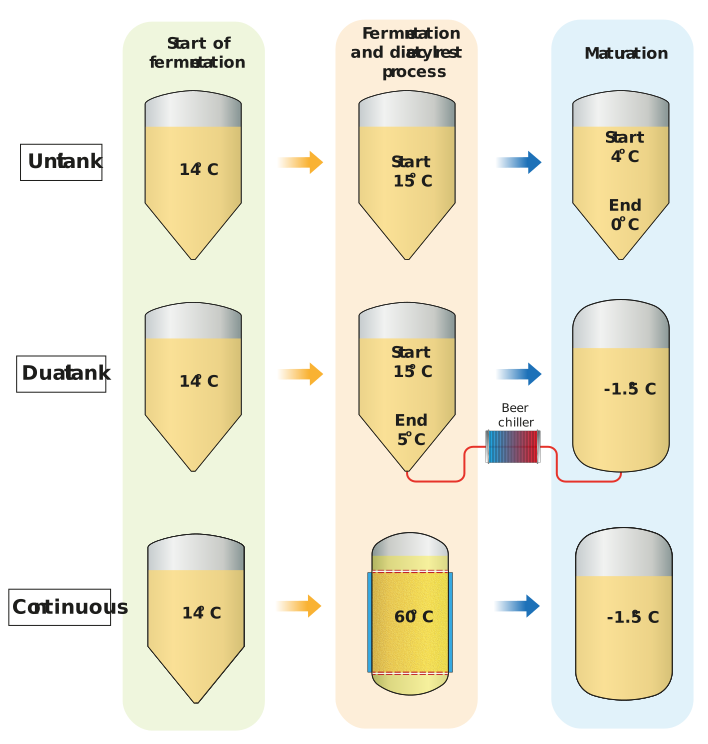
Figure: Illustration of unitank, dual vessel, and continuous vessel system designs
Unitanks can be particularly beneficial for smaller breweries as they give them far more flexibility than using dedicated vessels. However, unitanks need to cover a broad range of requirements – for instance, we need to be able to easily crop yeast at the end of fermentation. In addition, the temperature control needs to be able to handle temperature ranges from warm fermentation (for example 15-20°C) right through to below zero for cold maturation. Good brewing practices should allow for further yeast crops during maturation, in order to limit the development of off-flavours. Based on all of these requirements, the unitank is thus a vertical cylindro-conical vessel with cooling jackets positioned at the top and bottom of the vessel.
By having top and bottom cooling jackets, this cylindro-conical vessel is able to meet the different temperature needs of fermentation and maturation, which we will discuss later in this lesson.
Other than the flexibility advantage, there are several other advantages for combining fermentation and maturation in one tank. These include:
-
Less microbiological and foam retention risks because of fewer transfers
-
More efficient yeast collection
-
Improved CO2 control
-
Easier to introduce automation into the system
-
Smaller vessel footprint
-
Lower operating costs
One of the major drawbacks of a unitank is the challenge to drive cooling below 4°C. As the vessel uses cooling jackets to control fermentation, and due to the low temperature difference between the beer and the coolant, it takes longer and longer to cool; some unitanks may never fall below 0°C.
When designing a brewery, it may be wise to plan for the installation of a dual vessel and chiller, using the rapid cooling it offers, rather than waiting for a unitank to cool.
In order to help overcome this cooling challenge in a unitank, we can use a dynamic mixing device inside the vessel to improve the rate of cooling. This constantly mixes the vessel’s contents and ensures a homogenous beer temperature throughout. We can further increase the rate of cooling by placing a chiller in the recirculation pipework loop.
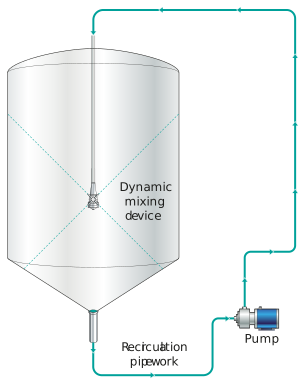
Figure: A dynamic mixing device
You can read more about dynamic mixing and its benefits to the brewer here:
(Please note, this is for illustrative purposes only and is not a recommendation or endorsement of a particular supplier’s product.)
Alternatively, you might like to watch this video showing the Alfa Laval Rotary Jet Mixer in action -
Before we leave this section, let us compare the three main shapes of maturation vessels, keeping their key system features in mind:
Table: Comparison of maturation vessel shape designs
|
Type |
Comments |
|
Vertical cylinder |
|
|
Horizontal cylinder |
|
|
Square |
|
Look to the future. Ensure your chosen maturation system design is robust enough to handle any future plans and projected volume expansions, even if you are just ensuring that space is set aside for additional vessels.
If you needed to upgrade and replace your maturation vessel farm to improve process time and quality, what factors would you consider?
Also, what design features would you consider?
Give yourself 5-10 minutes to think about potential solutions and the merits of these options, and then click ‘Next’ to continue with this lesson.