
Lesson 4 - Fermentation and Beer Flavour
Yeast and fermentation have an enormous impact on beer flavour. The most obvious changes during fermentation are sugar utilisation and the resultant formation of alcohol and carbonation. This is only a part of the story. Many thousands of compounds disappear and similar numbers of new ones are formed in fermentation as a result of yeast growth. This lesson describes what these are, how and why they are formed, and what effect they have.
The Use of Mixed Cultures
The use of unusual yeast strains and mixed cultures in fermentation to produce novel beers is becoming increasingly common. In this final section we will look at some of the organisms involved and how they influence beer flavour.
When humans first made beers, all fermentations were spontaneous; the beers made would have had very different flavours from those to which we are now accustomed. The discovery of yeast finally resulted in most brewers using pure cultures of either ale or lager strains. The vast majority of beers are made using strains of these two Saccharomyces yeasts.
However, there have always been some who continue to use old traditions, where there is a much bigger choice of transforming organisms, both yeast and bacteria.
Traditional fermentations which are spontaneous rely on inoculation from the environment. Time periods can be very lengthy – months or even years.
We now know which species are involved in spontaneous fermentations. The most significant can be purified and used in mixed but more controlled fermentations designed to produce certain flavour metabolites. This can shorten process times and allow a more refined control of flavour.
Spontaneous fermentation
We live surrounded by microorganisms which grow when supplies of nutrients and environmental conditions allow them to. It is likely that only a small proportion of the total microbial population will be able to grow and, providing conditions do not change, the environment will become enriched in these species. This is probably how brewing yeast strains were first domesticated.
Microbial growth changes the environment. We have already discussed how good brewing yeast is at making changes that inhibit the growth of many potential competitors. For example, it produces alcohol and CO2, both inhibitory to many organisms, and it lowers the pH and makes conditions anaerobic, two changes that prevent the growth of many others.
The reverse effect is also true. The changes in conditions might allow the growth of certain species which could not grow initially. The result is that populations of different microorganisms predominate at different times. These shifts in populations are accompanied by changes in the spectrum of metabolites present in the medium.
All of these factors are involved in spontaneous brewing fermentations. The production of Belgian Lambic and Gueuze beers gives us a good example. These beers are made from a mixture of malted barley and un-malted wheat and use hops which have already been used to make other beers and therefore have had most of the bittering and flavouring agents already extracted. The process is outlined in the next figure.
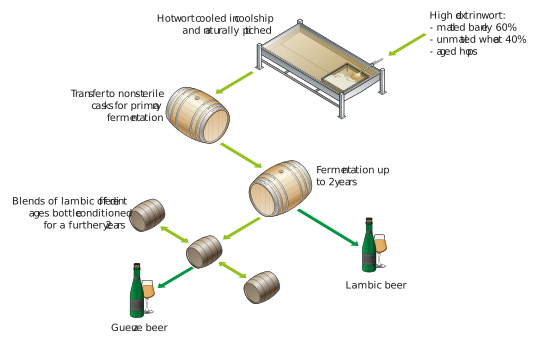
Figure: Process for making Lambic and Gueuze beers by spontaneous fermentation
The microbiology of these spontaneous fermentations is very complex.
The following phases can be identified:
● 1-2 weeks: Growth of enteric bacteria and the yeast Kloeckera. In this period acetic acid is produced.
● 1-4 months: Saccharomyces yeasts take over and in this period most of the alcohol is formed, together with considerable esters.
● 4-8 months: Bacteria (mainly species of Pediococcus and Lactobacillus) take over, and the beer becomes a lot more acidic as lactic acid is formed.
● 9 – 13 months: Species of the yeast Brettanomyces become dominant. These yeasts produce many products that contribute to flavour. These include several carbonyls such as 2-acetyl-3,4,5,6-tetrahydropyridine. Collectively these give a character described as ‘mousiness’. Several phenolic compounds are also produced including 4-vinylphenol, 4-vinylguaiacol, 3-ethylphenol, and 3-ethylguaiacol. These have medicinal and clove-like flavours.
For more information see:
Van Oevelen, D., Spaepen, M., Timmermans, P. & Verachtert, H. (1977). Microbiological aspects of spontaneous fermentation in the production of Lambic and Gueuze. Journal of the Institute of Brewing, 83, 356 – 360. https://onlinelibrary.wiley.com/doi/epdf/10.1002/j.2050-0416.1977.tb03825.x
Schifferdecker, A.J., Dachko, S., Ishchuk, O.P & Piskur, J. (2014). The wine and beer yeast, Dekkera bruxellensis. Yeast, 31, 323 – 332. https://www.ncbi.nlm.nih.gov/pmc/articles/PMC4257070/
Brettanomyces or Saccharomyces
These spontaneous fermentations are very complex and it is not easy to work out what exactly is happening and what is causing changes in flavour. There are some quite simple aspects, though, as we can see by comparing some of the properties of Saccharomyces and Brettanomyces yeasts.
Both of these yeasts carry out fermentation and produce alcohol from fermentable sugars. Both are Crabtree-positive, but fermentation rates under anaerobic conditions are lower for Brettanomyces than for Saccharomyces. This partial inhibition is called the Custers effect (mentioned briefly in the Yeast Biochemistry lesson).
This happens because Brettanomyces yeasts contain both NAD and NADP-linked dehydrogenases that convert some of the pool of acetaldehyde into acetate (which appears in the beer as acetic acid). This means that less alcohol is produced.
The effect is reversed at high glucose levels or if oxygen is present or alternative hydrogen acceptors.
This might suggest that conventional brewing yeast and Brettanomyces would not compete well if present together in fermentation. This seems to be the case. However, Brettanomyces is very tolerant of high ethanol levels and low pH. It can also use poor sources of nitrogen including nitrate. These are just the conditions that occur in the later stages of a Lambic fermentation and, as we saw earlier, that is where you find Brettanomyces at its most active.