
Lesson 4 - Fermentation and Beer Flavour
Yeast and fermentation have an enormous impact on beer flavour. The most obvious changes during fermentation are sugar utilisation and the resultant formation of alcohol and carbonation. This is only a part of the story. Many thousands of compounds disappear and similar numbers of new ones are formed in fermentation as a result of yeast growth. This lesson describes what these are, how and why they are formed, and what effect they have.
Biochemistry of Yeast-derived Flavour Compounds
In this section we look at the biochemistry that leads to the formation of the important groups of yeast-derived beer flavour compounds.
The last section listed the main groups of flavour compounds; most of these derive from the pathways which arise during central metabolism. For example, when sugar and nitrogen-containing metabolites come together, these compounds are created as intermediates.
Pyruvate sits at the end-point of glycolysis and, therefore, is formed when yeast utilises sugars. It is also the product formed from the carbon skeletons left over when the amino (NH2) groups are removed from amino acids, a process called deamination.
Conversely, pyruvate is the starting point for the synthesis of some amino acids. A lot of other metabolites with flavour importance also begin with pyruvate and other related metabolites, in particular acetyl-CoA.
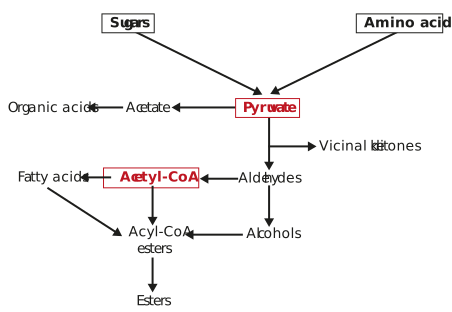
Figure: Relationships between the formation of flavour compounds and intermediary metabolism
The inter-relationships between sugar and nitrogen metabolism, and the number of routes through which carbon can flow, indicate how closely factors such as wort composition, yeast strain, and environmental conditions can work together and affect beer flavour.
We will now go on to look at the various groups of flavour compounds in more detail.