
Lesson 4 - Fermentation and Beer Flavour
Yeast and fermentation have an enormous impact on beer flavour. The most obvious changes during fermentation are sugar utilisation and the resultant formation of alcohol and carbonation. This is only a part of the story. Many thousands of compounds disappear and similar numbers of new ones are formed in fermentation as a result of yeast growth. This lesson describes what these are, how and why they are formed, and what effect they have.
Organic Acids and Fatty Acids
A huge number of organic acids and some fatty acids are formed during fermentation. This section discusses their contribution to beer flavour and how they arise.
Organic acids
At least one hundred organic and fatty acids are found in beer. Some come directly from wort but many are formed by yeast in fermentation. Their appearance in green beer partly explains why pH drops in fermentation.
As a group they give beer salty and sour flavours. The most abundant are citric, lactic, and pyruvic acids (100-300 mg/L of each). Sour beers have much higher levels, as we will discuss later in this lesson.
The following table shows the most common organic acids found in beers, together with their typical concentrations.
Table: Organic acids found in beers
|
Organic Acid |
Typical Concentration (mg/L) |
Flavour Threshold Values (mg/L) |
|
Lactic |
50-300 |
400 |
|
Pyruvic |
100-200 |
300 |
|
Citric |
100-150 |
- |
|
Succinic |
50-150 |
- |
|
Malic |
30-50 |
- |
|
α-Ketoglutaric |
10-60 |
- |
Organic acids are largely formed by the citric acid cycle – also called the Krebs or tricarboxylic acid (TCA) cycle – the usual function of which is disrupted in brewery fermentations because of the Crabtree effect. One of the genes repressed by this effect is the one coding for α-ketoglutarate dehydrogenase. The result is that the TCA cycle becomes a two-branched pathway and TCA intermediates (such as fumaric, succinic, malic, and citric acid) are formed in beer. The TCA cycle is shown in the next figure; the enzyme that is absent as a result of repression via the Crabtree effect, α-ketoglutarate dehydrogenase, is highlighted.
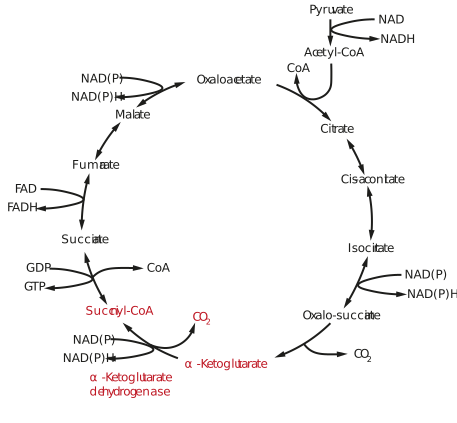
Figure: Reactions of the TCA cycle
Some organic acids may also be formed from amino acids. Lactic acid is formed from the reduction of pyruvate. Indeed, pyruvate acts as a key intermediate and branchpoint in many pathways involved in central metabolism, many of which have a role in beer flavour.
Pyruvic acid concentrations in beer reach a peak in mid fermentation and then usually fall in later stages. It is probable that the peak coincides with the point at which FAN uptake ceases. This is interesting because it must mean that up to this point intracellular pyruvate is being formed from both sugar and amino acids, and that the pathways which might use it are not operating quickly enough to divert it elsewhere and so some is temporarily excreted. This may indicate that wort is an unbalanced growth medium and that the cell cannot cope with high intracellular levels.
There are no specific control measures for organic acids; we control it through the design of wort composition and the fermentation conditions that influence yeast growth. Wort FAN is also important. In general, conditions that push metabolism away from acetaldehyde and alcohol provide more carbon for the pathways, such as the TCA cycle, which in turn lead to more organic acid formation. This means that, as well as wort composition (FAN content), the initial oxygen concentration and pitching rate are important.
Small concentrations of the oxo-acids α-acetolactate and α-acetohydroxybutyrate are formed in beer. These are important in the metabolism of vicinal diketones (VDK), as explained in the next section.
Fatty acids
Some short-chain fatty acids, of six to ten carbon atoms, can be found in beer. These give off soapy flavours. We need to keep concentrations very low since they are powerful detergents and are beer foam-negative. It is not likely that short-chain fatty acids are excreted by brewing strains of yeast cells. It has been suggested that their presence in beer might be as a result of ethanol stress; in this case, higher than normal levels might be seen in very stressful fermentations, such as very high gravity worts. In extreme cases, such conditions will result in higher rates of cell death and lysis. Short-chain fatty acids will be included in the range of compounds released into beer when this occurs.