
Lesson 4 - Fermentation and Beer Flavour
Yeast and fermentation have an enormous impact on beer flavour. The most obvious changes during fermentation are sugar utilisation and the resultant formation of alcohol and carbonation. This is only a part of the story. Many thousands of compounds disappear and similar numbers of new ones are formed in fermentation as a result of yeast growth. This lesson describes what these are, how and why they are formed, and what effect they have.
Sulphur Compounds
Many important beer sulphur compounds come from wort but a significant fraction are made by yeast in fermentation. This section explores beer, yeast, and sulphur and how they are synthesised.
A whole range of sulphur compounds are formed by yeast in fermentation. Most of these are undesirable. Generally, lager strains produce more than ale strains. A few strains can reduce dimethyl sulphoxide oxide (DMSO) to dimethyl sulphide (DMS), a beer flavour compound which is mainly formed in the brewhouse.
Inorganic sulphur compounds produced by yeast are more important. Both SO2 (burnt match) and H2S (rotten egg) can be formed.
Typical levels of H2S and SO2 in beers (with flavour-threshold values shown in brackets) are 1-20 (5) and 200-20,000 (3,000 - 7000) µg/L, respectively.
Sulphur dioxide has a positive effect on beer flavour stability. This is because it is able to bind to carbonyl compounds and prevent some of the oxidation reactions that give rise to beer staling aldehydes.
Excessive SO2 and H2S are considered to be flavour defects in most beers but not all. A small amount of H2S is part of the normal flavour profile of Burton-on-Trent-style ales. This gives a big clue as to how the inorganic sulphur compounds are formed because the local water contains a lot of gypsum (calcium sulphate).
Did you know that the composition of the water supply in various parts of the world was a huge factor in the evolution of some famous beer styles?
Pilsen in the Czech Republic is renowned for delicate pale lager beers; Burton on Trent has a long history of brewing much more robust pale ales. Pilsen water contains about 10 mg/L sulphate. In Burton-on-Trent the figure is more than 600 mg/L. It is hardly surprising, then, that this causes differences in beer flavour.
The development of economical methods for removing all salts from water, using reverse osmosis, has allowed any beer style to be brewed anywhere. As such, these historical geographical associations have lost a lot of their meaning, except for the process called ‘Burtonisation’ where water is treated with a package of mineral salts so that it resembles the natural water of Burton on Trent.
We now turn to pathways. Yeast can synthesise amino acids or take them up “ready-made” from wort. In this case we are talking about sulphur-containing amino acids, such as cysteine and methionine. Yeast can take these up from wort or under some circumstances, when necessary, synthesise them. Synthesis can be via interconversions of existing intracellular sulphur-containing amino acids. Alternatively, de novo synthesis can occur using inorganic sulphur, in our case from the sulphate in brewing water, which can be taken up and incorporated into newly synthesised sulphur-containing amino acids.
The sequence of pathways and their control is influenced by three factors:
-
Fermentation conditions which influence yeast growth
-
Concentration of wort FAN
-
Concentration of sulphate in wort
The uptake of sulphate and metabolism need a lot of energy in the form of ATP and reducing power (NADPH) so a source of fermentable sugar is also needed. See the next figure.
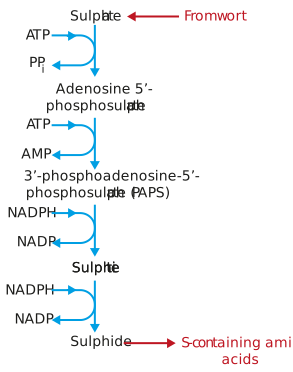
Figure: Pathway for sulphate uptake and conversion to sulphide
The yeast takes up sulphur-containing amino acids first since this requires less energy.
Earlier in this lesson we looked at the relationship between diacetyl formation, the ilv pathway, and the concentration of valine in wort, and we saw that intracellular valine concentration controls the ilv pathway which is needed to synthesise diacetyl. It is a similar situation with sulphate uptake (see the figure below).
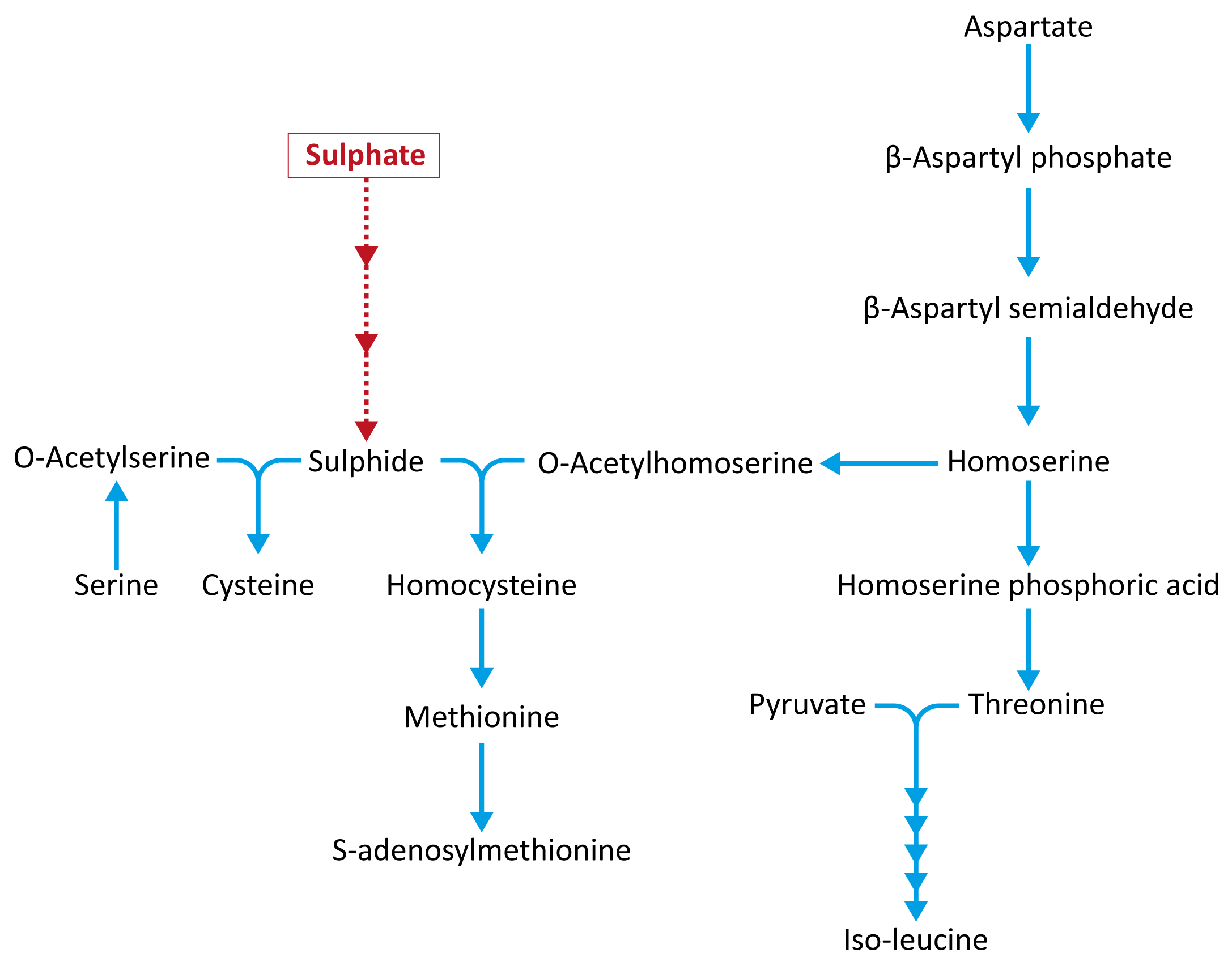
Figure: Relationships between sulphide and amino acid biosynthesis
This shows how inorganic sulphur is linked to the metabolism of sulphur-containing and some other amino acids.
● The key metabolites are S-adenosylmethionine and, to a lesser extent, methionine and threonine. When intracellular concentrations are high, they repress all genes leading from sulphate to methionine, and sulphate uptake does not occur.
● If conditions favour yeast growth, and S-adenosylmethionine concentration drops because of high rates of usage of sulphur-containing amino acids, the sulphate uptake pathway is switched back on.
● If conditions continue to favour more yeast growth, SO2 and H2S do not accumulate because they are used immediately in further biosynthetic reactions.
● In late fermentation, if growth has ceased but there is still a supply of fermentable sugar and of sulphate in the wort, the activity of the enzyme which converts sulphite to sulphide (sulphite reductase) falls and accumulation of sulphite can occur.