
Lesson 4 - Fermentation and Beer Flavour
Yeast and fermentation have an enormous impact on beer flavour. The most obvious changes during fermentation are sugar utilisation and the resultant formation of alcohol and carbonation. This is only a part of the story. Many thousands of compounds disappear and similar numbers of new ones are formed in fermentation as a result of yeast growth. This lesson describes what these are, how and why they are formed, and what effect they have.
Alcohols and Esters
Two groups of flavour compounds produced by yeast in fermentation always get a lot of attention because of their combined impact on beer flavour. These are higher alcohols and esters. We discuss higher alcohols first.
Higher alcohols
These flavour compounds, also called fusel alcohols, mostly give a warming character to beers. The most important are n-propanol, 2-methylbutanol, 3-methylbutanol, and isobutanol but more than 40 have been found. Concentrations are typically 100-200 mg/L, apart from glycerol, which is usually 1-2 g/L.
The following table shows typical flavour-threshold values for some higher alcohols.
Table: Flavour-threshold values for some higher alcohols
|
Higher Alcohol |
Concentrations in Beer (mg/L) |
Flavour Threshold Value (mg/L) |
|
n-Propanol |
5-20 |
800 |
|
2-methylbutanol and 3-methylbutanol |
50-100 |
65 |
|
Isobutanol |
5-60 |
200 |
|
Isoamyl alcohol |
25-150 |
70 |
|
2-Phenylethanol |
1-2 |
130 |
A good review of the flavour effects of higher alcohols and other yeast-derived flavour compounds can be found in:
Olaniran, A.O., Hirlal, L., Mokoena, M.P. & Pillay, B. (2017). Flavour‐active volatile compounds in beer: production, regulation and control. Journal of the Institute of Brewing, 123, 13 – 23. https://doi.org/10.1002/jib.389.
Higher alcohols can be formed by two metabolic routes: from pyruvate, called the anabolic route, or from amino acids, called the catabolic or Ehrlich route.
In both cases two oxo-acids are formed and these are decarboxylated to give an aldehyde which is then reduced to the alcohol, as shown in the next figure.
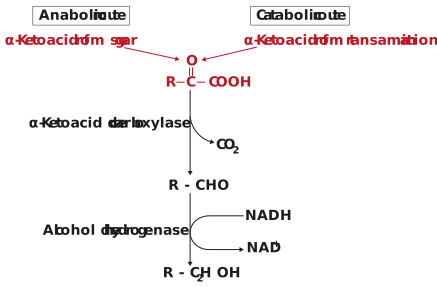
Figure: Routes for higher alcohol formation
This is similar to the pathway in which ethanol (alcohol) is synthesised in fermentation from pyruvate, which we looked at earlier in this lesson.
Some higher alcohols, such as n-propanol, can only be made by the anabolic route because there is not a corresponding amino acid. Generally, though, the FAN content of the wort controls which route is used. If FAN is high, the catabolic pathway is most used. This pathway is more important in early fermentation when FAN is being rapidly taken up; the anabolic route becomes more important in later fermentation.
The yeast strain is the most important factor influencing the quantity of higher alcohols formed. There is a lot of variability but generally ale strains make more than lager types. Conditions that create a lot of yeast growth – in particular, high wort FAN and high wort oxygenation – are also favourable for high concentrations of higher alcohols. Typically, concentrations increase at higher fermentation temperatures.
The link to growth gives a clue as to why they are made. As we can see in the above figure, the last stage re-oxidises NADH; this contributes to the shortfall in redox balance brought about by the balance between fermentation and yeast growth. This is an important point; glycolysis generates NADH and that cells have finite pools of these coenzymes, so these cells need methods for re-oxidising NADH. Most of this occurs when acetaldehyde is reduced to alcohol. This is insufficient, though, because not all the carbon from pyruvate flows into alcohol – some is diverted into important pathways required for yeast growth – and so other redox-balancing steps are needed. Higher alcohol formation meets this need. However, glycerol formation is the most important route for redox balancing and we find a lot more of this than the higher alcohols in beer.
These metabolic products often have more than one role. Glycerol is what is known as a compatible solute. It is made by cells when they are exposed to media with high osmolarity (a medium containing a lot of dissolved solutes), which subjects the cells to a big osmotic stress. A way of dealing with this is to increase the osmotic potential inside the cell to try to match that of the environment. In osmosis, water flows through a semi-permeable membrane (here the yeast cell membrane) from a low to high concentration of dissolved solutes. This is the basis of osmotic stress. If you increase the number of dissolved solute particles inside the cells this lessens this force (osmotic potential) and relieves the stress. Putting this into a brewing context, if we increase the gravity of wort, this will also increase the concentration of glycerol formed in the beer. Of course, it is difficult to distinguish the osmotic effect from the need to balance redox, if the higher gravity fermentation also results in more yeast growth.
Higher alcohols also appear to have multiple functions. Some appear to function as cell-to-cell messengers. In this case the messages are to do with sensing what is happening in the environment and making a suitable response. It seems that yeast produces isoamyl alcohol and 2-phenylethanol, in particular, to signal when growth is about to be limited by lack of nutrients. This triggers the cells to change morphology to adapt themselves to starvation conditions. Relevant to us is the onset of flocculation, where cells inside flocs are in a much more protected state than they would be if simply freely suspended.
The next table summarises factors affecting higher alcohol formation in fermentation and respective control measures.
Table: Factors affecting higher alcohol formation and control measures
|
Parameter |
Factor |
Comment |
|
Yeast strain |
Probably the most important factor of all. |
Generally, more produced by ale strains compared with lager types but a lot of variability. |
|
Wort composition |
High growth leads to increases in higher alcohols. |
FAN easiest parameter to manipulate. |
|
Pitching rate and wort oxygenation |
Direct correlation between extent of yeast growth and higher alcohol formation. |
Combinations which favour a lot of growth favour high levels of higher alcohols (at least in part because of increased need for redox balancing). |
|
Temperature |
Increase in temperature leads to increase in higher alcohols. |
Few breweries set fermentation temperatures to control higher alcohol level exclusively. Excessive temperatures are always avoided. |
|
Pressure |
Often higher alcohols reduced by increase of top pressure in fermenters. |
Can be used where vessels can be top-pressured but does not always work. |
Esters
When it comes to yeast and beer flavour, esters probably get more attention than anything else. This is probably because in most beers they make a big contribution to flavour, giving floral and fruity notes, but also because there is a lot of (sometimes conflicting) advice on how to control them.
More than a hundred esters have been found in beer. An alcohol is one of the precursors of ester formation and therefore because of the relative high concentrations of ethanol in brewery fermentations, as you might predict, acetate esters such as ethyl acetate are the most abundant. Concentrations are highly variable, ranging from less than 0.03 mg/L for minor esters to more than 12 mg/L for the most abundant (such as ethyl acetate).
Some important beer esters together with their flavour threshold are shown in the next table.
Table: Flavours and aromas of common beer esters
|
Ester |
Flavour/aroma |
Flavour Threshold |
|
Ethyl acetate |
Fruity/Solvent/Nail Polish Remover |
33 |
|
Isoamyl acetate |
Banana/apple |
1.6 |
|
Isobutyl acetate |
Fruity/banana |
1.6 |
|
Ethyl caproate |
Aniseed |
0.2 |
|
2-phenylethylacetate |
Rose/honey |
3.8 |
Esters are formed in reactions with an alcohol, either ethanol or a higher alcohol, and an organic or fatty acid, depending on the chain length. The acid portion is always attached to a molecule of Coenzyme A (CoA). CoA is involved in its usual role as a carrier of acyl groups.
In some strains, another group of enzymes, esterases, can also be involved. These normally break esters down to their component parts but in some instances they work in reverse.
Acetate esters are formed in a two-stage reaction, as shown in the next figure.
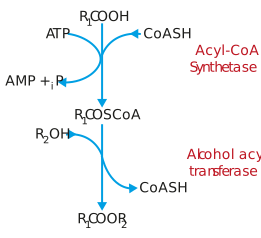
Figure: Ester synthesis
In the first reaction, a carboxylic acid, shown here as R1COOH, is esterified by reaction with a molecule of Coenzyme A. The reaction, catalysed by acyl-CoA synthetase, requires considerable energy since both high energy bonds in ATP are used and AMP is formed. The “activated” acyl CoA ester then reacts with an acyl alcohol, catalysed by alcohol acyl transferase (AAT) to form the ester. The molecule of Coenzyme A is released for re-use elsewhere.
Medium chain length fatty acid ethyl esters are synthesised in a similar way but the longer chain substrate is provided by the fatty acid synthetase machinery.
Several genes have been identified which code for the esterification reaction. ATF1 and ATF2 seem to be the most important for acetate esters and EHT1p for fatty acid ethyl esters.
Before we move on to look at control methods, we also need to be aware that the cells use ATP for these reactions, which means there has to be a good metabolic reason for doing it.
Control of esters
Esters are formed throughout fermentation. Physical effects are important, especially temperature. More esters are formed at higher temperatures; the reasons for this are not clear but it may be linked to the fact that more higher alcohols are also formed at high fermentation temperatures and some of these are used to make esters, or it may simply be that more esters leave the cell under these conditions.
The mechanism by which pressure exerts its effects are not at all clear since there are few published studies. Where it has been investigated it was concluded that the primary effect was as a result of increased dissolved CO2 concentrations brought about by over-pressuring which in turn inhibited yeast growth. Pressurisation of fermenting vessels is also used by some to reduce esters but it does not work for all yeast strains. It is considered by some an attractive control strategy because it does not entail modification of other parameters such as wort composition or pitching rate and wort oxygenation which would be likely to cause other perhaps unwanted changes.
Putting temperature and pressure to one side, the key seems to be the relationship between growth, oxygen availability, and lipid synthesis.
Conditions which should promote a lot of growth, such as having a good supply of nutrients like FAN and sugar, combined with limited oxygen (which restricts growth) result in a lot of esters. If we increase the oxygen supply, esters are reduced.
The most likely reason for this is the cell’s need for an adequate supply of free CoA.
This is explained in the following figure.
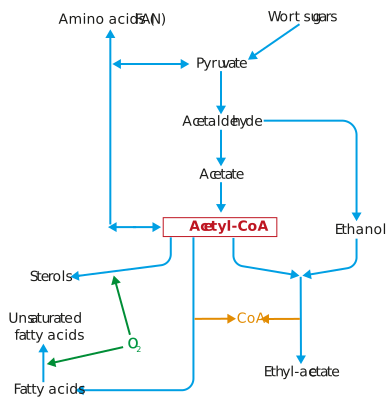
Figure: Relationships between ester synthesis and oxygen
The pathways show the flow of carbon from wort sugars and amino acids leading to pyruvate and acetyl-CoA. We see that acetyl-CoA can be used to make the ester ethyl acetate (using some of the ethanol formed), and also fatty acids and sterols.
Both of these pathways regenerate free Coenzyme A, as shown, and these can be used in further reactions.
Fatty acids can form unsaturated fatty acids but this needs oxygen as does sterol synthesis. Oxygen promotes growth, as we know, and so it makes sense that under these conditions the sterol and unsaturated fatty acid pathways are active.
Under these conditions, to support sterol and unsaturated fatty acid pathways and to continue to regenerate free Coenzyme A, ester formation is inhibited. This works in two ways. In the short term, oxygen inhibits the alcohol acyl transferase. In the longer term, where oxygen is present for longer, it represses the ATF genes.
The concentration and timing of oxygen availability can be used as the main levers to control ester formation in fermentation. The main factors affecting ester formation are summarised in the table below.
Table: Factors affecting ester formation times and control measures
|
Parameter |
Effect |
Control |
|
Wort oxygenation |
Oxygen reduces ester formation by inhibition and repression of acyl alcohol transferase enzymes and genes producing them. |
Timing of oxygen availability is critical. The longer the exposure time lasts after pitching, the greater the reduction in ester formation (but also see additional comments, below, on yeast growth). |
|
Wort composition, wort oxygenation, and pitching rate |
Conditions which favour a lot of yeast growth (high wort FAN, high pitching rate) together with low oxygen favour ester formation. Where oxygen is increased, ester formation is reduced. |
Choose appropriate parameters for all control variables but consider the effect of timing of oxygen exposure. |
|
Fermentation temperature |
Increasing temperature usually increases esters, probably via effect on higher alcohols (which are also increased) but also because more are released. |
Often use a lower fermentation temperature in early to mid fermentation to restrict ester formation. This is followed by a warmer phase to encourage VDK reduction. |
|
Pressure |
Often reduces esters via an unknown mechanism but may be related to transport out of cells. |
Can be used where vessels can be top-pressured but does not always work. |