
Lesson 4 - Fermentation and Beer Flavour
Yeast and fermentation have an enormous impact on beer flavour. The most obvious changes during fermentation are sugar utilisation and the resultant formation of alcohol and carbonation. This is only a part of the story. Many thousands of compounds disappear and similar numbers of new ones are formed in fermentation as a result of yeast growth. This lesson describes what these are, how and why they are formed, and what effect they have.
Vicinal diketones
VDKs, especially diacetyl, are extremely important both to beer flavour and in relation to fermentation management. We now explore how they are formed and ultimately reduced by yeast.
We mentioned diacetyl in the Fermentation Principles lesson when we looked at beer flavour and cycle times, and we discuss it further below.
Vicinal diketones are a big group of compounds that share the common feature of having two ketone groups attached to adjacent carbon atoms, hence the name.
Did you know the term ‘vicinal’ comes from the Latin meaning ‘in the same neighbourhood’? And ‘di’ means two. A ketone is a compound which contains a carbonyl group attached to a carbon atom. So ‘vicinal diketone’ describes a molecule with two carbon atoms close to each other which both have a carbonyl group attached to them (see the figure below).
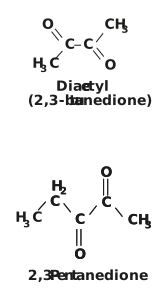
Figure: Structures of the vicinal diketones, diacetyl and 2,3-pentanedione
We find many of these vicinal diketones in beer and that is why we generally refer to them in the plural.
We also often measure another VDK, 2,3-pentanedione, during fermentation. This has a similar taste and aroma to diacetyl but its flavour threshold in beer is much higher, around 0.9 mg/L, and so it is much less important.
It is formed in beer in a very similar way to diacetyl but in this case from the spontaneous oxidative decarboxylation of α-acetohydroxybutyrate, which is also an intermediate in the isoleucine valine (ilv) pathway, in this case leading to the synthesis of isoleucine from threonine.
Both of these VDKs can also be formed by beer spoilage bacteria, especially Pediococcus. If high levels of VDK have formed in beer and we want to find out if it is via the yeast pathway or as a result of a microbial infection, we measure the ratio of these two compounds. Diacetyl can be formed at high concentrations by some beer spoilage bacteria but smaller quantities are made by yeast in fermentation. Therefore, the yeast route will cause the ratio to be about 1:1; in the case of an infection there is always a lot more diacetyl, maybe as much as 100:1.
Diacetyl has a strong flavour and aroma of toffee or butterscotch and it has a low flavour threshold in beer, usually around 0.05-0.1 mg/L. It is part of the normal character of some ales but is a serious defect in pale lager beers where there are fewer stronger flavours to mask its presence. In this case, we need to remove it.
Yeast not only makes diacetyl in beer early in fermentation but also, at a later stage, takes it up and reduces it to products that are much less flavour-active.
Where lager beers are made without a traditional lagering step the diacetyl has to be removed by yeast at the end of primary fermentation and green beers cannot be transferred to the next stage of processing until this has happened.
This waiting period is called the diacetyl, or VDK, stand (VDK for reasons we will discuss in a short while). It is also known as a warm stand or rest because we cannot cool the fermenter until the diacetyl concentration falls below the flavour threshold.
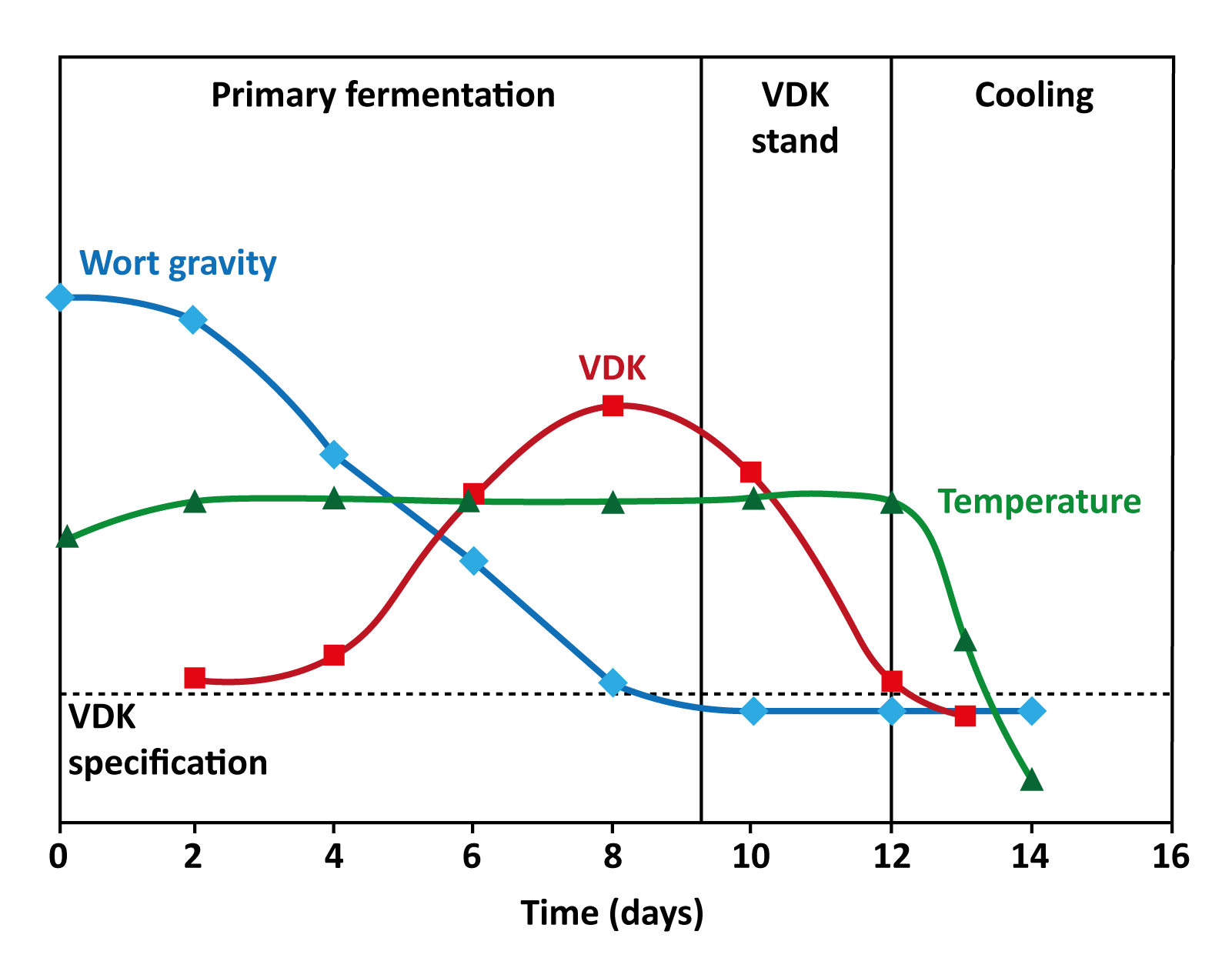
Figure: Stages in a rapid lager-fermentation process
Diacetyl formation is related to amino acid metabolism. Yeast can synthesise valine itself or take it up from wort. The method used depends on intracellular valine concentration.
The biosynthetic route is called the isoleucine leucine valine (ilv) pathway and, in the case of valine, starts with pyruvate (see the figure below).
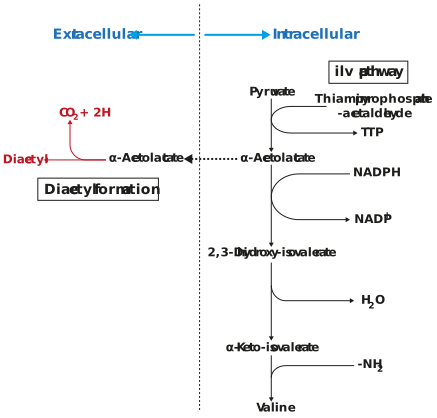
Figure: The isoleucine leucine valine (ilv) pathway and diacetyl formation
The first step in the ilv pathway converts pyruvate to α-acetolactate. Some of this is transported out of the cell and into the fermenting wort. Once here it undergoes a chemical change where a molecule of CO2 and a proton are lost and diacetyl is formed. This step is spontaneous and does not involve an enzyme.
The diacetyl is then taken up again by the yeast and it is reduced by dehydrogenase enzymes to form acetoin and then 2,3-butanediol (see next figure).
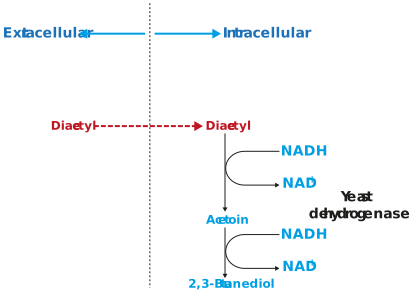
Figure: Diacetyl reduction
2,3-butanediol and acetoin are much less flavour-active than diacetyl.
We can break down this process into three parts which help to explain what is happening, how it is controlled, and how process conditions influence the outcome.
1. The ilv pathway is only active when valine concentrations inside the cell are low. Valine is not taken up by yeast until the middle of fermentation – this follows the order of nutrient uptake. The result is that in the early stages of fermentation the cell needs to make valine and so the ilv pathway is switched on. Under these conditions, diacetyl is formed and the peak increases.
2. In the fermenting wort, the α-acetolactate spontaneously forms free diacetyl. This is the slowest step in the whole pathway. This has three important ramifications.
a) Providing yeast is present the actual diacetyl concentration is always very low because as soon as it is formed it is taken up and reduced. Typical values for the total VDK concentration during fermentation are around 0.5 to 1.5 mg/L but there is a lot of variability depending on the wort composition and fermentation conditions.
b) We have to heat samples taken for analysis to convert all the α-acetolactate into diacetyl (the sample is actually a mixture of both and that is why it is usually called ‘VDK’). The conversion step is faster in the presence of oxygen.
c) During fermentation, beers might not smell or taste of diacetyl if we have not allowed the conversion to happen. They will if we remove the yeast before the reduction step is completed though! If this happens, it is very hard to put right.
3. In the middle to end of fermentation, the yeast takes up wort valine and the ilv pathway is shut down via feedback inhibition of the first step. Diacetyl uptake and reduction dominates in this end stage and proceeds as long as sufficient yeast is present. This is why it is vital to keep the beer in the fermenter and also warm since this makes sure the yeast is active. A large peak does not necessarily indicate that the fermentation will take a long time to achieve specification, since a rapid rise to reach the peak value may also be followed by an equally rapid rate of decline.
Factors affecting diacetyl formation
Conditions that create rapid fermentations and a lot of yeast growth – such as high wort oxygen, high wort FAN, reasonably high pitching rates, and high temperature – give large, sharp VDK peaks. The reason is that valine uptake begins sooner and so the third period of diacetyl uptake happens sooner.
Wort valine concentration is important. If it is too low the feedback control of the ilv pathway is affected so that if valine runs out in the middle of fermentation, the pathway can be reactivated and we see either a very long but low VDK peak or even a second peak. Providing FAN concentration is normal (150-200 mg/L at 10.5 °P) this should not be a problem, but it can be if a wort with a high level of sugar adjunct is used.
We now learn a bit more about FAN and diacetyl, and how the manner in which vessels are filled can have a big effect. Amino acids are taken up in an ordered manner. Studies carried out many years ago showed they could be put into four classes giving the rough order in which they are assimilated in fermentation. These are shown in the following table.
Table: Uptake of amino acids during fermentation
|
Class A |
Class B |
Class C |
Class D |
|
Arginine |
Histidine |
Alanine |
Proline |
The Class A group are taken up in early fermentation, Class B, mid-fermentation, Class C towards the end, and proline generally not at all. There is some variability between different brewing strains but in general this seems to hold true. As mentioned above, the VDK concentration increases in early fermentation; we can see here that this is because valine is not taken up in this phase and the ilv pathway is active. This effect is reversed in later fermentation and the VDK peak declines.
However, if the vessel filling process is very long (as can be the case with very big tanks), and all the yeast is pitched with the first batch of wort, the order of uptake is disrupted by the continual addition of fresh Class A amino acids. The result is a long, often shallow, VDK peak. We can avoid this undesirable effect by pitching later, preferably when all, or at least nearly all, the wort is in the vessel. Of course, we must also consider the potential spoilage risks of leaving un-pitched wort for several hours.
The nature of the yeast strain can also be important. Some strains, when used in very stressful fermentations, are prone to forming mutations. A common mutation is one in which there is a total loss of mitochondria, or at least some loss of mitochondrial functions. These are called petite mutants. If we do not check the proportion of these in the yeast, the population can gradually increase with each fermentation cycle. The ilv pathway in yeast is actually located in the mitochondria and so any disruption is likely to have undesirable effects on VDK performance. Petite mutants have therefore been shown to be associated with long VDK stand times.
Control of VDK
Most brewers making beers where VDK is an issue accept that they have to live with the warm rest and wait until the specification is achieved before the beer can be finished. This means that a lot of beer is sitting in expensive vessels waiting for yeast to do its work.
The factors which influence VDK formation and reduction are summarised in the following table.
Table: Factors affecting VDK cycle times and control measures
|
Parameter |
Effect |
Control |
|
Wort FAN |
Influences total yeast growth (together with other fermentation conditions). |
Take care not to dilute FAN with pure sugar adjuncts. Require minimum of 150-200 mg/L FAN at |
|
Wort oxygenation |
High levels favour vigorous growth and rapid fermentation, including sharp VDK peak. |
Ensure adequate wort oxygenation. |
|
Pitching rate |
Higher pitching rates (with high oxygenation effects) ensure vigorous growth and rapid fermentations and give sharp VDK peaks. |
Ensure adequate wort pitching rate. |
|
Fermentation temperature |
Warmer fermentations encourage rapid rates of VDK formation and removal. |
Common to allow fermentation to warm up slightly in later stages to promote rapid rates of VDK breakdown. |
|
Wort fill time |
Long fill times can disrupt normal VDK cycle. |
Optimise filling procedure with regard to time of pitching. |
|
Yeast strain |
Petite mutants cause slow VDK formation and removal. |
Check for petites and reduce number of fermentation cycles if necessary. |
Others who are not willing to accept this situation adopt a more proactive approach.
A few methods have been proposed and, in some cases, used at commercial scale. For example, transferring beer when gravity is reached, removing yeast, heating beer to convert all VDK to free diacetyl and then passing it through a column of immobilised yeast to very quickly reduce the diacetyl. Further information on the use of immobilised yeast in removing VDK can be found in this article:
Fundementals of Imobilised Yeast
The most common method is to use an enzyme, α-acetolactate decarboxylase, purified from a species of Bacillus. We add this process aid directly to the fermenter, where it converts α-acetolactate directly to acetoin and no diacetyl is formed.
Genetically modified brewing yeast strains have been produced which contain the bacterial gene that produces α-acetolactate decarboxylase. Although these strains do not produce very much diacetyl, the fear of negative consumer reaction to the use of such strains has prevented their use to date in commercial brewing.