
Lesson 2 - Fermentation Principles
Fermentation is critical to the whole brewing process. Achieving success at the fermentation stage involves many factors. In this lesson we look at what these fundamental factors are and the effect they have.
Fermentation Variables
We have looked at markers of fermentation progression. We now explore how fermentation is influenced by the major variables.
The variables we discuss here are:
-
Choice of transforming organism
-
Wort composition
-
Oxygen concentration
-
Pitching rate
-
Temperature
Transforming organism
The obvious choice of organism is yeast, but not always for all beers, and there is not just one type of yeast.
A few beers are made with mixed cultures, either two or more yeast strains or a mixture of yeast and bacteria. These mixed fermentations may use selected and defined starter cultures or the fermentation may be spontaneous, relying on chance contamination of wort from the atmosphere.
Organisms commonly used for these beer styles include the yeast strain Brettanomyces and bacteria such as Lactobacillus, Acetobacter, and Pediococcus. These organisms produce a wide range of flavours ranging from simple acidity to more exotic characters using flavour descriptors such as ‘farm yard’ and ‘horse blanket’.
Spontaneous fermentations are exceedingly complex and uncontrollable because natural populations of microorganisms are involved. Different organisms tend to dominate during particular phases of growth, because the growth of one organism changes the environment and makes growth of others either more or less likely. Fermentations may be very lengthy.
Most beers are made with single, pure yeast cultures. The main choice is ale or lager but we now know there are thousands of strains to choose from. The following table lists some of the features of individual strains that we need to consider. Some are inter-related.
Table: Characteristics influencing choice of brewing yeast strains
|
Yeast Feature |
Consideration |
|
Flavour impact |
Spectrum of flavour volatiles formed |
|
Degree of attenuation |
Sugar spectrum utilised |
|
Alcohol tolerance |
Maximum alcohol concentration that can be tolerated |
|
Osmotolerance |
Maximum gravity supporting growth |
|
Flocculence characteristics |
How flocculent in fermentation |
|
Cropping behaviour |
Top or bottom cropping |
Wort composition
The composition of wort has a big impact on beer flavour and colour; this is based on the choice of grist materials and brewhouse procedures. In addition, the method and material we use to make wort both influence critical parameters such as wort fermentability.
Here are some points we need to consider regarding the effect on yeast growth and metabolism.
-
Wort concentrations for most worts fall within the range of around 1.03 - 1.08 SG (7.5-20 °P).
-
The stronger and more fermentable the wort, the higher the alcohol yield but also the bigger the risk of inhibition due to alcohol toxicity or lack of osmotolerance. If we use a conventional malt wort, the useful upper limit is about 1.08 - 1.092 SG (20-23 °P).
-
The more concentrated the wort, the longer the fermentation cycle time.
-
Oxygen solubility decreases with wort strength and also with increase in temperature.
-
Adjuncts can be used deliberately to modify beer flavour and colour, for example using rice in pale lager beers. If we use relatively pure sugar adjuncts as a low-cost means of increasing wort concentration, this increases the ratio of C:N and other essential wort nutrients, and it can cause big shifts in beer volatiles like esters.
Before moving on to consider the next variable, we will take a quick look at high gravity brewing. This produces very strong beers but this is not the ultimate aim. High gravity brewing is a method for making more beer without having to buy more fermentation capacity.
We produce and ferment a concentrated wort, in order to obtain a strong beer. We then dilute it, immediately before packaging, to a strength suitable for sale. The gains can be enormous, which is why it is so attractive to many brewers working at big scale.
If we make a beer that is double the normal strength, we roughly double the annual output of a fermenter. Not quite, in fact, because the cycle times are longer but we can get around this to some extent by increasing the fermentation temperature.
The process is summarised in the next figure.
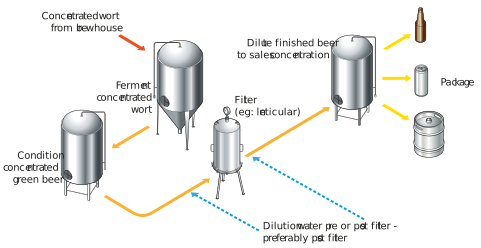
Figure: Process steps for high gravity brewing
The same volume of water is used overall but, for most of the brewing process where the concentrated beer is being handled, batch volumes are lower.
Concentrated beers have a lower freezing point and so can be conditioned at very low temperatures which also shortens process times.
However, there are some disadvantages:
Higher pitching rates are necessary, which places more pressure on the yeast handling plant.
We need to increase wort oxygenation rates and generally this means using pure oxygen.
The biggest risk is to beer flavour. Often ester levels are different, compared with a similar beer brewed at sales gravity, so we need to adjust other control parameters to correct for this.
Despite these drawbacks, it is a very attractive approach for many brewers and is very commonly used.
The following table compares wort concentrations (none of these are formal classifications for each category).
Table: Wort concentration and high gravity brewing
|
Description |
Wort Concentration (°Plato) |
|
Sales gravity |
7.5-12.0 |
|
High gravity |
12.0-18.0 |
|
Ultrahigh gravity |
18.0-25.0 |
Wort oxygenation and pitching rate
We are considering these together as they are related. Generally, an increase in either parameter results in a faster fermentation but the relative concentrations used are important.
Different yeast strains have different oxygen requirements for successful fermentation. This ranges from half air saturation (about 4 mg/L) up to oxygen saturation (about 30-35 mg/L, or more). We therefore need to know how much oxygen is needed by the strain that we are using. Generally, ale strains need less than lager types. Dried yeast is made in a way so that it does not require any oxygen at all.
Oxygenating wort is a vital part of fermentation management because of the fact that we crop and re-pitch yeast. The yeast uses oxygen to synthesise essential membrane lipids, sterols, and unsaturated fatty acids. The synthetic pathways the yeast uses to make these compounds need oxygen as a substrate.
Once these lipids have been made and incorporated into membranes, the yeast can take up wort nutrients and grow. When conditions become anaerobic, the yeast cannot make any more of the lipids; as the cells bud and multiply they then have to share their supplies with the new cells. This dilutes the lipids and eventually they fall to a critical level where no more growth is possible.
This explains why oxygen is usually the factor that controls how much yeast growth occurs in fermentation. When we re-pitch the crop, the cycle has to be repeated. Although active dried yeast is loaded with these lipids so that it does not need wort oxygenation, it does if it is cropped and re-pitched.
We also need to remember that in a brewery fermentation we never use oxygen in respiration because of the Crabtree effect.
We have now seen that oxygen and pitching rate are related in their effects on fermentation. The important parameter is how much oxygen is supplied per yeast cell.
If we do not add any oxygen, fermentation is slow and might even stop before all the fermentable sugar has been used up, called a sticking fermentation. In general, the more oxygen we add, the faster the fermentation, and the more the yeast growth we get. This can be a problem because if we force more carbon flow towards yeast growth, there is then less available for alcohol formation and so yields fall (as shown in the next figure).
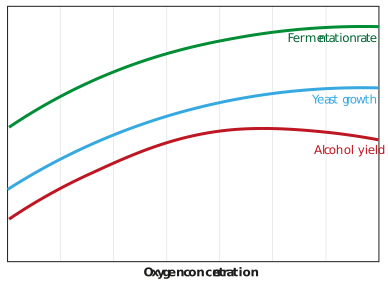
Figure: Relationships between initial oxygen concentration, yeast growth, and alcohol yield
We also have to take the pitching rate into account. This ratio controls how much lipid is formed per yeast cell. Within limits, if we increase the pitching rate, fermentations are quicker and we grow more yeast. Eventually, though, an inflexion point is reached where less lipid is formed per cell and yeast growth reduces (see the next figure).
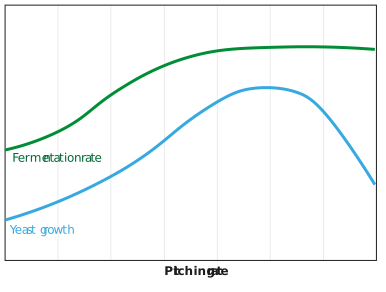
Figure: Effect of increasing pitching rate on yeast growth and fermentation rate
The position of the inflexion point in yeast growth is influenced by the available oxygen. The more oxygen we provide, the further the inflexion point is pushed towards the right. The fermentation rate increases to reach a level above which the pitching rate has no effect.
Fermentation temperature
All brewing yeast strains have optimum growth temperatures greater than 30 °C. The figure is higher for ale yeasts; lager strains can grow better at lower temperatures compared to ale types.
Although they grow best at these high temperatures, in practice we have to use much lower values because of the effect on beer flavour, as discussed fully in the next lesson.
Fermentation is an exothermic process. Yeast generates heat during fermentation and that is why we have to apply cooling.
The amount of heat produced is 587 kJ per kg extract fermented. Or 219 kJ per mole of glucose fermented.
Ale fermentations are typically controlled at 18-22 °C and lagers at around 8-15 °C. However, many mainstream lager brands now often use temperatures of between 15 and 20 °C. The reason for this is the huge savings that they can achieve in fermentation cycle times, as illustrated below:
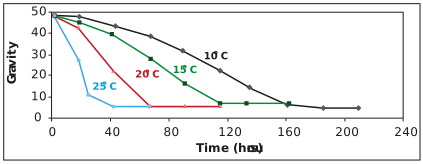
Figure: Effect of temperature on fermentation cycle time
This simple change is very attractive where fermentation capacity is limiting. Of course, as we have discussed already, there is a risk of causing undesirable changes in beer flavour. Another side effect is that oxygen solubility decreases with temperature. As we will see in the next lesson, there are steps we can take to remedy the flavour changes by manipulating the other variables that influence fermentation and beer flavour.
Finally, fermentation temperature influences yeast growth rate, and therefore fermentation rate, but it does not affect total growth.