
Lesson 2 - Fermentation Principles
Fermentation is critical to the whole brewing process. Achieving success at the fermentation stage involves many factors. In this lesson we look at what these fundamental factors are and the effect they have.
Indicators of Successful Fermentation
In every part of the brewing process, specifications are needed to check real performance against that which is expected. This section outlines the specifications that will tell us whether we have achieved perfect fermentation.
The key parameters for fermentation are:
-
Time to reach gravity (plus time to reach vicinal diketone specification, if relevant)
-
Correct degree of attenuation (target final gravity achieved)
-
Expected yeast crop size and consistency
-
Yeast Crop viability specification achieved
-
Expected alcohol concentration or beer yield
-
True-to-type beer flavour
-
Absence of unwanted contamination
Several of these relate to cycle times. The cycle time is how long it takes for a fermentation to be finished (excluding time for filling, emptying, and cleaning). For many beers this is simply the time taken to reach the final gravity but, for many others, aspects of beer flavour are also important.
Yeast makes beer flavour compounds which increase in concentration throughout fermentation. The spectrum and quantities formed are governed by many factors, which we will consider in the next lesson.
For many lager beers, a group of compounds called vicinal diketones (VDK) are important. The most important of these is called diacetyl which has a strong flavour and aroma of toffee, or butterscotch, and is not at all desirable in these lager beers.
In a normal fermentation, diacetyl is formed in the early stages of fermentation and is then taken up in the later stages, largely after wort attenuation has been reached. Brewing yeast carries out both of these processes. Therefore, an important aspect of fermentation management of lager beers is to make sure there is enough yeast present in the later stages to mop up diacetyl. This will happen naturally if the beer is lagered for a lengthy period at cool temperature, without the need for any intervention by the brewer.
Many modern lager brands use a more rapid process where the VDK is allowed to fall to a concentration lower than the flavour threshold at the end of primary fermentation. The beer is kept at fermentation temperature for a period to make sure the yeast is active enough to remove VDK quickly. This is called a warm VDK / diacetyl stand / rest / warm maturation. The fermentation is not finished until this step is completed (see figure below).
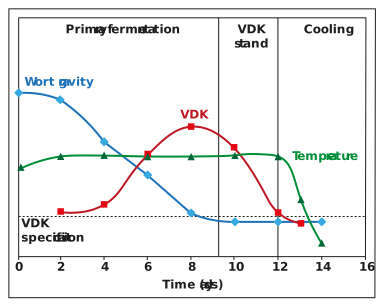
Figure: Fermentation profile of a modern rapid lager fermentation
For many big lager brands this is a key specification that has to be met. We will consider it further in the next lesson.