
Lesson 2 - Fermentation Principles
Fermentation is critical to the whole brewing process. Achieving success at the fermentation stage involves many factors. In this lesson we look at what these fundamental factors are and the effect they have.
Changes Occurring in Fermentation
We have identified the major stages of fermentation based on changes in wort gravity. Now let us look at changes in the concentrations of some other key variables related to yeast growth.
Brewing fermentations differ in their numerical values and how they change with respect to time. However, they all show similar features. We can see these patterns in the next figure.
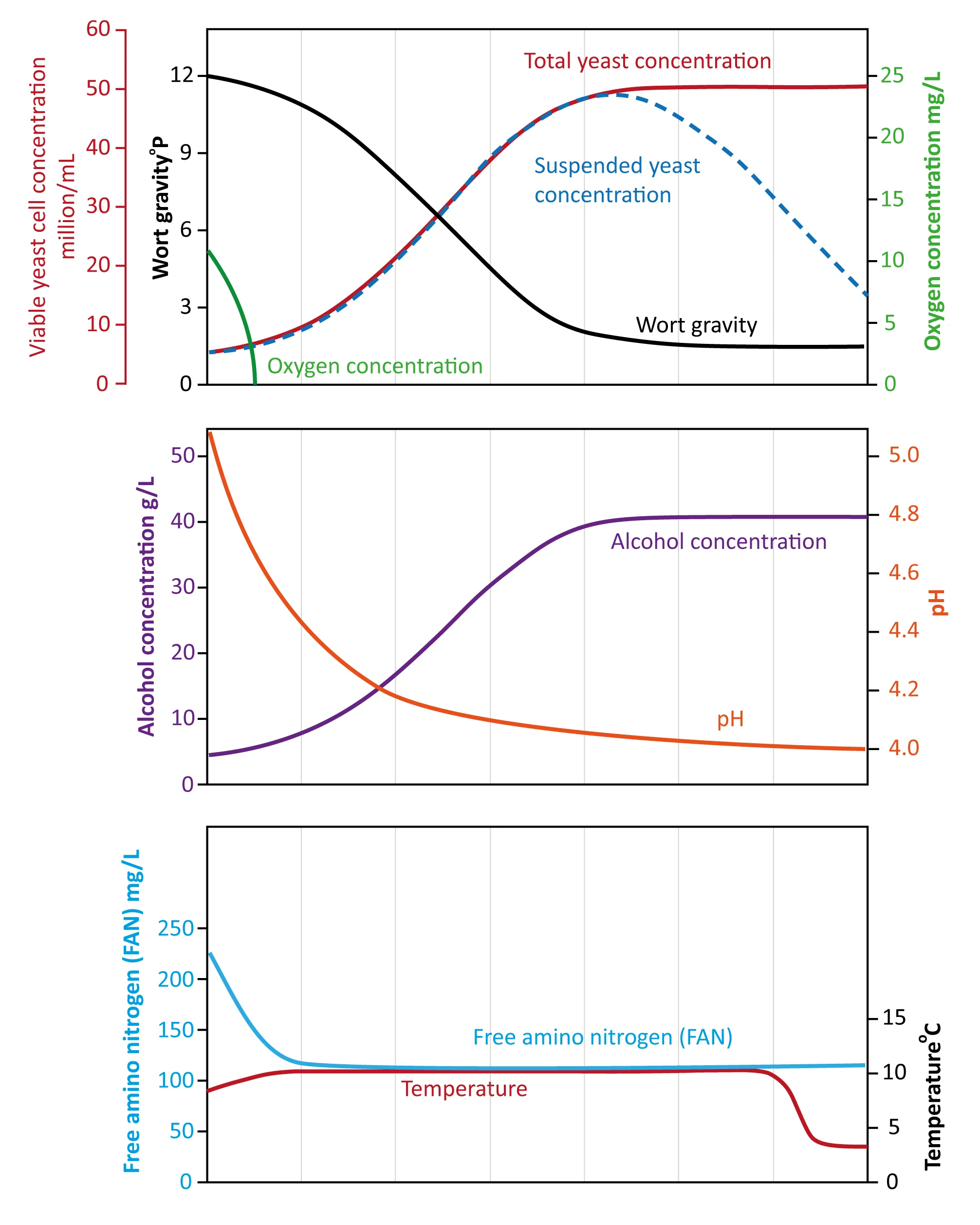
Figure: Patterns of changes seen in a typical brewery fermentation
These can be summarised as follows:
-
Temperature is usually held at a constant value which relates to the type of beer being made, usually higher for ales and cooler for lagers. Occasionally, stepped profiles are used to help control aspects of beer flavour, as we will see in the next lesson. Usually the wort is pitched at a slightly lower temperature than the set point. The ‘free rise’ seen in the first few hours demonstrates that the yeast is active, and the cooling system is working. At the end of the fermentation period, the beer is often cooled to aid yeast separation.
-
The ethanol and yeast concentrations are mirror images of the pattern of decline in wort gravity. This reflects the relationship between them.
-
During fermentation, the yeast concentration increases to about three or four times its starting level. Towards the end of fermentation, the yeast begins to separate out, as a result of flocculation (covered in our Yeast Morphology lesson), which causes the concentration of cells suspended in the wort to fall. This makes it hard to measure exactly how much yeast is present at any given time. Cooling helps with yeast separation.
-
The dissolved oxygen is rapidly taken up by yeast and disappears after a few hours. After this time, the fermentation is anaerobic.
-
Wort pH is about pH 5.0 – 5.2. It drops rapidly as yeast activity increases reaching a minimum value of around pH 4.0. Quite often at the end of fermentation it rises slightly. This is normal. The decrease in pH is mainly a result of excretion of organic acids and protons in fermentation as well as the absorption of basic amino acids. The slight increase probably reflects some yeast death and lysis. If it rises steeply this indicates excessive yeast death and autolysis. This is a marker of poor yeast health and should trigger investigation and remedial actions.
-
Wort nitrogen is usually measured as the concentrations of compounds (such as amino acids and short peptides) that contain free amino groups and that are easily utilised by yeast. The measure is called free amino nitrogen (FAN) and this drops during fermentation.
-
CO2 levels are not shown in the figure above. The rate of formation is similar to that for alcohol. Formation of gaseous CO2 does not happen until the wort becomes saturated. The gas is collected in most large-scale commercial fermentations for use elsewhere in the brewing process; for example carbonation, and to limit carbon emissions.
Fermentation mass balance
Looking at what goes in and what comes out of fermentation, we can draw up a mass balance:
2.0665 g extract → 1 g C2H5OH + 0.9565 g CO2 + 0.11 g yeast
We might expect to get equal quantities of CO2 and alcohol (according to the fermentative pathway from pyruvate to ethanol; 1 mole glucose gives 2 moles of ethanol + 2 moles CO2) but a small amount of carbon is actually used by yeast during growth on wort.
We therefore produce less alcohol than the amount that is theoretically possible because of the proportion of carbon that is used for new yeast growth.