
Lesson 2 - Fermentation Principles
Fermentation is critical to the whole brewing process. Achieving success at the fermentation stage involves many factors. In this lesson we look at what these fundamental factors are and the effect they have.
Assessing Fermentation Performance
In this section we look at how fermentation performance is monitored and assessed.
Gravity
Most aspects of fermentation are quite difficult to measure (including alcohol concentration, which is unfortunate since that is what we are making). Instead, we monitor the gravity profile. Although this is an indirect measure, the advantages are that it is easy and the shape lets us assess if performance is as we expect.
The key indicators are:
-
Time to reach final gravity
-
Final gravity
For many fermentations, once final gravity has been reached the process is finished. This means we can move the beer onto the next stage of processing. We want it to be as consistent as possible because this makes planning our production schedule much easier.
We subtract the final gravity from the starting gravity (original gravity, OG); this tells us how much sugar has been fermented and therefore how much alcohol we should expect to get. It should be a constant.
Did you know why it is called original gravity?
Beer has always been viewed by governments as a handy revenue stream. However, levying tax on beer needs a system of measurement. In many countries it used to be based on how much malt had been used to make a batch of beer. This does not indicate how much fermentable sugar is produced by a given amount of malt, though, let alone how much alcohol it creates.
Since alcohol is not easy to measure, countries such as the UK changed the system from a malt tax to one based on wort gravity. The problem here is that brewers do not retain unpitched wort and so, by the time samples were taken for gravity measurements, the wort had already been pitched and some of the sugar had gone.
To solve the issue, a group of brewers took samples of different fermentations around the country. They measured the gravity and the alcohol concentration, then used these to calculate what the gravity must have been originally. They put this information in the Mean Brewery Tables; after measuring the actual gravity and alcohol concentration, the tables could be used to infer the starting, or original, gravity.
When the tables were drawn up they included quite a generous allowance for how much sugar was used for yeast growth. The bigger brewers could do a lot better than the allowance and so made more (tax-free) beer than the Government thought they should be able to. This loophole was closed when the taxation system changed to one based on alcohol.
Now OG just means the starting gravity.
By the end of the fermentation stage, the yeast has usually used all the fermentable sugar. In this case the wort is said to be fully attenuated. Sometimes the final gravity is called the attenuation gravity.
Density measurement
Wort concentration is measured as density. Usually it is quoted at 20 °C. This is important since density varies with temperature. Tables are available that enable us to make a correction for the actual temperature the measurement was made at.
Specific gravity, SG is the weight of a volume of sample compared with the weight of an equal volume of pure water, measured at 20 °C.
Wort is denser then water and therefore will have a SG greater than 1.0. The wort’s density falls as the fermentation progresses and sugar is used up. However, most of the sugar is converted to alcohol, which is less dense than water, and so this introduces an error to SG calculations.
In the UK, the term present gravity (PG) is often used to describe wort concentrations measured during fermentation (as usual at 20 °C).
PG = (SG x 1,000) – 1,000
Using this calculation, a wort with an SG of 1.050 would have a PG of 50, said to contain 50 degrees of gravity (50 °PG), or sometimes referred to as 1.050.
There are other units that also describe wort density, such as degrees Plato, Brix, and Balling. All were named after the scientists who introduced them. These are based on the density of solutions of sugar relative to water. There are slight differences between them but for all practical purposes they are identical. The Plato unit (°P) is the one most commonly used throughout the brewing world.
The Plato scale was introduced to convert specific gravity into the weight percent of sucrose, as a measure of total fermentable material. It is very similar to the Brix scale. Wort measured at 12° Plato has the same density as a water−sucrose solution containing 12% sucrose by weight. In practical terms, Plato is the mass of sugars in grams in 100 grams of wort. E.g. 12 °Plato = 12g of sugar in 100g of wort.An approximation, good enough for everyday use, is 1 degree Plato = 4 degrees of gravity; so wort of 15 °P = 60 °PG.
If we know the gravity of a partially fermented wort, we can calculate the approximate alcohol content, by volume, by multiplying the degrees of gravity fermented by 0.13.
The following figure shows an example.
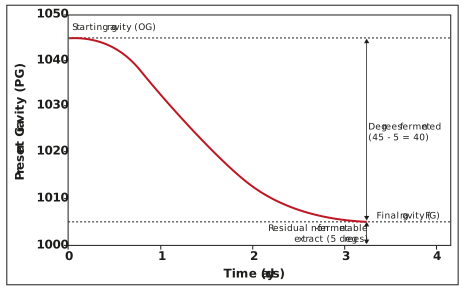
Figure: Parameters that characterise a fermentation
In this example, 40 degrees of gravity were fermented and so the approximate alcohol concentration would be (40 x 0.13) = 5.2% by volume.
To calculate the fermentability of the wort we divide the degrees fermented by the OG; in this example (40 / 45 x 100) = 88.9%.
If all the fermentable sugar (also called fermentable extract) is used up, we say the wort is fully attenuated, and the final gravity, largely made up of unfermentable dextrins, is called the attenuation or final gravity.
Occasionally we might want to stop fermentation before all the fermentable sugar has been used up; for example, for a cask beer or in traditional lagering. We can do this (though not easily) by applying maximum cooling, which slows down yeast activity.
Sometimes fermentations can stop before you expect them to. Can you think of some reasons (there are a few) why this unexpected behaviour might occur? How would you test your hypothesis?
Give yourself 5-10 mins to think about this and then click ‘Next’ to continue with the lesson.