
Lesson 2 - Fermentation Principles
Fermentation is critical to the whole brewing process. Achieving success at the fermentation stage involves many factors. In this lesson we look at what these fundamental factors are and the effect they have.
Main Stages of Fermentation Progression
Fermentation is a batch process and therefore events happen in a linear fashion. Let us now dive in and see what the major changes are as wort is converted into green beer.
A point to note regarding terminology. We know that in fermentation yeast converts most of the simple sugars in wort into alcohol and CO2. The word “alcohol” needs a bit of discussion. We are all used to seeing this word on beer packaging and we all know what it means; however, scientifically, what we refer to as alcohol should more properly be called ethanol or ethyl alcohol. Alcohol is a general term for an organic hydrocarbon compound where a hydrogen atom has been substituted by a hydroxyl group. There are many different alcohols and as we will see in other lessons many are important in beer flavour. Ethanol, the main alcohol in beer has the formula, CH3CH2OH, so an ethyl group with a hydroxyl group attached to it. To avoid any confusion in these lessons we will carry on using the term alcohol except in the case of metabolic pathways where the more proper term ethanol will be used.
Fermentation starts when we pitch cooled and usually aerated or oxygenated wort with yeast. To check fermentation progress, we measure the decrease in the wort’s density; this is called its gravity. We measure our sample of the fermenting wort with either a simple hydrometer (saccharometer) or a more sophisticated automatic densitometer.
The usual pattern we see is shown in the figure below.
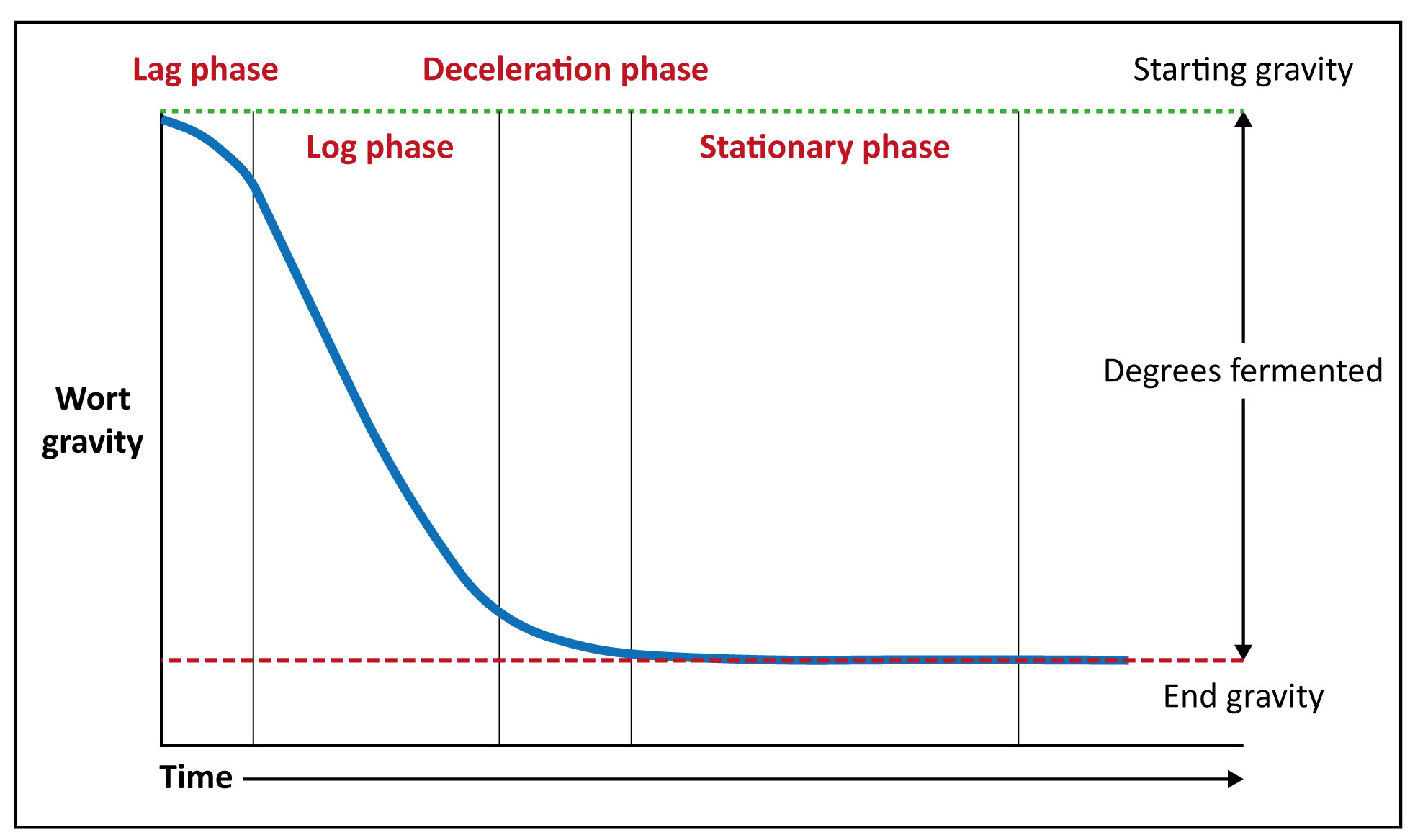
Figure: Stages in fermentation
The change in wort gravity follows a smooth curve. However, it is usual to consider the profile as comprising the following distinct stages, as labelled in the figure.
-
Lag phase: In this initial phase nothing much seems to be happening and there is little change in wort gravity, but it is crucial to the outcome of fermentation. During this period, the yeast adjusts its physiology in response to being moved from starvation conditions to a warm, oxygenated growth medium. It is the stage when oxygen is taken up, glycogen is broken down, and essential membrane lipids, sterols, and unsaturated fatty acids are synthesised. This enables the yeast to grow and convert extract into alcohol and CO2. The processes that take place in this phase are important because they determine what will happen in the rest of fermentation. Please note that alcohol refers to ethanol and is used interchangeably throughout this lesson. However, higher alcohols refer to those alcohols with more carbons groups than ethanol (propanol, butanol, pentanol etc).
-
Log phase: The fall in wort gravity has a brief period of acceleration and then reaches a maximum rate. To begin with, the initial pitching rate and wort oxygen level control the actual rate of decline, and then temperature controls how fast things happen. At this point all the other markers of progress – such as rates of formation of CO2, alcohol, and yeast concentration – are at maximum. Since the yeast concentration roughly doubles every time the cells have successfully budded, the rate of change, for a short period of time, is logarithmic, hence the name.
-
Deceleration (or retardation) phase: Eventually the yeast stops multiplying, and the decrease in wort gravity slows down. This happens when either an essential nutrient runs out or the concentration of a component of the green beer inhibits growth. In this second case, alcohol might be the cause if the wort is very concentrated. In most cases, the yeast stops growing because of nutrient depletion and probably a loss of yeast membrane function caused by sterol depletion.
-
Stationary phase: In the deceleration phase the cells begin to adapt their genomes back into the state needed to withstand storage and starvation. These changes mark the end of fermentation, and wort gravity reaches a low and constant value. At this point the slow rate of cell growth is matched by the rate of cell death.