
Lesson 8 - Yeast Management
This lesson will explore the methods that are used to measure yeast’s concentration and to assess its health. We will then go on to describe how this knowledge underpins the methods used to store and handle yeast in the brewery.
Yeast Storage
The final stage in the yeast cycle is when the portion of the crop retained for re-pitching is put into storage. Care has to be taken to make sure there is no deterioration.
When the crop is removed from fermentation, the yeast should be in good health (high viability and vitality). The aim of storage before re-pitching is to make sure it stays that way. The key is to keep it cool to slow down metabolism (for a limited time as it is being starved), and to put it in a place that prevents contamination.
The golden principles are 2-4 °C for no longer than five days, preferably three days or less and with no exposure to air.
We may recall from our lesson on Yeast Biochemistry, and our discussions on glycogen, sterols and oxygen, that yeast needs glycogen to get through periods of starvation. It also needs this when it is pitched into oxygenated wort, for energy and carbon to create sterol synthesis. Glycogen breakdown is rapid if oxygen is present, so it is not a good idea to have it present during storage.
Yeast cake
Pressed yeast is usually stored in a cold room or refrigerator. The goal is to not keep it in large containers where heat transfer is difficult. Remember, yeast generates heat all the time, and we need to be able to dissipate this efficiently.
The following figure shows the profile of yeast cake stored in large bins.
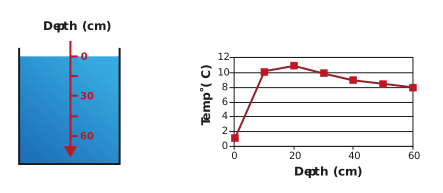
Figure: Temperature profile of a mass of 90 kg of yeast cake stored in stainless steel bins in a cold room attemperated to 1 ºC.
[Data courtesy of Andrew Jones, Molson Coors Brewing Company]
It is quite remarkable that more than 10 °C difference was seen between the outside of the bin and the middle of the yeast cake.
Yeast slurry
Most yeast is stored as a slurry in beer in a vessel designed for this purpose (see figure below).
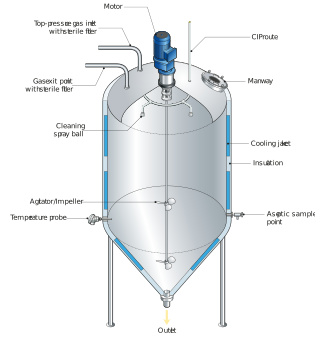
Figure: Storage vessel for pitching yeast
-
Vessels have excellent hygienic design and are cooled usually via wall jackets.
-
They are not designed to cool and if yeast is cropped warm in-line cooling to storage temperature is best.
-
An agitator is fitted. This helps keep the slurry well-mixed (an important feature when sampling) and is essential for good temperature control.
-
Load cells or an in-line flow meter are used for metering during filling and pitching.
-
If the yeast is cropped from fermentations using very concentrated worts it is good idea to dilute with sterile brewing water to reduce the alcohol concentration (< 8%).
Disinfection of pitching yeast
Many brewers choose to subject pitching yeast to a controlled acidification process in order to kill off any contaminating bacteria. The rationale is that yeast is quite resistant to acid conditions, but a lot of potential spoilage bacteria are not.
The specifications for the treatments are:
-
pH 2.1-2.3 for a maximum of two hours at a temperature of 2-4 ºC.
-
The acidulant must be food grade, and usually, phosphoric acid is used.
-
Yeast with a viability less than 85% should not be acid-washed.
The specifications for acid washing are critical. If the target pH is not achieved the treatment will not work. If the pH is lower than specified, or it is carried out at a higher temperature or for a longer time period, the yeast will die.
Acid washing does not affect wild yeasts.
The process is usually managed to start so that the two-hour treatment ends when the yeast is ready to pitch. This is great if we can get it right every time, but of course, this is not always possible, for example, if there is a delay for whatever reason in the brewhouse.
The important message for us is that we should use acid washing with great care. If we can, it is better to take care of hygiene in general, so that acid washing is not necessary.
Cone to cone pitching
Some brewers use a practice called cone to cone pitching. As the name suggests yeast is harvested directly from the cone of a completed fermentation and used to pitch a new batch of wort. The main advantage is that there is no need for yeast storage vessels. Since the yeast is not stored, other than the time it has spent in the fermenter, the handling process is simplified and there is less opportunity for deterioration and resultant loss of viability.
In practice, the process is used by few brewers. Yeast storage vessels provide a good buffer which makes it much easier to manage brewing schedules, especially where large tank farms and multiple yeast strains are used. Assessing the quality of the yeast crop is more difficult since there is only a limited time available to carry out the necessary checks. Choosing which portion of the crop to re-pitch has also to be considered.