
Lesson 8 - Yeast Management
This lesson will explore the methods that are used to measure yeast’s concentration and to assess its health. We will then go on to describe how this knowledge underpins the methods used to store and handle yeast in the brewery.
Yeast Cropping
In this section, we discuss yeast cropping, which is the process where excess yeast is removed from the fermentation vessel.
At some stage in fermentation, yeast must be separated from green beer, and usually, a fraction of the crop will be retained and stored before re-pitching. This prompts two questions; firstly, how and when the crop is removed and secondly, which fraction is retained.
Top-cropping yeast
Many ale yeasts rise to the surface as fermentation progresses, to form a top-crop. Fermentation vessels used with this type of yeast are designed to help the brewer remove the crop.
Several options can be used depending on the vessel design. A traditional approach is shown in the figure below:
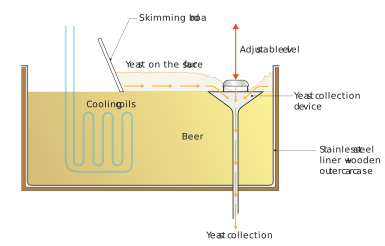
Figure: Top-cropping from an open square fermenter using a skimming board and parachute
The method illustrated above uses a board that can be drawn across the surface of the vessel pushing the crop towards a funnel-shaped parachute. The heights of the parachute and skimming board can be adjusted to make the crop removal easier to control.
These methods rely on the skilled eye of the brewer. The first top-crop that forms is heavily contaminated with trub and therefore discarded. When fermentation reaches its maximum rate, a deep frothy head forms on the surface. Gradually, this subsides and a thick layer of yeast forms. This is skimmed before it has a chance to drop out. It might be top-cropping, but it does not stay that way forever.
The experienced brewer judges the right time to crop based on the appearance of the head. A thin layer remains, which is good because it continues to generate CO2 and protects the beer from contamination.
Bottom-cropping yeast
Most beers are fermented in closed cylindrical vessels, usually a cylindroconical, where the cone helps with crop formation and removal.
This is both good and bad. The closed design is excellent for hygiene but not so good for yeast health and the cleanliness of the crop.
The yeast drops out during and towards the end of fermentation. This is aided by applying cooling, which slows down CO2 formation and natural convection currents. The problem is that once it has settled and formed a compact mass, it is not easy to control the temperature in the middle of the cone, even if cone cooling jackets are fitted. Therefore, any non-yeast solids will also drop out and contaminate the yeast.
Given the circumstances, the cone of a large and tall cylindroconical is quite a hostile environment for yeast.
It becomes even more complicated because not all yeast cells are the same. Some are bigger (and may be older or more flocculent than normal), others are very small, probably virgin immature cells and less flocculent than normal. Some cells are just right for cropping and re-pitching, and others are not good at all.
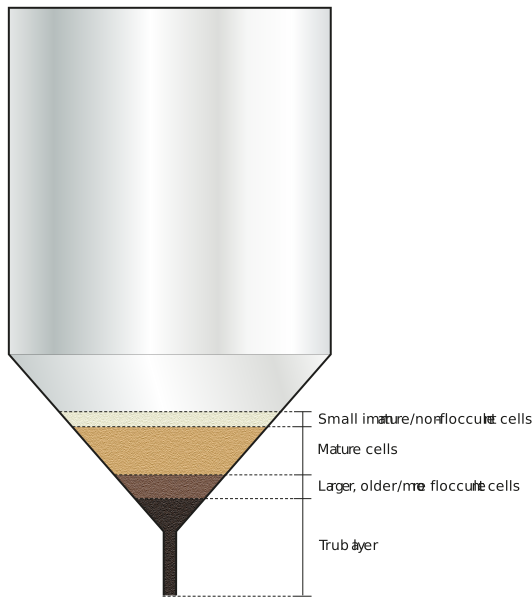
Figure: Cone crop heterogeneity
The figure above is, to some extent, idealised. Some studies have shown that cone crops are heterogeneous in the manner shown, others (and there are a few of them) have not confirmed these results. Confirming such results is challenging because the only way to carry out the analysis is to sample the yeast as it is removed from the vessel. This has to be done both carefully and slowly to prevent back-mixing, which would produce incorrect results. Either way, it is important to make sure that the correct cut of the crop is retained for re-pitching in order to get consistent fermentation performance; this, in turn, will have to be identified by trial to account for differences in vessel design and the nature of the yeast being used.
Below is a paper that outlines this in more detail:
Powell, C., Smart, K.A & Quain, D.E. (2004). The impact of sedimentation on cone crop heterogeneity. Journal of the American Society of Brewing Chemists, 62, 8 – 17.
Cropping from cones needs careful management. Low shear pumps are used at a rate that makes sure there is no back-mixing. The first portion, enriched with trub plus some of the first yeast, is diverted to waste. The middle portion is retained, but the last portion of the crop is not. The cropping regime needs to be optimised for each yeast and wort quality fermenting vessel combination. The timing of cropping also needs to be optimised. In very intensive fermentation, using warm temperatures and concentrated worts, it is a good idea to take the crop off early and before the vessel has been chilled. This helps to avoid damaging the health of the yeast.