
Lesson 8 - Yeast Management
This lesson will explore the methods that are used to measure yeast’s concentration and to assess its health. We will then go on to describe how this knowledge underpins the methods used to store and handle yeast in the brewery.
Measuring Yeast Concentration
In many stages in brewing, we need to know how many yeast cells are present because this affects how each stage in the process proceeds. We need methods for measuring yeast concentration.
Yeast concentration can be measured at various stages in the brewing process. The measurement methods that are used depend on how precise the result needs to be. There may, or may not, be a correction for viability.
Methods can be off or on-line.
Where high precision is required, for example, for pitching rate control, a method that counts live cells directly, or a parameter closely related to this, is used.
Where medium to low precision is required, for example, monitoring green beer counts for a brewery conditioned keg beer, an indirect method is likely to be used.
Table: Process stages where yeast counts may be required
| Process Stage |
| Yeast storage vessel |
| Start/end of fermentation |
| Green (rough) beer |
| Propagation |
| Krausening/lagering tanks |
| Cask beer racking tank |
| Bottle conditioning |
Indirect methods
Typically, light scattering (turbidometry, nephelometry) or particle counting via impedance measurement is used.
Light scattering methods measure how much transmitted light is deflected by particles in a sample. Particle counters detect changes in electrical impedance when a stream of cells passes through a detector.
Both methods work very well but of course, cannot distinguish between live and dead cells or between yeast and similarly sized non-yeast solids. They work fine where a simple estimate is needed, such as a green beer count.
Direct methods
There are times when only a proper cell count will do, preferably with a measure of viability as well.
It is a fairly monotonous job, but we could count cells under a microscope. It is made easier using a special microscope slide, called a haemocytometer (named this because they are intended to be used for counting blood cells).
The slides contain two chambers, each of a known volume. A diluted sample of yeast is pipetted into a chamber, and we would count the cells we can see using a light microscope. The process is made much easier because the chambers contain a grid, as seen in the figure below.
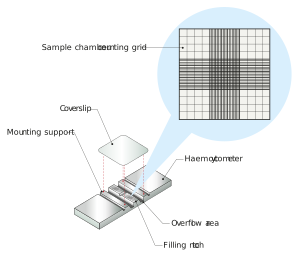
Figure: Haemocytometer slide showing the grid in one of the chambers
The aim is to count about 300 cells. We know the volume of the chamber and the dilution factor, so with some simple maths, we would know the number of yeast cells in the original sample.
Anyone who has spent time counting yeast cells under a microscope will agree that it is hard work. It is, however, very useful. If the sample is badly contaminated with bacteria, we can see them. It also gives us the opportunity to get to know our yeast and can, therefore, often spot where something is not normal. As we will discuss later, this method is used a lot to calculate pitching rates.
Automatic cell counters
Many brewery analyses that once needed a skilled operator have now been replaced with automatic measuring devices. This is also the case with yeast counting. Several companies produce bench-top machines which work on a ‘plug and play’ principle. They are quite costly both in terms of CAPEX and consumables, but we do not need a skilled analyst. We can load a sample, with or without some degree of preparation, start the machine, and a few moments later, the yeast concentration pops up on the display.
We might also obtain more information; usually, viability is given. In some cases, cell size or a measure of cell condition, other than a simple viability estimate.
Table: Automatic yeast cell counters
|
Instrument |
Comments |
|
Countstar (www.aberinstruments.com) |
Total and viable cell count via image analysis using methylene blue or other traditional viability stains. |
|
Cellometer (www.Nexcelcom.com) |
Total, viable count and cell size via image analysis using oxonol or propidium iodide |
|
CASY Meter (www.roche.innovatis.com) |
Total, viable cell count, cell size and vitality based on impedimetric detection |
|
Cell Yeast Analyser (www.aberinstruments.com) |
Viable yeast concentration via capacitance measurement |
The Aber Yeast Analyser needs a bit more explanation about how it works and what results it gives (explained in the following diagram).
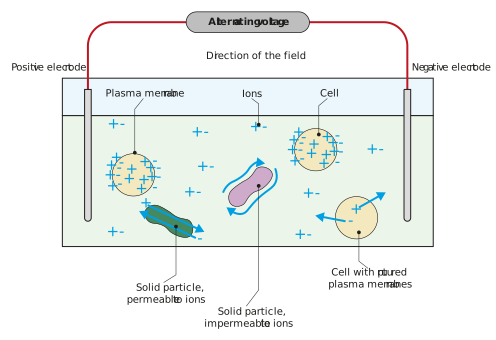
Figure: Diagram showing the effects of suspending yeast cells and non-yeast particles in an electrical field
The instrument uses the dielectric properties of cells. Although it might sound a bit complicated, it is quite simple.
-
Viable cells with an intact membrane suspended in a medium which contains charged ions, such as wort or beer, function as tiny capacitors when they are placed in an electrical field; in this case, one with a frequency of radio-waves.
-
The capacitance can be measured, and the value is related to the total surface area of the membrane within the operating field of the instrument. The instrument is calibrated to give yeast concentrations in units that we are familiar with, such as viable cells per mL.
-
The strengths of the instrument are:
- Dead cells, with a disrupted membrane, are not able to generate any capacitance and so are not detected. In the same way, trub particles or gas bubbles do not interfere with it.
- The result matches well the result for the detection of viable cells obtained with methylene blue staining.
To clarify this: methylene blue staining positively identifies dead cells since they stain blue and can be counted. The Aber instrument does not do this because dead cells are invisible to it. This means that the weakness of the instrument is that because it does not detect dead cells, it cannot measure viability.
-
In-line versions are available, and these are used for automatic pitching rate control, as we will discover later in this lesson.