
Lesson 8 - Yeast Management
This lesson will explore the methods that are used to measure yeast’s concentration and to assess its health. We will then go on to describe how this knowledge underpins the methods used to store and handle yeast in the brewery.
Yeast Pitching
Yeast pitching is a critical control parameter in fermentation management; it influences how much yeast grows, how much alcohol is formed and the concentrations of important beer flavour components formed by yeast during fermentation and so it must be controlled properly.
Yeast pitching is the starting point of fermentation, and it is important to get it right. Before understanding what it is, we should first define it.
Very simply, it is the inoculation (addition of yeast) of wort. However, there is more to it than such a simple definition, and we need to be able to understand it in more detail:
-
Usually, it is a pure culture of yeast but occasionally a mixture of yeast strains and possibly bacteria.
-
It uses an inoculum that is fit-for-purpose and free from non-yeast solids.
-
It is designed to deliver a pre-determined concentration of viable cells, the pitching rate, in a precise and repeatable way.
-
It is pitched in a way that instantaneously exposes all the cells to wort.
The sophistication of the pitching system depends on the scale of the fermentation. It can be a simple manual operation or a very costly automatic process.
Before we begin to look at pitching systems, let us first discuss the numbers.
- The figure used to calculate pitching rates is one million viable cells per mL per degree Plato.
- A typical pitching yeast slurry of 50% wet weight/volume solids contains around 1 x 10⁹ yeast cells/mL. Of course, the actual conversion rate of weight/volume to cell number will vary depending on the average cell size of individual strains. This will be determined by suspending a known weight or volume of the yeast solids in water and counting the number of cells using a haemocytometer or electronic cell counter.
Manual pitching systems
-
Where active dried yeast is used, the yeast should be rehydrated according to the manufacturer’s instructions and pitched at a rate which gives desired fermentation performance. Dried yeast should not be pitched directly into wort as significant losses in viability are likely.
-
Some brewers store cropped yeast in pressed form (discussed later). Pitching rates are often calculated in terms of the wet weight of pressed cake per unit volume of wort, using figures similar to those we have discussed already. The cake can be added directly into the fermenter, but it is better if it is first suspended in sterile brewing water to give more efficient dispersion.
The majority of commercial brewers will be pitching yeast which has been cropped from a previous fermentation and stored suspended in beer as a slurry.
-
Before pitching, a sample of slurry must be removed from the storage vessel for analysis. The sample must be representative of the whole slurry.
- Pitching based on slurry volume or mass is the simplest method. A known weight or volume of slurry is centrifuged, the beer layer removed, and the yeast sediment weighed or its volume determined. The figure below shows the determination of solids weight. If volume is to be measured a graduated centrifuge tube is used or the supernatant is decanted into a measuring cylinder.
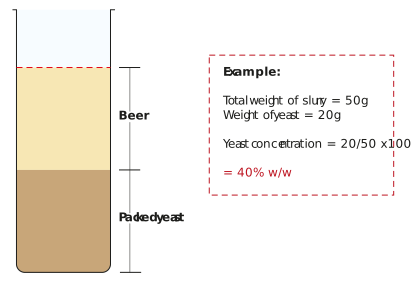
Figure: Spun solids determination
-
Analyses can be based on weight or volume and may include a viability correction which would need to be determined in a separate test.
Let’s calculate a volume of slurry to pitch based on a solids and viability determination.
We need to pitch 150 hL wort of 10 °P; target pitching rate 1 million viable cells per mL per °P.
Our solids and viability determination tells us that the slurry is 43% wt/vol and 91% viable.
For the yeast strain in question we have established that a 50% wt/vol slurry at 100% viability provides 1.2 x 10⁹ viable cells/mL.
So, first we calculate the number of viable cells required for pitching:
We need 1 x 10⁶ cells per mL per °P.
We have 150 hL so to convert this into mL we need to multiply by 100,000:
150 x 100,000 = 1.5 x 10⁷
In each of these mLs of wort we need 1 x 10⁶ cells so we multiply this rate by the volume:
1.5 x 107 x 1 x 106 = 1.5 x 10¹³
and we have 10°P so need to multiply this by 10:
1.5 x 1013 x 10 = 1.5 x 10¹⁴ cells
Each mL of our slurry at 50% wt/vol solids and 100% viability gives us 1.2 x 10⁹ viable cells. So, we need to divide the number of cells we need by the number of cells in this slurry to calculate the volume required.
1.5 x 10¹⁴ / 1.2 x 109 = 125,000 mL or 125 L at 50% wt/vol solids and 100% viability
We don’t have 50% solids and 100% viability in our slurry so need to adjust this volume to take our viability and solids into account. So, we divide the volume by 43 then multiply by 50 for the solids and then divide by 91 and multiply by 100 for the viability to get our pitching volume.
125 / 43 × 50 = 145.35 L
145.35 / 91 × 100 = 159.7 L
Pitching may be a manual operation or automatic based on metering a pre-determined volume or weight of slurry via in-line flow meters or load cells.
Automatic pitching rate control
Many of the world’s larger commercial breweries now use automatic pitching rate control systems; the yeast concentration is measured in-line using the Aber capacitance yeast sensor. The way this works has been described already in this lesson.
An in-line installation is shown in the figure below:
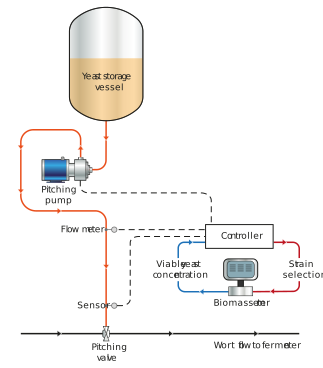
Figure: Schematic of an in-line pitching rate control system
The system uses a sensor, which is located in the yeast pitching main that runs from the yeast storage vessel to the wort main. This gives a continuous measurement of how much viable yeast has passed the sensor. This number, together with the output from an in-line flow meter located in the same pipeline (or a load cell on the storage vessel), is integrated by a controller which calculates the total volume, or weight, of yeast delivered. When this figure equals the desired set-point, based on the wort volume, the process is stopped, and pitching is completed.
The probe detects viable cells and not dead ones. This means that if the viability of the yeast was abnormally low, this system would continue to dose in yeast until the set-point for live cells was achieved.
The significance of the above is that we still need to check viability off-line; alternatively, the controller should know how much total yeast it would expect to pitch for a given beer quality and wort volume, and be able to provide warnings if things go wrong.
The automatic in-line pitching system is very costly and only the larger brewing operations can justify the outlay. A version of the Aber yeast monitor suitable for smaller brewers is available, called the Compact Perfectpitch . It is portable and skid mounted and consists of yeast monitor, flow meter and a dedicated plc with stainless steel pipework and fittings suitable for connection to a yeast storage vessel. Operation is similar to the more sophisticated in-line system but relies on manual connection to be made between the yeast storage vessel and entry point on the skid and then from the skid output to the fermenter. The desired quantity of viable yeast to be pitched is entered into the plc. Pitching then commences and when the set-point is an audible warning sounds and the process is terminated.