
Lesson 8 - Yeast Management
This lesson will explore the methods that are used to measure yeast’s concentration and to assess its health. We will then go on to describe how this knowledge underpins the methods used to store and handle yeast in the brewery.
Assessment of Yeast Growth
Yeast growth is central to both fermentation and propagation. Propagation was covered in the last lesson so we will now focus on fermentation.
Our focus will be on how yeast growth is assessed. In the next lesson, we will describe the stages of fermentation in more detail.
Surprisingly, yeast growth is not often monitored closely. It is assumed that if the crop is roughly the same size as usual, then everything is as it should be.
In many ways, assessing the crop size is useful; we can check the viability, which should be within specification. If the size of the crop has changed, it might indicate that growth had changed also. This in itself is an indicator of another problem, either wort composition or lack of fermentation process control. It can also indicate that there has been a shift in the flocculation characteristics of the yeast, so quite a useful and easy check to make.
Comparing yeast that has been pitched and cropped, provides us with a rough measure of growth, but it does not include yeast in the green beer or any lost in processing.
We can measure yeast concentration during fermentation using the counting methods we have discussed already in this lesson. If we did this, we would see something similar to the patterns shown in the figure below.
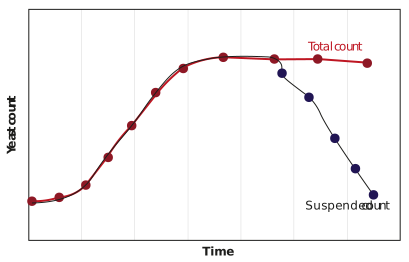
Figure: Total and suspended yeast concentration during fermentation
The graphs demonstrate why obtaining a true assessment of growth during fermentation is difficult. Towards the end of fermentation, the bulk of the yeast begins to separate, and if we base our analyses on samples taken at intervals from, e.g. a sample tap at a fixed point in the vessel, we will get a false picture.
If we were able to measure total yeast concentration in fermentation, we would expect to see that there are about five to six times more at the end compared with the initial pitching rate.
This means that the individual cells have only budded two or three times and probably some of those pitched might be still alive in the crop and can be re-pitched to go through the whole cycle again.
We know that yeast cells have a finite lifespan and that it is perfectly normal some will die of natural causes in the course of fermentation, but how many cells actually die?
Consider this example:
Fermentation batch size: 100 hL
Pitching rate: 10 million cells / ml @ 90% viability
Crop: 60 million cells / ml @ 95% viability
How many more dead cells are present in the crop compared with the pitching yeast?
Give yourself 5-10 mins to think about this and then click ‘Next’ to continue with this lesson.