
Lesson 7 - Yeast Propagation SAQ
This lesson enables you to test yourself on the material covered in Yeast Propagation, and determine the level to which you have met the learning outcomes.
Suggested Response - Q5
*Your brewery is required to handle four different yeast strains. All four strains are required for brewing simultaneously. Strains 1,2 and 3 have fermentation cycle times of two weeks and they can be re-pitched eight times after which a new culture is required. Strain 4 has a three-week fermentation cycle time and can only be re-pitched five times before disposal and replacement.
Your brewery has a single propagation system which requires two weeks in the laboratory and two weeks in the brewery. The brewery propagation uses a two-tank plant each stage of which takes a week to complete.
Draw up a propagation plan which ensures that pitching yeast is always available for brewing.
Response:
Using the information given and assuming only one propagation can be carried out at once the following plan can be drawn up:
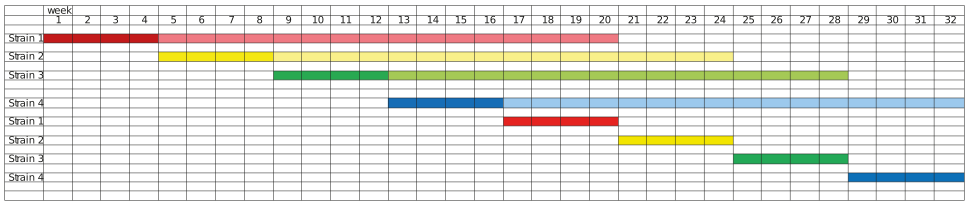
Figure: Propagation schedule for four strains, each with a propagation cycle of four weeks. The propagation phase is shown in the darker colour. The paler colours show the number of weeks needed for the fermentation cycles after which a new replacement culture is required
It may be possible that this plan would not work. It would work (just) for strains 1,2 and 3 since if:
a) The propagation plant was in continuous use
b) The new culture would just be available for use when the maximum number of fermentation cycles is reached.
However, in the case of strain 4, which has a longer fermentation cycle and fewer allowable cycles, it can be seen from the plan that the propagator would not be available when needed.
In a practical working environment, it would prove to be more challenging than the above shows. It assumes that the fermentation cycle time is consistent, which would be very unusual. It also assumes that the propagations would all work to plan with no problems, which again, is not very likely. In addition, it would be necessary to plan in maintenance time to prevent breakdowns. It also assumes that demand for the beers is consistent, which is not usual.
There are two options to solve these problems:
a) To have some leeway in terms of how many times the yeast can be re-pitched
b) Shorten the propagation cycle.
The second of these is a better option. The laboratory part of the propagations takes two weeks. However, the equipment that is used is relatively inexpensive and could quite easily be duplicated. In this case, more than one laboratory propagation could be carried out at the same time. This would create more time and would relieve the pressure on propagation. Brewery propagation is a two-stage process, and each part takes one week to complete. There is no reason why these could not be run simultaneously with different yeast strains in the seed and main growth vessels, respectively. This would also relieve pressure on the propagation plant. Despite all this, it could still prove to be quite a challenging scenario.