
Lesson 7 - Yeast Propagation SAQ
This lesson enables you to test yourself on the material covered in Yeast Propagation, and determine the level to which you have met the learning outcomes.
Suggested Response - Q2
***Answer all three parts of this question:
Your brewery is expanding and is to install a new fermentation tank farm. Currently, your yeast stocks are replenished periodically via a road tanker supplying bulk pitching yeast from another brewery in your group. This yeast is not of reliable quality, and you have been tasked with designing a propagation plant so that you can manage your own yeast supply.
You will need to propagate three different yeast strains, each of which can only be re-pitched eight times. This will put considerable pressure on the propagation plant.
a) Using a suitable diagram show the key features of a propagator which would be suitable for this task.
b) Describe the yeast supply system you would put in place to support the propagator. Provide details of the conditions you would use for each stage in the propagation from the recovery of the strain from storage in the laboratory to the final brewery propagation and indicate likely cycle times and yields.
c) Give a list of the criteria you would use to judge the success of the propagation process together with target specifications.
Response:
a) A high-yielding continuously aerobic propagator will be needed. This will provide a short cycle time and has the capacity to produce sufficient yeast to meet the target pitching rate for the first production scale fermentation.
Apart from excellent hygiene, the key to ensuring a high yield is that the growth vessel must be designed to provide efficient oxygen transfer from gas to liquid phase. Practically, this means having an efficient method of stirring the contents of the vessel. Short cycle times can be ensured by using a relatively high temperature (20-25 °C)
The key features of a suitable propagation vessel are shown in the following figure:
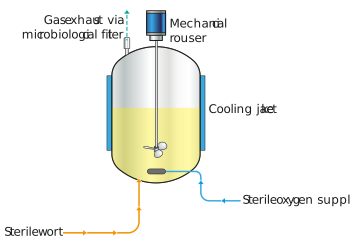 Figure: Outline design for a high-yielding aerobic propagator
The vessel would be designed to ensure good oxygen transfer so that continuously aerobic conditions are maintained. Preferably the oxygen supply would be linked to an in-tank dissolved oxygen probe. It would also need a control method for maintaining a positive but low oxygen concentration in the tank.
An alternative to the system shown above is to fit a recirculation loop to the vessel and inject pure oxygen.
In addition to the features shown, particular care would be needed to ensure good hygiene. These would include:
-
Dedicated single-use CIP, and a method of sterilisation before use and filling the propagator
-
All gas inlets and outlets fitted with sterile filters
-
Ability to operate under positive pressure
-
Aseptic sample point and aseptic inoculation port
-
Aseptic seals on the drive shaft
The attemperation system must be capable of controlling the temperature within the range 15-25 °C (+/- 0.5 °C). The ability to chill to storage temperatures (2-4 °C) is also an advantage.
The main vessel would be supported by a seed vessel of similar design to the one shown.
b) The yeast supply system would be made up of three parts:
-
System for maintaining master cultures.
-
Recovery of strains from storage and laboratory propagation.
-
Delivery of the laboratory culture to the brewery and propagation in the seed vessel and main propagation vessel.
Master cultures can be supplied by a third party who uses a quality system. This should be audited to ensure it complies with acceptable requirements in terms of culture purity and identity. Alternatively, the process can be managed in-house.
Preferably the in-house maintenance system would use liquid nitrogen storage. The quality system must be based on assurance principles which guarantee, beyond a reasonable doubt, that the correct strain has been deposited and is recovered.
A working culture is prepared from the master culture and checked for purity and identity using standard microbiological and genetic fingerprinting techniques.
The working culture is then used for laboratory propagation using a regime similar to that shown in the following figure:
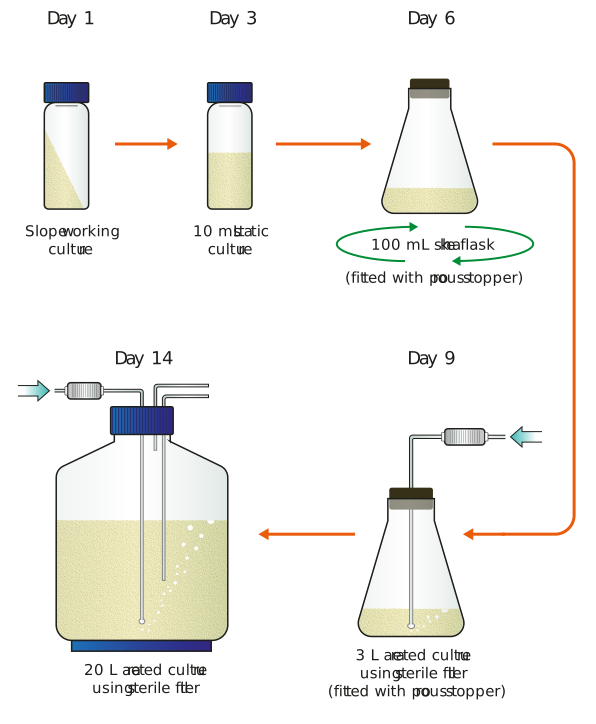
Figure: Regime for laboratory yeast propagation
This method uses standard microbiological techniques and equipment. Artificial yeast nutrient media are used in the early stages and wort in the last. Cultures are incubated at room temperature (20 °C). Good growth is encouraged by making sure conditions are continuously aerobic. The process times are shown in the diagram.
The last stage uses a bespoke vessel, made from stainless steel, which is designed with good aseptic properties, and efficient oxygen transfer characteristics. It should have a method of transferring the culture aseptically into the brewery seed vessel and be robust enough to withstand brewery conditions.
The brewery stage of propagation uses a two-vessel plant made up of a seed vessel and main propagation vessel. The step-up ratio would be around 1:100.
Using a temperature of 20-25 °C and a typical malt wort, yields of around 200 million cells per ml are achievable within 24 hours.
c) A pure strain, checked by standard microbiological analysis would be required. The few days waiting time that are needed for gathering results would mean that they would not be available before the transfer of the culture. They would therefore be only for QC confirmation of purity and for trend analysis.
Strain identity is also important; this would not usually be checked at the end of the process, but instead, the whole process is reliant on quality assurance.
Yield and cycle time should also be included, to achieve the desired terminal count within a given time, typically 180-240 million cells per ml with 24 hours.
Lastly, yeast condition which is usually assessed based on viability – typically > 98%.