
Lesson 4 - Yeast Biochemistry
This lesson describes the biochemical pathways that explain the activities of yeast in brewing. It begins by looking at what metabolism is and how we control it. It then looks at how nutrients, including sugar, are taken up by brewing yeast. Next, it explores metabolism in more detail, focusing on sugar metabolism and looking at two particular modes of metabolism, respiratory and fermentative. Finally, it considers the need for redox control and takes a brief look at gluconeogenesis and the storage of carbohydrates in yeast.
Redox Control and Beer Flavour
We have already considered a cell’s need for redox balance. This section now describes the different pathways for carbon flow that work towards meeting this need, and how this can have an impact on beer flavour.
Redox control
Carbon flow from pyruvate to acetaldehyde and alcohol meets part of a cell’s need for redox balance. When yeast is pitched into wort it grows and multiplies; this means that some of the carbon flowing through glycolysis has to be used to make this new biomass rather than alcohol. A consequence is that the redox balancing act falls down and other steps are needed to make up the shortfall. Many of these steps are involved in the synthesis of important beer flavour components.
The next figure shows carbon flow through pyruvate.
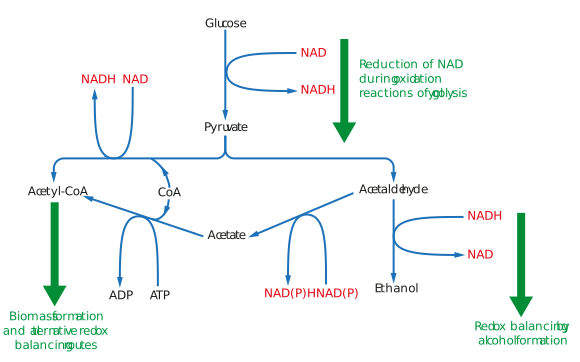
Figure: Carbon flow from glycolysis through pyruvate
We can see the different pathways in this process. These are controlled in the following ways.
Under repressed conditions, pyruvate dehydrogenase (which catalyses the conversion of pyruvate to acetyl-CoA) is not made. An alternative route, acetaldehyde → acetate → acetyl-CoA, is used instead.
Acetyl-CoA is another busy junction in metabolism since it is the starting point for the synthesis of many important cellular components. Fatty acids are synthesised from acetyl-CoA and in turn these are incorporated into many cellular lipids. These include unsaturated fatty acids and sterols. Both of these pathways require molecular oxygen. Acetyl-CoA and fatty acids derived from it are also used in the synthesis of beer esters.
● A key point is that during fermentation the amount of new yeast (biomass) formed is largely controlled by how much oxygen is available. The more oxygen, the more carbon is pushed from pyruvate towards acetyl-CoA and the pathways leading from these.
● This means that less alcohol is formed and also means the cell needs other routes for balancing redox. As we will see this has important consequences for beer flavour.
Beer flavour
Many of the final steps in pathways that are used by yeast to synthesise key beer flavour compounds have a redox step in them. Examples include higher (fusel) alcohols, the final steps in diacetyl reduction, and the synthesis of glycerol. Glycerol is found in beer, typically around 1-2 g/L. It is thought to provide sweetness and a fuller mouthfeel.
To explore this further, we take the example of glycerol synthesis.
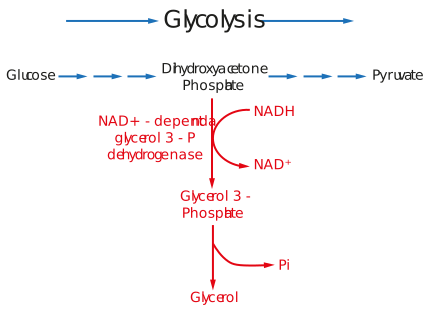
Figure: Glycerol synthesis
Glycerol is formed as a branch-point leading from dihydroxyacetone phosphate. As mentioned earlier, this is the step in glycolysis when the six-carbon sugar is spilt into two three-carbon compounds. We can see this again in the following figure.
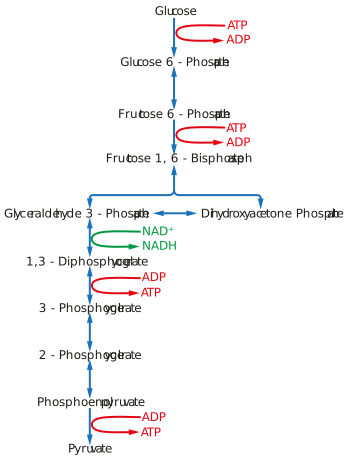
Figure: The glycolytic (Embden-Myerhof-Parnas) pathway
In the first step, glycerol 3-phosphate is formed and this is an NADH-dependent reaction and so it regenerates the oxidised form of the coenzyme making it available for use elsewhere.