
Lesson 4 - Yeast Biochemistry
This lesson describes the biochemical pathways that explain the activities of yeast in brewing. It begins by looking at what metabolism is and how we control it. It then looks at how nutrients, including sugar, are taken up by brewing yeast. Next, it explores metabolism in more detail, focusing on sugar metabolism and looking at two particular modes of metabolism, respiratory and fermentative. Finally, it considers the need for redox control and takes a brief look at gluconeogenesis and the storage of carbohydrates in yeast.
Sugar Metabolism
This section describes how yeast uses sugar once it is inside the cell. This is especially important because it explains why alcohol is formed in a brewery fermentation.
Glycolysis
Glycolysis, also called the Embden-Myerhof-Parnas pathway, is the route that most cells use to metabolise glucose and other sugars. It is a constitutive pathway and is always present. It is located in the cytoplasm of the cell.
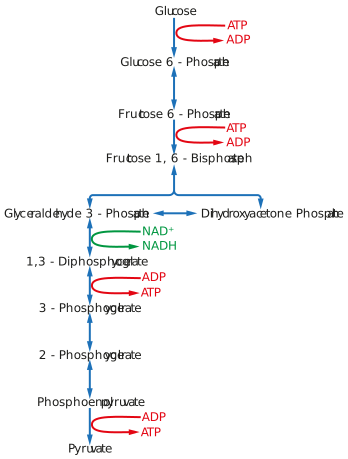
Figure: The glycolytic (Embden-Meyerhof-Parnas) pathway
The key aspects of the pathway are that:
● It converts glucose (a six-carbon hexose sugar) into two molecules of pyruvate (a three-carbon molecule).
● It does not need any oxygen.
● In the first part of the pathway, energy is used and two molecules of ATP are converted to ADP.
● In the second half of the pathway, from glyceraldehyde 3-phosphate to pyruvate, two molecules of ATP are made. Since two molecules of glyceraldehyde 3-phosphate are formed for each molecule of glucose used, the net gain is two molecules of ATP; this means glycolysis is an energy-forming pathway.
● The oxidation of glyceraldehyde 3-phosphate to 1,3 diphosphoglycerate uses a molecule of phosphate and reduction of NAD. The NADH has to be re-oxidised somewhere else.
● Some steps are reversible.
● Pyruvate is the starting point for the synthesis of many other compounds, including alcohol as we will see later in this lesson.
Entry of other sugars into glycolysis
Other fermentable sugars feed into glycolysis directly, for example hexoses such as fructose. Di- and trisaccharides are converted to their monosaccharide constituents before entering the pathway; in some cases, they are phosphorylated prior to entry. These different routes are set out in the following table.
Table: Entry points of sugars into glycolysis
|
Sugar |
Fate |
|
Glucose |
Glucose → Glucose 6-Phosphate |
|
Fructose |
Fructose → Fructose 6-Phospahte |
|
Galactose |
Galactose → Galactose 1-Phosphate → Glucose 1-Phosphate → Glucose 6-Phosphate |
|
Mannose |
Mannose → Mannose 1-Phosphate → Fructose 6-Phosphate |
|
Maltose |
Maltose → Glucose |
|
Sucrose |
Sucrose → Glucose + Fructose |
|
Melibiose |
Melibiose → Galactose + Glucose |
|
Trehalose |
Trehalose phosphate → Glucose 6-Phosphate |
|
Raffinose |
Raffinose → Galactose + Glucose + Fructose |
|
Maltotriose |
Maltotriose → Glucose |
Phosphate is an essential nutrient for all cells and yeast is no exception. Adding a phosphate group to a molecule is called phosphorylation, and taking it away again is dephosphorylation. The enzymes involved are called kinases and phosphatases, respectively.
One important reason for cells to carry out this process is the reversible phosphorylation of enzymes. This changes their activity and so is a method for fine-tuning metabolism. Some of these reactions can produce changes that affect gene expression, so it can be fundamental to cell function.
In the case of sugars, phosphorylation prevents them from diffusing back out of the cell. Furthermore, phosphorylation and dephosphorylation are involved in reactions where ATP is made or used.
Hexose monophosphate pathway
Not all glucose passes down the glycolytic pathway directly. This is an alternative route which is usually referred to as a shunt or bypass because it leads from glycolysis and eventually feeds back into it.
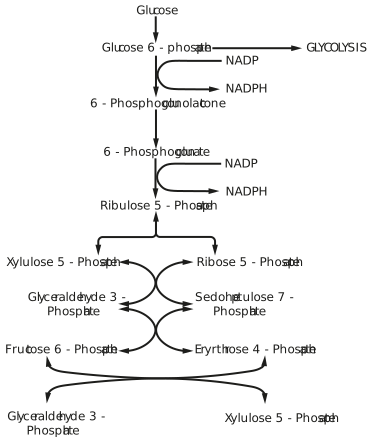
Figure: Hexose monophosphate pathway
The role of this pathway is to make reducing power in the form of NADPH. Some enzymes can use both NAD and NADP but others are specific for one or the other. Many enzymes involved in the synthesis of lipids require NADPH and this is where it comes from.
It is called a shunt because (as shown in the figure above) it branches off from glycolysis at glucose 6-phosphate and eventually produces glyceraldehyde 3-phosphate and fructose 6-phosphate, both of which can feed back into the main glycolytic pathway.
It is the route used by some yeasts (not brewing types) that can use odd-numbered sugars such as pentoses.
It is not very important in brewery fermentations and only around 2% of fermentable sugar passes through it (mainly in the early stages).