
Lesson 4 - Yeast Biochemistry
This lesson describes the biochemical pathways that explain the activities of yeast in brewing. It begins by looking at what metabolism is and how we control it. It then looks at how nutrients, including sugar, are taken up by brewing yeast. Next, it explores metabolism in more detail, focusing on sugar metabolism and looking at two particular modes of metabolism, respiratory and fermentative. Finally, it considers the need for redox control and takes a brief look at gluconeogenesis and the storage of carbohydrates in yeast.
Introduction
To settle us into yeast biochemistry, we begin by looking at some basic principles that explain metabolism and how it works.
Metabolism is the sum of all of the chemical processes that make a cell a living thing. More simply, it is the machinery that makes the cell work.
Metabolism is divided into two opposite and balanced parts:
● Catabolism: this refers to all of the chemical reactions that are involved in breaking down nutrients to provide the building blocks that are needed to make new cell mass and to provide energy to drive these processes.
● Anabolism: this is the counterpart of catabolism and is the sum of all the reactions that are used to make new cell mass, repair or replace damaged components, and make new cells. All of these reactions need energy.
The next figure shows us a bit more about how this cellular machinery is organised.
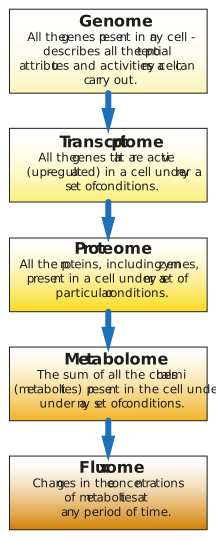
Figure: Hierarchy of cellular function
The figure shows how the cellular machinery is arranged to take best advantage of any situation in which it happens to find itself. We can take flocculation as an example and work through how the above hierarchy applies.
● The genome sits at the top. This is just a name for all the genes present in a cell and so it is all the potential activities that any cell can carry out. Flocculation needs FLO genes. If a cell does not possess these it will never be flocculent.
● Next is the transcriptome. Not all genes are active (expressed) at any instant. This is sensible and means that only the genes that are needed are active at any given time. Genes that are active are up-regulated and those not, down-regulated. Some genes are always turned on (constitutive) others not. Generally, in brewing yeast, the FLO genes are turned off in early fermentation when we want the cells to be dispersed in wort. They are turned on in late fermentation when we want the cells to form clumps and separate from green beer.
● The proteome is all the proteins made by the up-regulated genes at any instant. Most of these are enzymes, the cellular catalysts that actually carry out all the reactions that make up metabolism. This will include the enzymes needed to synthesise the flocculins which bind to mannans receptors when flocculation occurs.
● The metabolome is simply all of the chemicals present in the cell at any instant. In our flocculation example, these will be the amino acids that the cells either take up from the wort or synthesise from scratch to make the flocculins proteins.
● Lastly, the fluxome. This is the change in concentration of all metabolites at any instant.