
Lesson 4 - Yeast Biochemistry
This lesson describes the biochemical pathways that explain the activities of yeast in brewing. It begins by looking at what metabolism is and how we control it. It then looks at how nutrients, including sugar, are taken up by brewing yeast. Next, it explores metabolism in more detail, focusing on sugar metabolism and looking at two particular modes of metabolism, respiratory and fermentative. Finally, it considers the need for redox control and takes a brief look at gluconeogenesis and the storage of carbohydrates in yeast.
Respiratory and Fermentative Metabolism
Pyruvate, the end-point of glycolysis, sits at a major metabolic cross-road. External conditions decide which route the majority of carbon flow takes. This has far-reaching consequences for how the cell obtains energy. Understanding this is key to understanding brewery fermentations.
Two modes of metabolism are possible: respiratory and fermentative. We now explore what these terms mean and how they work.
Respiratory metabolism
In all organisms, including yeast, respiratory metabolism requires the presence of oxygen.
As we discussed earlier, one of the roles of glycolysis is to generate energy as ATP. When this happens some NADH is also formed and this has to be re-oxidised elsewhere to keep everything going.
When respiration is active, NADH is re-oxidised in a series of reactions in which oxygen is ultimately reduced to water. Starting with glucose, the whole reaction is:
C6H12O6 + 6O2 → 6CO2 + 6H2O + energy
Some of the energy that is formed is captured as ATP via glycolysis. This is called ‘substrate level phosphorylation’. During respiration a lot more of this energy is converted into ATP in a process called ‘oxidative phosphorylation’.
Oxidative phosphorylation happens in the mitochondria when metabolism is respiratory. Electrons pass down a chain of carriers moving from high to lower energy. Some of this energy is used to make ATP. At the end of the chain, the electron is passed to an oxygen molecule to create water.
Respiratory pathways
Pyruvate is converted into another key metabolite, acetyl Coenzyme A, also in the mitochondria. This then feeds into another pathway called the citric acid cycle, Kreb’s cycle, or tricarboxylic acid (TCA) cycle.
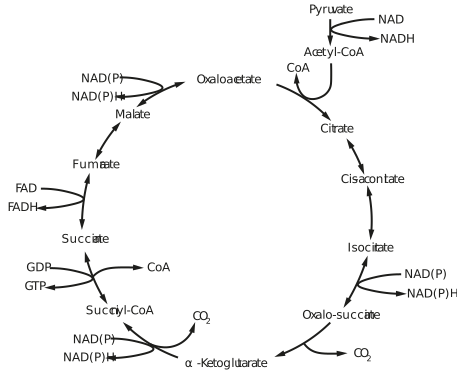
Figure: Reactions of the TCA cycle
Although there is a lot going on here, we can note these key points.
● The intermediates are acids. Many of these are found in beer and this cycle is where they come from.
● Some steps are reversible.
●Several steps are oxidations and generate reduced coenzymes, NADH, NADPH or FADH (flavin adenine dinucleotide, another coenzyme sometimes used in these types of reaction).
● Two molecules of CO2 are formed for each turn of the cycle.
● Some energy is generated using a molecule related to ATP, called GTP (guanosine triphosphate).
● Some reactions involve another coenzyme, called Coenzyme A (CoA).
RCOOH + R1OH → RCOOR1 + H2O
(where R and R1, which can be the same or different, are acyl groups)
The reduced coenzymes, mainly NADH, which are formed in glycolysis and the TCA cycle now need to be re-oxidised. During respiration this is done in the electron transport chain.
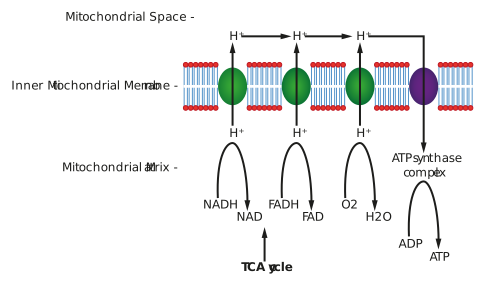
Figure: Electron transport chain
This process occurs in the mitochondria. It consists of a series of electron carriers, mainly cytochromes, across which electrons are passed. They come from reduced coenzymes and as a result these are re-oxidised and are then free to take part in other reducing reactions.
Cytochromes are a group of special proteins that are usually coloured, hence the name. As they contain atoms of iron they are also called haemoproteins. They are able to carry and release electrons because they can be reversibly reduced and re-oxidised. Cytochromes are arranged in chains in a sequence each with a different redox potential (the tendency to gain or lose electrons) so that they are able to pass electrons from one to another.
The terminal electron acceptor is oxygen and water is formed. This explains why this process can only occur under aerobic conditions.
The flow of electrons creates an electrochemical proton gradient and the energy in this is captured and used by an enzyme complex called ATP synthase to create ATP.
Going back to glycolysis and our molecule of glucose, two molecules of ATP are created in glycolysis and as many as 36 by oxidative phosphorylation; the actual number varies in different organisms but it is always much more than through glycolysis.
Fermentation
From looking at the respiratory pathway, we can see that it does not make any alcohol. Instead, this happens in fermentation. During fermentation, acetaldehyde, formed from pyruvate, acts as the terminal electron acceptor and alcohol (ethanol) is formed.
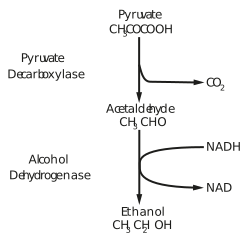
Figure: Alcohol formation during fermentation
The bulk of the CO2 that forms during fermentation arises from the conversion of pyruvate to acetaldehyde. Acetaldehyde is then reduced to form ethanol (alcohol). In this step, the NADH that is formed in glycolysis is re-oxidised and so redox is balanced and the NAD formed can be used in other oxidation reactions.
The equation for this differs from respiration and can be written as:
C6H12O6 → 2C2H5OH + 2CO2
Respiration or fermentation?
The conversion of glucose to alcohol does not need any oxygen. When we use the word fermentation we tend to think of this as being an anaerobic process.
However, we also know that if we do not add any oxygen to wort at the start of fermentation the whole process is slow; it might even stop before all the sugar has been used up and not much new yeast is formed.
Thinking about our discussions on respiration and fermentation you might think that at the start of fermentation when oxygen is available the yeast would use the respiratory pathway and form a lot of ATP. When all the oxygen was used up the fermentative pathway would be used and alcohol formed.
This sounds reasonable but it is not at all true. Brewing yeast show something called the Crabtree effect. If there is any glucose present metabolism is always fermentative and sugars are largely converted into alcohol, irrespective of the presence of oxygen. If any oxygen is present, as it is at the start of fermentation, it is never used as a terminal electron acceptor, instead it is used to synthesise unsaturated fatty acids and sterols. The Crabtree effect is absolutely vital to explain what happens in brewery fermentations.
The Crabtree effect is named after a biochemist called Herbert Crabtree but a similar effect is seen in cancer cells and here it is called the Warburg effect and this explains why a lot of research has been done on it.
Saccharomyces yeast that is growing when sugar supplies are plentiful, but which is also in the presence of potential competitors, will be at an advantage if it is able to use this sugar very rapidly and beat the competition to it. That is exactly what happens. Rates of glycolysis increase when a lot of sugar is present and so it rapidly disappears. Many yeasts, referred to as Crabtree negative, cannot do this and in this situation are at a competitive disadvantage.
Saccharomyces yeasts rapidly use the sugar and make a lot of ATP via glycolysis. They make so much that they do not need to make any more from the electron transport chain and so the genes coding for this and part of the TCA cycle are switched off, or repressed. However, the cells still need to balance redox and cannot do this by coupling the reduction of oxygen to water. Luckily for us they get around this by making alcohol.
A key message here is that it is sugar that operates the switch. Oxygen has no role in the Crabtree effect. That said, respiration cannot occur without oxygen and so Crabtree-negative yeasts cannot grow under anaerobic conditions. However, under the right circumstances (a low sugar concentration and aerobic conditions), Saccharomyces yeasts can turn on the respiratory pathways, generate ATP via the electron transport chain, and balance redox by making water.
When glucose is present the genes responsible for oxidative phosphorylation are all switched off. Some others are as well, including the step from pyruvate to acetyl-CoA (pyruvate dehydrogenase) and the TCA cycle step from α-ketoglutarate to succinyl-CoA (α-ketoglutarate dehydrogenase). In this state the cells are repressed (meaning some genes are turned off).
If glucose falls to a very low concentration and oxygen is present, respiratory pathways are turned on and the cells are then in a derepressed state.
The disrupted TCA cycle makes it a two-branched pathway and this is where a lot of the organic acids that are found in beer appear.
Oxygen is needed by yeast in fermentation to make essential membrane lipids, mainly unsaturated fatty acids and sterols. These are diluted amongst mother and daughter cells during the anaerobic phase of fermentation and when the cropped yeast is re-pitched they need to be topped up again.
Before moving on to the next section, there are two other terms that are relevant here.
Pasteur effect
This is either a reduction in fermentation rate in the presence of oxygen or, conversely, an increase in fermentation rate under anaerobic conditions. This arises because if oxygen is present in cells that do not show the Crabtree effect, respiration produces a lot of ATP and so the rate of glycolysis is reduced to avoid a build-up of ATP. The reverse argument also applies. In fact, in Saccharomyces yeasts, which we know to be Crabtree positive, it is not very important and only really happens under certain conditions, such as a limited source of nitrogen and low glucose concentration.
Custers effect
This is an increase in rates of fermentation under aerobic conditions and inhibition of fermentation in the absence of oxygen. In effect, this is the reverse of the Pasteur effect. The Custers effect is seen in Brettanomyces, the yeast now popular for making some sour beers. These yeasts contain both NADP- and NAD-linked dehydrogenase enzymes that produce acetic acid. The NAD-linked version is repressed by glucose. The effect is a result of an interplay between control of redox via competition in the rates of conversion of acetaldehyde into either alcohol or acetate.