
Lesson 4 - Yeast Biochemistry
This lesson describes the biochemical pathways that explain the activities of yeast in brewing. It begins by looking at what metabolism is and how we control it. It then looks at how nutrients, including sugar, are taken up by brewing yeast. Next, it explores metabolism in more detail, focusing on sugar metabolism and looking at two particular modes of metabolism, respiratory and fermentative. Finally, it considers the need for redox control and takes a brief look at gluconeogenesis and the storage of carbohydrates in yeast.
Point of Reflection – Reconvene:
Welcome back. So, what were your thoughts?
Where there is a choice, the cell will first take up those nutrients that are most easily used. When those have gone it will move on to the next most easily used nutrients, and so on. ‘Easily used’ means nutrients that require the minimum amount of energy or chemical modification to make use of them.
The result of this, in the case of a brewery fermentation, is that uptake of nutrients is ordered. This has big consequences. It explains, for example, how, when, and how much some important beer flavour components are formed, as we will discuss in later lessons. The key point is that if you change wort composition, such as replacing a proportion of malted barley with a relatively pure sugar adjunct, it is quite likely that beer flavour will change and part of the explanation is that the ordered uptake of nutrients has also been changed.
Transport mechanisms
We now look at the methods used by yeast cells to transport materials into the cell. We are going to concentrate on sugar transport because of its importance in brewery fermentation but similar mechanisms are used for other important nutrients such as amino acids.
The figure below summarises the different methods that are used for transporting materials across the cell membrane.
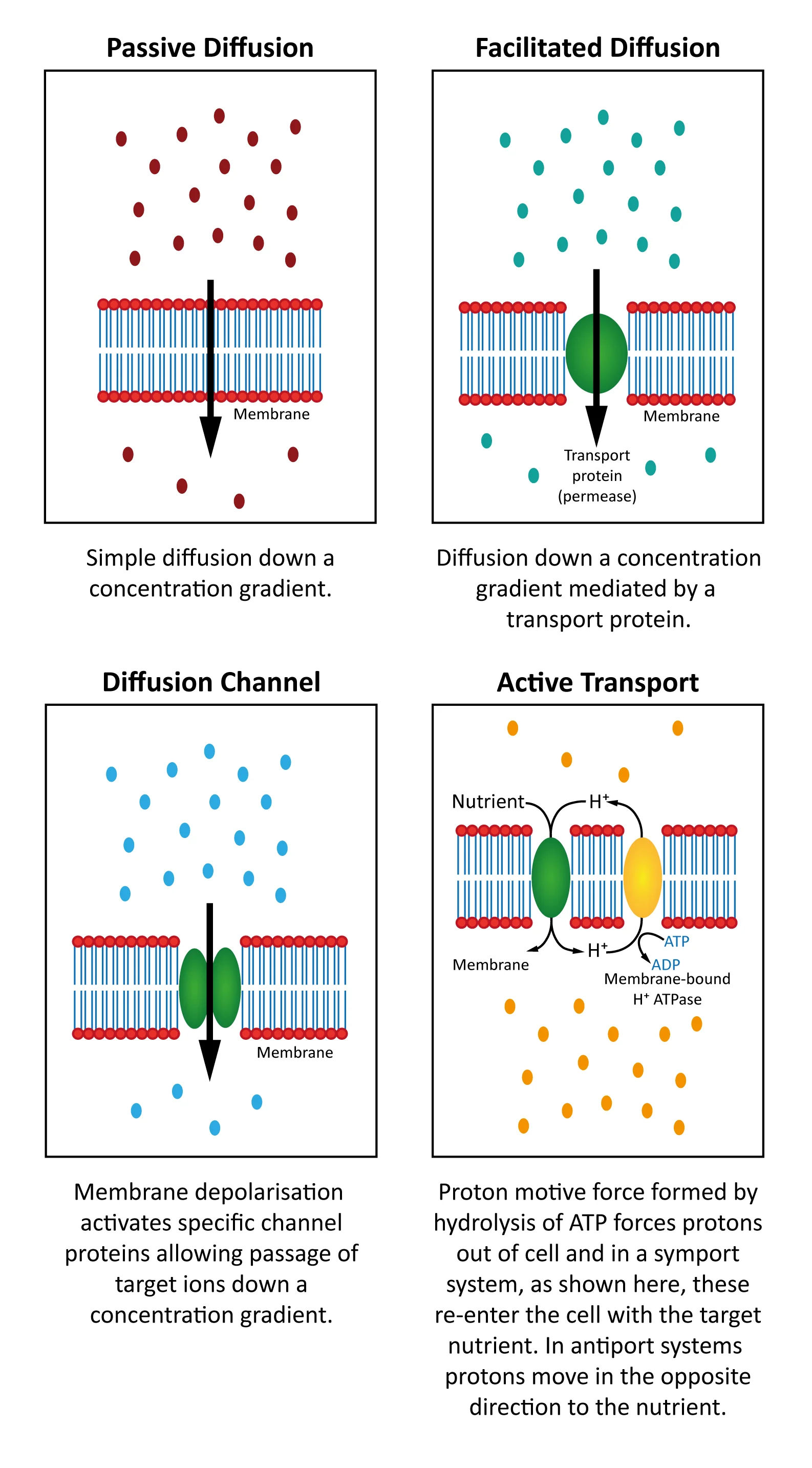
Figure: Mechanisms used to transport materials across the cell membrane
The transportation of nutrients into cells and of products of metabolism to the outside is a key activity of all cells. As we can see, there are several ways in which this is carried out. The simplest methods do not require energy, whereas other more complex methods do. We now consider each of the mechanisms in turn.
Simple or passive diffusion: This is the simplest method but transport of a compound into cells via this method can only occur if the external concentration is higher than the internal concentration. In other words, compounds diffuse in the direction of a concentration gradient.
This method also requires the substance to dissolve in the phospholipid bilayer that makes up most of the cell membrane. Therefore, it only works if the molecule is quite small, for example a gas such as oxygen or CO2, or relatively hydrophobic. Ethanol is an example of the latter group.
However, some believe that when external sugar concentrations are very high, such as at the beginning of fermentation, a small proportion of glucose may enter cells via this route.
Facilitated diffusion: This method, like passive diffusion, does not require cellular energy and also only works in the direction of a concentration gradient. It overcomes the barrier of the lipid bilayer, though, by using proteins to move the target molecules. This type of transport system is much more rapid than simple diffusion.
There are two types of protein used:
● Channel proteins provide a hydrophilic environment that allows molecules to diffuse across the membrane. They function as gates that may be open or closed depending on the polarisation of the membrane. Typically, they are closed if this is negative and open when positive. They are used mainly to transport ions such as K+ but also glycerol, the efflux of which is used by yeast to respond to osmotic stress.
● Carrier proteins, also called permeases, bind to the target molecule, which causes a change in conformation that allows the molecule to move across the membrane. The molecule is released on the inside and the permease changes back to its original form ready to transport another substrate.
This is a much-used method for many essential yeast nutrients, including sugars and amino acids. Cells possess specific permeases for given nutrients. They may work with a single nutrient only (narrow specificity) or a broader range of similar molecules (broad specificity). Permeases can be either constitutive, which means they are always present, or inducible, where they are only present and active under some conditions but not others.
Both low and high affinity permeases occur. This is a measure of how much substrate is required for the carrier to be active. All enzymes, which permeases are similar to, have an optimum substrate concentration for maximum activity. This is quite high for the low affinity types and the reverse for high affinity transporters. If a cell possesses a high affinity transporter, it is able to mop up very low concentrations of the target nutrient; this is an advantage if competing with other cells for scarce nutrients.
Active transport: This transport method is an active process that requires metabolic energy in the form of ATP. Again, transport proteins are involved that are specific for particular nutrient molecules.
Primary active transport uses the energy released when ATP is hydrolysed to generate an electrochemical gradient across the membrane by pumping protons or other cations from inside the cells to the outside.
Secondary active transport uses the gradient formed by the primary pumps. Two components are involved. One always moves in a direction that dissipates the electrochemical gradient and drives the process.
Antiport systems use the energy released when an ion is moved in one direction to drive the movement of another, in the opposite direction, against a concentration gradient.
In symport systems both components move in the same direction. The driving component, moving from a high to lower concentration, carries the second component with it against a concentration gradient.
Choice of carrier and control of transport
A common strategy is to use a low affinity method when there are abundant supplies of a particular nutrient. When these fall to low levels a high affinity transport system is used to scavenge as much as possible of what remains.
A second and higher level of control is via regulation of genes that code for the transport proteins. What usually happens here is that the presence of one nutrient turns off the genes needed for the transport and utilisation of another. A good example for brewing yeast is that glucose controls the genes needed for maltose utilisation.
Sugar uptake
In a typical malt wort, maltose is the main fermentable sugar, together with smaller concentrations of many others though mainly glucose, sucrose, and maltotriose. Brewing yeast strains cannot use longer dextrins or five-carbon sugars, and ale strains are less good at using maltotriose than lager strains. We now look at how sugars enter the cell.
The following figure shows the patterns of uptake for the main fermentable sugars in wort.
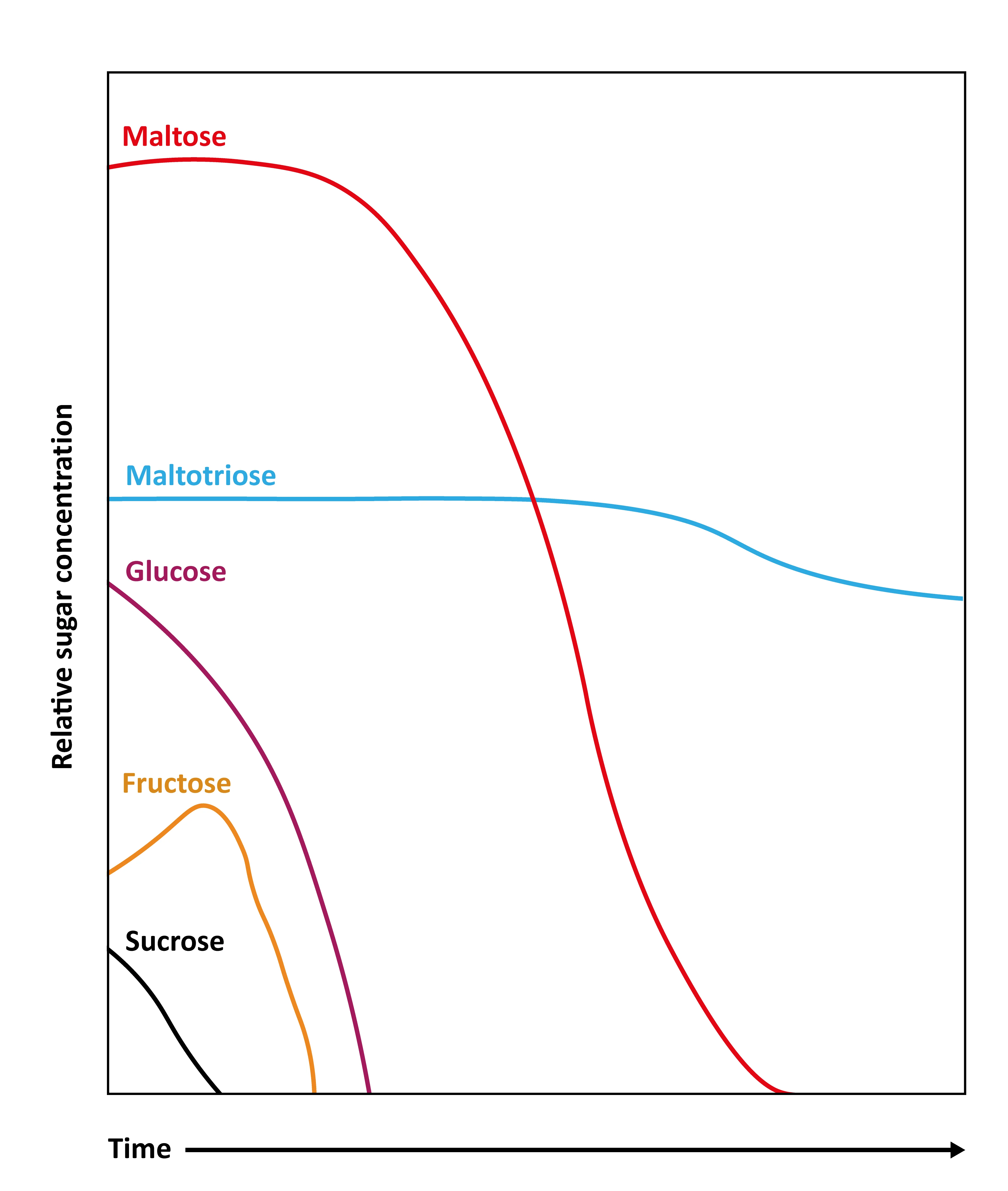
Figure: Patterns of sugar uptake by a lager yeast during fermentation (sugar concentrations are for the purpose of illustration only and although the patterns will be similar actual values will vary considerably depending on wort concentration)
The following points explain how and why this happens.
● Glucose is the preferred substrate and there are several uptake systems capable of taking it up, comprising both high and low affinity facilitated diffusion systems. High affinity carriers are turned off when high glucose levels are present. At least 20 hexose carriers have been identified in Saccharomyces yeasts. Some are specific for glucose, while others are active with more than one hexose sugar. For example, some carriers take up glucose plus fructose, mannose, and galactose in strains that can use this latter sugar. There are a lot of strain-specific differences here; however, active mechanisms do not appear to be used. Glucose uptake is the rate-determining step in sugar utilisation and so intracellular glucose does not accumulate and transport is down a concentration gradient. The large number of carriers for glucose shows how important this sugar is but also it seems that some may have a role as glucose sensors.
● Invertase converts sucrose into fructose and glucose within the periplasm. This explains the short increase in fructose concentration. The gene coding for invertase (SUC2) is repressed by glucose in some strains. Fructose is taken up by a glucose carrier.
● Brewing strains contain multiple genes for transporting and metabolising maltose, again apparently low and high affinity types. These multiple groups of (MAL) genes are found on several chromosomes; each is a complex, containing genes which control maltose uptake and metabolism, together with one with a regulatory function. The high affinity system is induced by maltose and repressed by glucose. Activity is shown towards other disaccharides, such as trehalose (discussed later).
● Maltotriose transport is carried out, in those strains that can utilise it, by specific transport proteins using active transport.
Below is a table summarising the uptake and fate of the main wort disaccharides.
|
Disaccharide |
Broken down into |
Genes involved |
Transport |
Fate inside cell |
|
Sucrose |
Invertase converts sucrose into fructose and glucose in the periplasm |
SUC2 codes for invertase. HXT1 codes for hexose permease |
Glucose and fructose from sucrose hydrolysis are taken up by facilitated diffusion via hexose permease. In lager yeast, fructose uptake is via active transport |
Glucose and fructose are used for energy production and cell growth |
|
Maltose |
Once inside the cell, maltose is converted into 2 glucoses by α-glucosidase |
MAL genes (maltose is principally assimilated by Agt1 which is encoded by MAL11) |
Maltose is transported into the cell via carrier proteins located in the cell membrane. Research indicates that maltose uptake is principally through active transport. The precise mechanism may depend on the wort maltose concentration and yeast strain |
Glucose is used for energy production and cell growth |