
Lesson 4 - Yeast Biochemistry
This lesson describes the biochemical pathways that explain the activities of yeast in brewing. It begins by looking at what metabolism is and how we control it. It then looks at how nutrients, including sugar, are taken up by brewing yeast. Next, it explores metabolism in more detail, focusing on sugar metabolism and looking at two particular modes of metabolism, respiratory and fermentative. Finally, it considers the need for redox control and takes a brief look at gluconeogenesis and the storage of carbohydrates in yeast.
Control of Metabolism
Metabolism is very tightly controlled, and this works at different levels. Metabolism is arranged into pathways where nutrients are taken up and broken down and cellular components are made. We will look at some of these later in this lesson.
Each pathway consists of a number of steps with chemical changes being made at each. Each step is catalysed by a specific enzyme. The genes coding for each of these enzymes must be up-regulated for it to be active.
As mentioned in the last section, some pathways are always active, described as constitutive. Others are only turned on (induced) or turned off (repressed) under certain circumstances. This is control at the gene level and is quite slow since it takes time for the enzymes to be synthesised and moved to where they are needed or, when no longer needed, labelled and transported to the vacuole for breakdown into amino acids for re-use somewhere else.
Although slow, this method of control is used to make big changes in metabolism. Quite simple molecules, such as oxygen or sugars, cause multiple genes to be up- or down-regulated with whole pathways being switched off or on.
Below the gene level there is a second method of control. This is by controlling the activity of the enzymes that genes code for. This is much quicker.
We can see how this works by looking at an example. All cells need to have a supply of amino acids to build proteins. Yeast cells have two options. If the amino acid they want is present in the medium they can take it up and use it. If none is available, for many amino acids, they can synthesise them from scratch. Making these themselves needs energy and so if there is a ready-made supply in the medium it will not make the effort to have the synthetic route active. There is an effective way to deal with this. Presence of the amino acid in the cell stops the action of the enzyme that catalyses the first step in the biosynthetic pathway. This is called control by feedback inhibition. If the concentration of the amino acid falls below a threshold value the inhibition is relieved and the pathway is re-activated. The activity of many pathways is controlled in this way. The following figure uses the ilv pathway, responsible for valine synthesis, to illustrate this method of control.
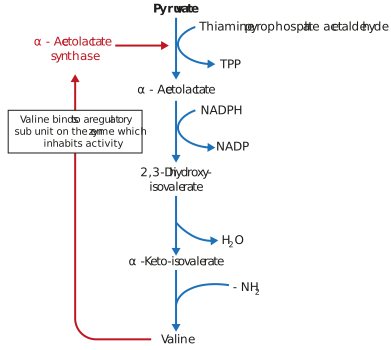
Figure: Feedback control of the ilv pathway by valine
Energy Conservation and Reduction–Oxidation (Redox) Reactions
All cells need energy to drive metabolism. To obtain this, they use a group of molecules that contain high energy bonds. The most important of these is called adenosine triphosphate (ATP). It has three phosphate groups attached to the nucleoside, adenosine, which is itself made of a molecule of adenine and the five-carbon sugar, ribose. The bonds between adenosine monophosphate (AMP) and the other two phosphate groups (ADP and ATP) are high energy bonds.
In some catabolic reactions, typically oxidations, energy is released and part of this is retained in high energy bonds when AMP or ADP are phosphorylated to form ADP and ATP, respectively, the second of these being more common. In subsequent reactions the energy present in these phosphate bonds is released and used to power the energy-requiring reactions which make up these pathways. In some cases both high energy bonds are required and ATP is converted to AMP. The catabolic reactions release ADP or AMP which is then available to again participate in regenerative anabolic reactions.
The cycle of making and breaking these high energy bonds has to carry on to allow essential cellular functions to continue. ATP is like the fuel in a car and if it runs out the car engine will stop. All living cells use this molecule in this way.
Many cellular oxidation reactions use a coenzyme called nicotinamide adenine dinucleotide (NAD). This molecule can be reversibly oxidised or reduced and so can take part in both oxidation and reductions.
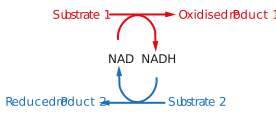
Figure: Oxidation and reducing reactions involving NADH
Cells have other coenzymes that carry out similar functions, the one most frequently seen being nicotinamide dinucleotide adenine phosphate (NADP).
Cells have limited amounts of these coenzymes and an important part of metabolism is to make sure that they remain in balance. If this does not happen metabolism becomes blocked. This is called redox balance and it has important implications for fermentation (covered later in this lesson).