
Lesson 2 - Wort Boiling Theory
This lesson explores changes that occur during wort boiling. It details how these changes occur and their effects on quality. We also describe how wort boiling can be monitored.
Removal of Unwanted Volatile Flavour Compounds
During the evaporation stage of wort boiling, undesirable volatile compounds are evaporated. Of particular concern for lager beers is dimethyl sulphide (DMS), which has a canned sweetcorn aroma.
DMS is produced by thermal decomposition of S-methyl-methionine (SMM).
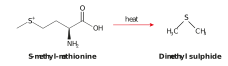
Figure: The conversion of SMM to DMS
The SMM is formed during the malting process. Where DMS is of concern, malt specifications should set a limit of SMM or DMSp (DMS precursor) supplied to the brewery. A maximum level of 5 mg/kg is often used.
Fortunately, DMS is volatile, with a boiling point of 38°C, so is easily evaporated in a vigorous boil. In order to remove DMS we need to form it from SMM and this is done by heat. If the wort is hot enough to boil at around standard atmospheric pressure, SMM is converted into DMS for evaporation. However, the rate at which this occurs is increased at higher temperatures. Increasing wort boiling temperature from 100°C to 110°C reduces the time taken to convert the SMM from 70 min to 22 min. Some wort boiling systems feature a hot phase where the wort is heated under pressure to increase temperature and convert SMM and then an evaporation phase with increase boil vigour to drive off the DMS produced. A higher pH also promotes the conversion of SMM to DMS. At pH 5.2 it can take 38 minutes to convert half the SMM in wort while at pH 5.5 this is reduced to 32.5 minutes.
If all the SMM is not converted to DMS, and the DMS evaporated, the conversion of SMM to DMS continues in the wort clarification vessel (whirlpool, hopback, sedimentation tank etc.). Once in the wort clarification vessel, (unless there is wort stripping after) any DMS formed is not evaporated and if the level is above the flavour threshold, the beer may smell of cooked sweetcorn.
The flavour threshold of DMS is about 30-50 μg/L.
The wort boiling process should ensure that the total DMS (made up of free DMS and DMS precursor) is reduced to the required level. A typical total DMS specification for wort at the end of wort boiling is below 50 µg/L. Some brands that require noticeable DMS have a higher specification target than this.
Very few brewers measure total DMS towards the end of the boil and use the result to determine if the boil is complete. Instead, DMS is measured at the end of a boil and the boil length and evaporation rate are standardised to achieve the same outcome. Measurement must be regular to ensure that changes resulting from raw material changes are accounted for.
The longer the boil, the more SMM is converted to DMS and the more DMS is evaporated.
There is another precursor to DMS that comes from malt called dimethyl sulphoxide (DMSO).
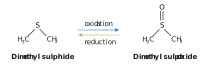
Figure: Formation of DMS from DMSO
Any DMSO that makes it through to fermentation can be taken up by the yeast. In some circumstances, depending on the yeast strain, it can be converted to DMS. Warmer fermentations can increase this reaction.
The prevention of excessive levels of DMS in beer can be achieved using:
- Malt with low SMM levels.
- A lower pH during fermentation.
- Sufficient heat added to convert SMM to DMS.
- A wort boiling system with effective evaporation and removal of volatiles to remove the DMS formed.
- A short wort clarification residence time, to prevent more DMS forming from SMM.
- Rapid wort cooling, (reducing the time that the wort is hot).
- Wort stripping after the wort clarification vessel, to remove DMS (this will be covered in the next lesson).
The wort boiling process should ensure that the total DMS (made up of free DMS and DMS precursor) has been significantly reduced. A typical total DMS specification for wort at the end of wort boiling is below 50 µg/L. Some brands that require noticeable DMS can have a higher specification target than this.
There are a number of unwanted volatiles other than DMS that we need to remove from wort during the boil. Several aldehydes have a worty, or grainy aroma. An example is isobutyraldehyde, which can give beer a grainy flavour. 3-methylbutanal is a Strecker aldehyde that boils close to wort boiling temperature. It is therefore a good indicator of volatile stripping. We can measure the level of 3-methylbutanal in wort after the boil. Elevated levels suggest that volatile removal was not effective.
Some of the volatiles that evaporate in the boil condense on the inside of the wort kettle stack (chimney). These volatiles must be collected by a channel at the base of the stack. This prevents the condensate running back into the wort and adding back the volatiles we were trying to get rid of!
We can evaluate the condensate produced in this drain or in the vapour condenser in two ways. We can analyse it for flavour compounds such as aldehydes, furans, ketones, pyrazines and sulphides using a gas chromatograph mass spectrometer (GCMS) or we can physically check its odour. Condensate early in the boil should smell worty and grainy but by the end it should be largely odour-free.
A few of the reactions discussed above are affected by pH. A higher pH produces more DMS and more colour and flavour from the Maillard reaction.
Thermal load
The application of heat is critical to many of the objectives of boiling, including the conversion of DMS and volatile evaporation. However, applying too much heat to the wort is not only wasteful of energy but also reduces flavour stability and foam potential. The amount of heat applied to wort is called the thermal load (or sometimes thermal stress). We evaluate thermal load in two ways. One is to measure the concentration of the Maillard reaction product 2-furfural using a GCMS. 2-Furfural has low volatility (boils at 162°C) and is formed, but not removed during boiling. A lower thermal load during wort boiling produces lower levels of 2-furfural. Another method of measuring thermal load is the thiobarbituric acid index (TBI). Maillard reaction products and some other heat-derived organic compounds react with thiobarbituric acid to form a yellow colour. The intensity of this yellow colour is measured to determine TBI. Low values of TBI indicate low levels of thermal load. It is important to remember that thermal load is the total amount of heat applied to the wort not just the temperature achieved in the boil. A long boil at a specific temperature will impart a higher thermal load than a shorter boil at that temperature.