
Lesson 2 - Wort Boiling Theory
This lesson explores changes that occur during wort boiling. It details how these changes occur and their effects on quality. We also describe how wort boiling can be monitored.
Formation and Precipitation of Protein/Polyphenol Complexes
An excess of nitrogenous material in the wort after the boil is bad news!
It reduces beer colloidal and microbiological stability. An excess of coagulable protein is thought to adhere to yeast cells which can hinder their ability to obtain the nutrients they need to ferment effectively. It can also reduce the pH drop in the boil as the nitrogenous material acts as a buffer (something that resists changes in pH). Some even feel that protein material can contribute an unpleasant bitterness to beer. We therefore need to remove any excess during boiling.
As we have found with most compounds, scientists give nitrogenous material several names. It is known as protein, nitrogen and nitrogenous material. Not all nitrogenous material or nitrogen is protein as it includes proteins, polypeptides, peptides and amino acids. Nitrogen is a misleading term because we are just talking about compounds that contain some nitrogen not literally the nitrogen. Unless of course that is what we are measuring directly! In the boil, the nitrogenous material we are usually most concerned with is proteins and polypeptides.
The levels of coagulable nitrogen in unboiled wort has been reported as 35-70 mg/L. If boiling is effective this drops to 15-25 mg/L after the boil. Both figures depend on the nature of the raw materials (amount of adjunct and protein/modification level of the malt). As its name suggests, coagulable nitrogen coagulates! But what is coagulation? Coagulation is a process in which parts of a liquid change to a solid or semi solid. In the case of proteins and polypeptides it is when their three-dimensional shape changes so that the charges on the molecule change and they no longer interact with water molecules. As a result they become more hydrophobic and come out of solution. It is also when they combine to form larger particles, again meaning they drop out of solution. As you would expect in the boil, this is due to the effect of heat on the molecules. The wort pH also affects protein coagulation, with pH 5.2 being optimal.
The proteins and polypeptides do not only combine with other proteins and polypeptides but also polyphenols, particularly oxidised polyphenols. Complexes, of proteins and polyphenols are insoluble in hot wort, and precipitate during boiling to form flocs (clumps) of hot break/trub. The figure below shows the binding of proteins and polyphenols.
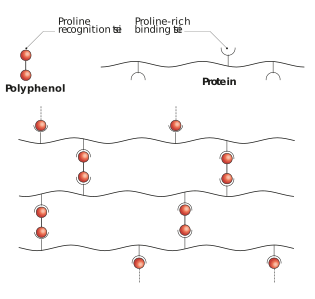
Figure: Protein-polyphenol interaction
Trub formation is encouraged by:
- Longer wort boiling (two hours can achieve almost complete precipitation).
- Increased wort boiling pressure/temperature.
- Vigorous boiling.
- Large numbers of steam bubbles.
- A pH of around 5.2.
The number of steam bubbles is especially important as the amphiphilic protein/polypeptide material is drawn to the bubble surface where it complexes with the polyphenols.
Amphiphilic means that part of the molecule is hydrophobic (water hating) and part is hydrophilic (water loving). It is an important property of the proteins involved in foam formation.
While a vigorous boil with plenty of steam bubbles is good for forming flocs of trub, we shouldn’t just opt for the maximum level of boil violence. We do need to avoid sheer forces when the wort is circulating. Shear forces can break apart the flocs reducing the likelihood of them settling out of suspension.
Some (mostly smaller) polypeptides and proteins do not precipitate in boiling. They form complexes that precipitate later in the brewing process, during wort cooling and fermentation. These are known as cold break or cold trub.
The table below shows the differences between hot and cold break.
Table: Differences between hot and cold break
|
|
Hot break |
Cold break |
|
Temperature at which insoluble |
100°C |
Below 60°C |
|
Particle size µm |
30-80 |
0.5-1.0 |
|
Typical wet weight g/hL |
150-400 |
5-30 |
|
Moisture % |
73-85 |
70-80 |
|
Proteinaceous matter degree |
40-70 |
45-75 |
|
Bittering substances % |
10-20 |
n/a |
|
Polyphenols % |
5-10 |
10-30 |
|
Carbohydrates % |
4-8 |
20-30 |
|
Ash % |
3-5 |
2-3 |
|
Lipids % |
1-2 |
n/a |
Kettle finings
We can improve trub and especially cold break formation with the addition of a fining agent, known as kettle (or sometimes copper) finings. Kettle finings are usually derived from Irish moss – the dried red marine algae Chondrus crispus. The following benefits have been claimed for kettle finings:
- Reduced wort boiling time.
- Faster trub compaction and, therefore, faster wort runoff.
- Tighter trub compaction, reducing losses.
- More consistent fermentations, giving superior beer flavour.
- Improved beer colloidal stability.
- Improved beer filtration throughput.
Kettle finings are available as dried Irish moss or a purified form of its active ingredient k-carrageenan. k-Carrageenan is a negatively charged sulphated helical polysaccharide with one sulphate attached to each pair of sugar residues.
Kettle finings are added towards the end of the boil, or to the whirlpool. They must be added early enough in the process to allow the k-carrageenan to dissolve and disperse throughout the vessel.
k-carrageenan interacts with the positively charged part of the proteins and polypeptides in the wort. This also happens with proteins and polypeptides that are part of a complex with polyphenols. This increases the size of the flocs which speeds their precipitation and sedimentation.
Kettle finings work better at lower pHs, as proteins become more positively charged as pH falls. The factors that can also influence the effectiveness of kettle finings include:
- Dose rate.
- Time of addition.
- Hot wort clarity.
- Wort pH.
- Malt variety.
- Degree of malt modification.
- Wort gravity.
- Wort polyphenol levels.
- Salt concentrations.
- Mashing temperature and profile.
The rate of fining addition requires frequent optimisation, particularly if there are changes of raw materials. Optimisation involves adding freshly boiled wort samples (taken just before the addition of kettle finings) to conical measuring cylinders, known as Imhoff cones and adding finings at different rates. After filling and fining addition, the Imhoff cone is left to settle for a period at a set temperature. After this period (for example, 36 h at 10°C), the amount of settled solids can be determined by reading the scale on the side of the cone. The differing levels of sediment and wort clarity at the various dose rates is then evaluated visually. This is shown in the figure below with measuring cylinders rather than Imhoff cones.
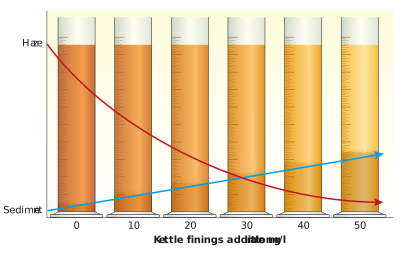
Figure: Finings optimisation
A good value for a sediment in lager is less than 5 mL/L although compact sediment should not be maximised at the expense of wort clarity. In the figure above 30 mg/L is the optimum rate as it is a good compromise between wort clarity and sediment volume.
Most suppliers of finings provide a finings optimisation service or instructions for how to best optimise their products.
We can also check the Imhoff cone after 5 min. In this case, the level of settled solids will be significantly higher (but less than 100 mL/L). This gives us an idea of the effectiveness of the protein coagulation. The sediment should be quite compact, not fluffy/wispy, and the wort should be clear.
The addition of kettle finings improves the coagulation of insoluble protein produced in mashing and boiling. This improved removal can enhance final beer filterability and colloidal stability.
For a more detailed understanding of the effects of kettle finings on beer clarification, please refer to the following article:
LEATHER, R.V. The Cambridge Prize Lecture 1996 – ‘From Field to Firkin: An Integrated Approach to Beer Clarification and Quality’. J. Inst. Brew., January-February, 1998, Vol. 104, pp. 9 -18.
Other process aids
We can also increase the effectiveness of protein removal by adding gallotannins. Gallotannins are polyphenols (tannic acid) and hence interact with nitrogenous material in the boil to form a precipitate. Gallotannins have also been found to remove metal ions by chelation. Removing iron and copper ions can reduce the rate of beer staling and the formation of permanent haze. A dose rate of 2 to 6 g gallotannins per hL has been shown to improve beer colloidal and flavour stability.
Proteins can also be removed using a silica sol solution. This disperses very readily so can be added at the end of the boil or during wort clarification. Silica sol addition rates are usually 15–30 g/hL but should be optimised based on process conditions and beer quality requirements.
We can also improve the formation and precipitation of protein/polyphenol complexes by adding polyvinylpolypyrrolidone (PVPP). PVPP interacts with polyphenols that might go on to form haze, forming a sediment.
Not all brewers use these process aids. Some prefer to deal with proteins and polypeptides later in the process. Some brewers of hazy beers use no process aids to remove protein and polypeptides as smaller proteins and polypeptides are required for a stable haze.
Measuring coagulable nitrogen
One method for determining total nitrogen in wort is the Kjeldahl method. Nitrogenous compounds in the wort are digested with hot sulphuric acid, in the presence of catalysts, to give ammonium sulphate. Sodium hydroxide solution is than added to liberate the ammonia. The ammonia is distilled off into an excess of boric acid solution, and the ammonia is titrated with standard acid. The total nitrogen is determined by the equation:

Where:
T = mL of 0.1 mol/L acid required to neutralise ammonia after subtracting the reagent blank.
V = volume of sample in (mL).
To determine the amount of coagulable nitrogen, a sample of the wort should be boiled for five hours at 105-108°C. This should cause the coagulable protein to precipitate out of the wort. The sample is then analysed using the Kjeldahl method. We can use this test before the boil and after the boil and calculate the difference. Or we can measure it after the boil only. A low result on a post boil sample indicates an effective boil, whereas a high result suggests that the boil was poor.
Not only do we want to remove unwanted solid materials from the wort, but also undesirable volatile compounds which if left behind will affect beer flavour.