
Lesson 2 - Wort Boiling Theory
This lesson explores changes that occur during wort boiling. It details how these changes occur and their effects on quality. We also describe how wort boiling can be monitored.
Development of Flavour and Colour
During the boil the colour of the wort increases and new flavour compounds are formed. The extent to which this is desirable/acceptable depends on the beer but with very pale beers we look to pick up as little colour and flavour as possible.
The source of the colour pick up is non-enzymatic browning. Two forms of non-enzymatic browning occur in the kettle, caramelisation that provides a small proportion of the colour and flavour and the Maillard reaction which provides the bulk.
Maillard reaction
We met the Maillard reaction earlier in the speciality malt lesson but here’s a short reminder and some more detail. The Maillard reaction is not a single reaction but a multitude of reactions starting with a reaction between reducing sugars (e.g., glucose, fructose and maltose) and amino compounds such as amino acids. The carbonyl group on the sugar reacts with an amino group on the amino acid or peptide. This forms N-substituted glycosylamines which are unstable and change to Schiff bases with the loss of water. The Schiff bases undergo Amadori rearrangement to form Amadori compounds. The Amadori compounds fragment, cyclise or dehydrate to form aromatic compounds and/or take part in Strecker degradation with amino acids to form Strecker aldehydes.
The products of these first sets of reactions are aromatic substances. They are aromatic in part because they are volatile. Examples include the furans and furanones that have sweet, caramel and sometimes slightly burnt aromas. Strecker aldehydes have nutty, malty and worty aromas. Examples include: 3-methylbutanal, 2-methylbutanal and 2-methylpropanal. Because they are relatively volatile many don’t make it through into the final beer. Strecker aldehydes also form independently of the Maillard reaction. Some are associated with stale beer flavour, appearing as the beer ages.
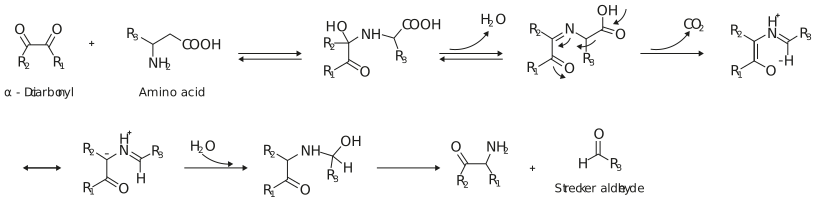
Figure: Strecker degradation
Very little colour is generated at this point. As the Maillard reaction proceeds the molecules produced polymerise, cyclise and condense to form larger more highly coloured molecules. These are called melanoidins. One thing to keep in mind is that despite its singular name the Maillard reaction is incredibly complex with many different substrates reacting to form thousands of intermediates that form thousands of products. Also keep in mind that its optimum temperature is 140°C-160°C so in wort boiling the temperature is always suboptimal.
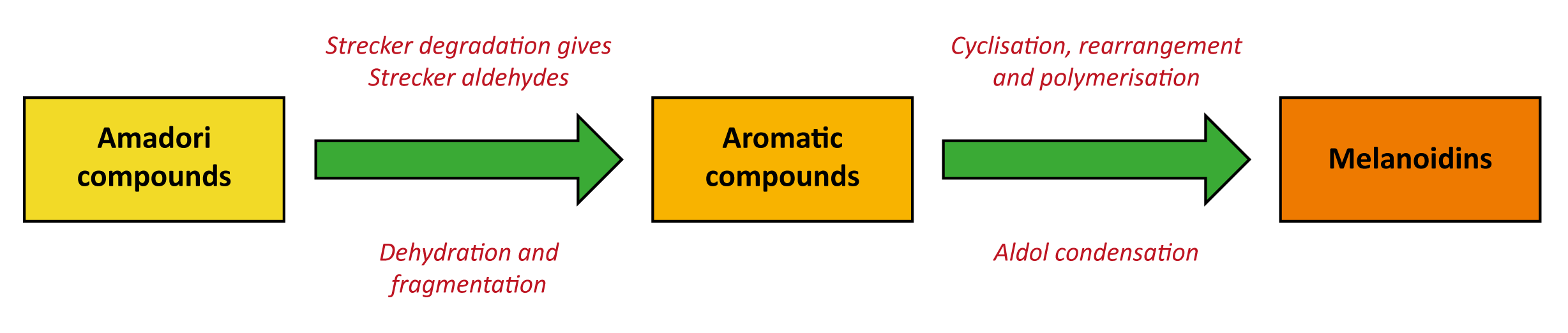
Figure: Maillard reaction
In delicately flavoured pale beers most flavour that is generated in boiling is unwelcome. Some flavour compounds produced during wort boiling are unwelcome in most beers. As well as the Strecker aldehydes, the furans furfural and 5-methylfurfural have nutty and bready aromas and are associated with stale beer flavour.
An increase in wort colour formation as a result of the Maillard reaction is affected by pH; wort with a higher pH picks up more colour.
The Maillard reaction does not only produce flavoursome and coloured compounds. It also produces compounds that can provide reducing (antioxidant) power to wort and beer. They are appropriately named reductones and ascorbic acid (vitamin C) is an example. Opinion is divided about the usefulness of reductones. Some feel that they help prevent oxidation causing the formation of stale beer flavour compounds or permanent haze by becoming oxidised themselves. Others feel that once they have been oxidised they are likely to lose the oxygen and promote oxidation, causing the formation of stale beer flavour compounds or permanent haze. Melanoidins which are also produced in the Maillard reaction have antioxidant or oxygen radical scavenging properties, although they have also been shown to promote oxidation! Therefore, trying to keep beer fresh by encouraging the Maillard reaction during boiling is probably not a good idea.
Caramelisation
Caramelisation is often called the pyrolysis (breakdown by heat) of sugar and this can be confusing. Some of the molecules that provide colour and flavour as a result of caramelisation are quite large and you don’t make large molecules by breaking up small ones! Caramelisation starts with the breakdown of disaccharides forming monosaccharides. These then dehydrate, fragment and polymerise to form coloured and flavoured products. Just like the Maillard reaction, there are many different reactions and intermediates. Unlike the Maillard reaction, only sugars are involved. This means that more energy is required to drive the process because sugars do not react with each other as easily as they do with amino groups. As a result, the optimum temperature for caramelisation is higher at 160°C-180°C. In wort boiling it occurs more readily when the wort is scorched by the hot surface of the kettle especially when the heating surface is very hot (direct fired kettles). Caramelisation can also become more significant if the boil is very long. Caramelisation can produce some of the same flavour compounds as the Maillard reaction. But as with speciality malt, its contribution is usually a lot less significant and is often exaggerated in what you might read about beer and brewing!
If you want to gain a lot of colour and flavour in the boil you should have:
-
High wort pH.
-
High wort polyphenols.
-
High wort FAN.
-
High temperature heating medium (flame, high pressure steam, high temperature electric element or thermal fluid).
-
A long boil time.
-
Low vigour.
If you don’t (and for most beers, you don’t!) you need the opposite.
Coloured compounds formed from sugars are not the only source of colour in the boil. Polyphenols increase in colour as they are oxidised. Higher pH values in mashing and wort separation favour their extraction so a high pH throughout the brewhouse processes increases colour pick up in the boil. Some feel that reducing the level of oxygen in the boil helps prevent oxidation of polyphenols. However, oxygen is pretty much insoluble in wort above 80°C so the reaction is likely to be driven by temperature rather than available oxygen.
There is some debate about which of the above sources is the most significant contributor of colour and it is likely to depend on the factors we have listed. The proportion of the total beer colour resulting from the boil depends on the malt types used. For very pale beer brewed with adjuncts, it can be the majority, but in beer made with speciality malt it is usually fairly minimal compared to that contributed by the malt.
The next process we will cover is the extraction and isomerisation of hop compounds; you have already encountered this in the hop unit.