
Lesson 2 - Wort Boiling Theory
This lesson explores changes that occur during wort boiling. It details how these changes occur and their effects on quality. We also describe how wort boiling can be monitored.
Preface
It is no exaggeration to say that without wort boiling, beer would be a disgusting and probably dangerous drink. On the face of it, compared to some of the processes we have covered so far, boiling wort is relatively simple. However, like every step so far, how we do it can bring success or failure.
We can start by broadly defining wort boiling. Wort boiling is when sweet wort (wort before hops are added) is collected in a vessel (a kettle) and boiled for a period (usually around an hour). As we are defining wort boiling it makes sense to also define boiling.
Boiling is when liquid water is changed into gaseous water (steam) which in the case of wort boiling is usually due to the application of heat. Liquid and gas are called states and also phases. So boiling is also described as phase transition or phase change. Liquids can make this transition without boiling and this is called evaporation. The difference between boiling and evaporation is that boiling takes place throughout the liquid while evaporation only occurs at its surface. Both boiling and evaporation take place when wort boils. The pressure on the surface of the liquid also affects boiling, with liquids boiling at lower temperatures as this pressure is reduced.
During the wort boil we can add hops, hop products, other flavourings and sugar-containing adjuncts.
At the end of the boil, the hopped wort goes forward into the wort clarification, cooling and oxygenation processes.
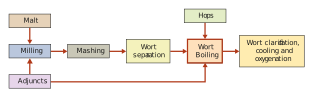
Figure: The brewhouse process
A number of changes occur during wort boiling. These are the:
- Inactivation of malt enzymes.
- Sterilisation of wort.
- Concentration of wort by evaporation.
- Development of flavour and colour.
- Extraction and isomerisation of hop compounds.
- Formation and precipitation of protein/polyphenol complexes.
- Removal of unwanted volatile flavour compounds.
- Acidification of the wort.
- Activation of foam stabilising proteins.
In this lesson we will discuss each of these changes, starting with the inactivation of malt enzymes, next.