
Lesson 3 - Wort Separation Principles SAQ
This lesson provides the opportunity for you to test yourself on the material covered in Lesson 2 on Wort Separation Principles. It allows you to determine to the level to which you have attained the learning outcomes.
Suggested Response - Q8
**Explain why different milling systems are used for the mash tun, lauter tun and mash filter. Demonstrate how this impacts on the relative flow rates of these wort separation devices.
Response:
Generally, the finer we grind our malt, the better our extract recovery. This needs to be moderated according to the wort separation device used.
The mash tun uses a deep floating grain bed. Larger husk particle fractions are needed to facilitate air entrapment. The grain bed is used to filter the wort. This coarsest grist can be achieved with a simple four-roller mill.
The lauter tun grist forms a sunken grain bed. Its husk particle fraction can be lower to increase extract efficiency, but it still needs to be able to filter the wort. This finer grind is best achieved with a six-roll mill.
The mash filter cloths have pore sizes that are vastly smaller than the false floor slots of a tun. They can hold back much smaller sized husk particles. They can process a much finer grind which will improve extract efficiency. This very fine grind cannot be achieved by a roller mill, so a hammer mill is used. The filter cloths will strain out most of the particulates but fine filtration is provided by the grain bed.
Our grain bed is made up from the 20% malt husk material that will not dissolve into the wort. We need to carefully control the husk particle size distribution at milling, as this determines the grain bed permeability.
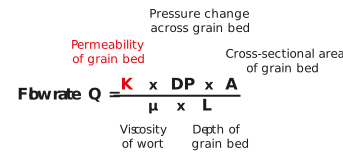
Figure: The Darcy equation and grain bed permeability
The Darcy equation shows that increased grain bed permeability  will increase filter flow rate. The permeability of the grain bed is a measure of its ‘openness’ to flow. The higher the grain bed permeability, the higher the flow.
The permeability of the grain bed is a function of particle size and porosity. The smaller the particle size of the husk material, the lower the permeability. The grain bed porosity is the ratio of the wort volume in the grain bed to the total volume of the grain bed. The lower the volume of wort in the grain bed, the lower the porosity.
Grain bed permeability is defined by the equation:
Grain bed permeability 
Here, n is the grain bed porosity, and d is the mean particle size diameter in metres. The grist husk fractions needed for each device are generally quoted as:
mash tun ‒ 25%
lauter tun ‒ 20%
mash filter ‒ < 10%
Assuming that the husk fraction % varies proportionately to the grain particle size and grain bed porosity, then substitution in the grain bed permeability formula, provides us with a relative grain bed permeability of:
Mash Tun ‒ 250 m².
Lauter Tun ‒ 75 m².
Mash Filter ‒ 1 m².