
Lesson 3 - Wort Separation Principles SAQ
This lesson provides the opportunity for you to test yourself on the material covered in Lesson 2 on Wort Separation Principles. It allows you to determine to the level to which you have attained the learning outcomes.
Suggested Response - Q7
**Explain the impact of wort viscosity on wort separation flow. Account for the difference in the strong worts viscosity between the mash tun and the lauter tun.
Response:
Darcy’s Law shows us that lower wort viscosity results in higher wort flow.
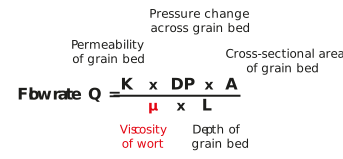
Figure: The Darcy equation and wort viscosity
Wort viscosity varies with density and temperature. Wort viscosity reduces with reducing gravity and reduces with increasing temperature.
This is best demonstrated with a graph:
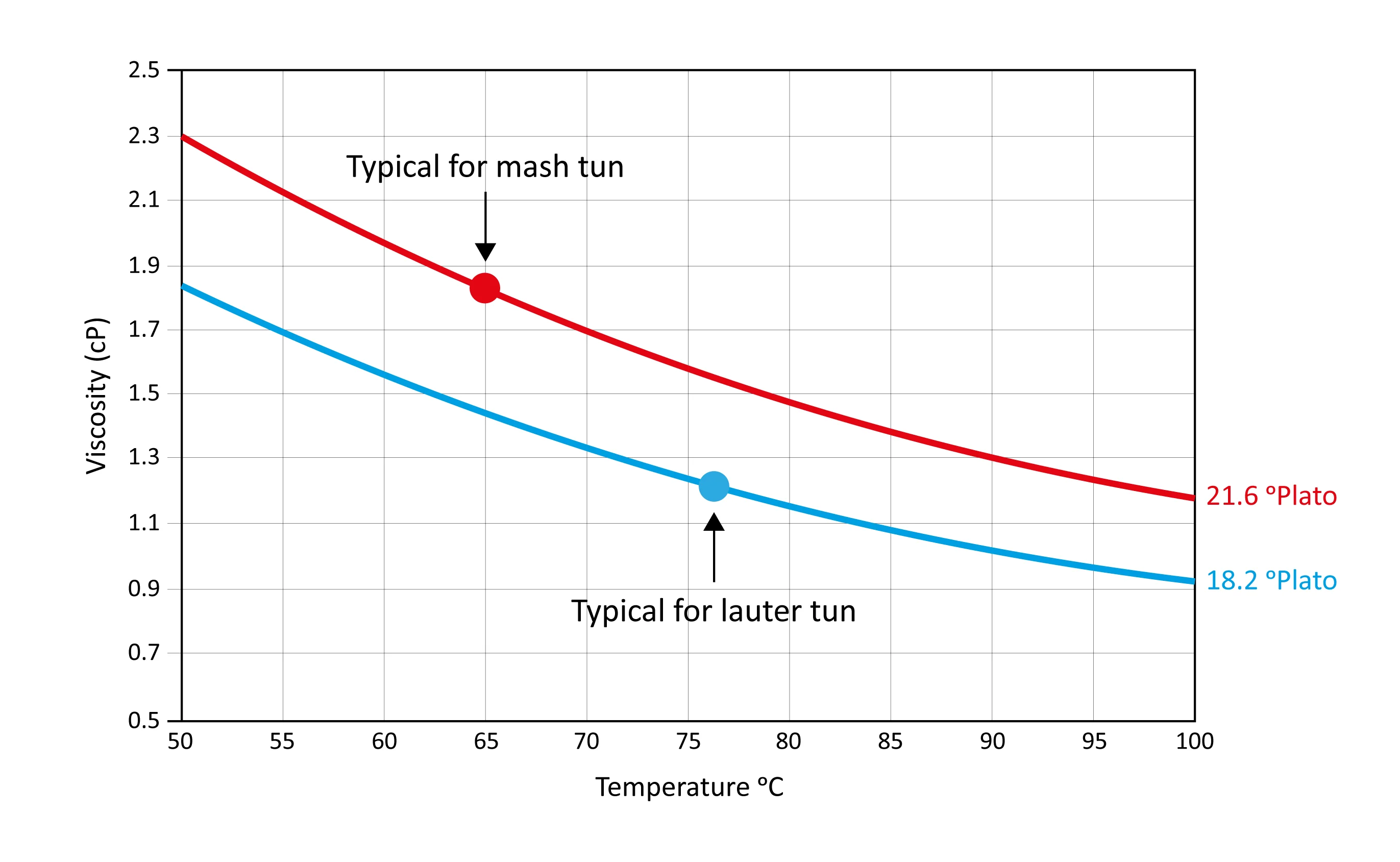
Figure: Viscosity varies with wort strength and wort temperature
Be sure to mark the x-axis as temperature, and the y-axis as viscosity. This graph shows two different gravities representative of the lauter tun and mash tun.
Reducing wort gravity reduces wort viscosity.
For any particular malt, the wort strength is directly related to the ratio of mash water to grist weight. The mash tun uses around 2.5 L/kg, and the resultant strong worts are roughly SG 1.090 or 21.5 ˚Plato. The lauter tun uses about 3.2 L/kg and its resultant strong worts are approximately SG 1.075 or 18.1 ˚Plato.
If we assume that these two strong worts were at the same temperature, say 76˚C, the viscosity for the mash tun would be 1.6 cP, compared to the lauter tun at 1.28 cP. The gravity difference of 15˚ has created a 20% difference in viscosity.
Increasing wort temperature reduces wort viscosity.
The temperature of wort leaving the mash tun is initially at the saccharification temperature of around 65˚C. The lauter tun receives mash from the mash conversion vessel at around 76˚C. So the higher gravity and lower temperature of the mash tun strong worts result in a viscosity of 1.83 cP, which is 30% higher than the lauter tun at 1.28 cP.
The higher gravity and lower temperature of the mash tun results in higher viscosity strong worts. Darcy’s Law shows us that with reference to viscosity, the mash tun strong worts flow rate will be slower than the lauter tun.