
Lesson 3 - Wort Separation Principles SAQ
This lesson provides the opportunity for you to test yourself on the material covered in Lesson 2 on Wort Separation Principles. It allows you to determine to the level to which you have attained the learning outcomes.
Suggested Response - Q6
**With the aid of diagrams, demonstrate the differences in grain bed formation and grain bed depth, between the lauter tun and the mash filter. Explain the relevance of this to strong worts flow rate.
Response:
Your diagrams should show the main features of each wort separation device, and how the mash slurry enters and forms a grain bed.
The lauter tun
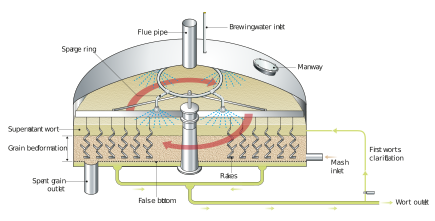
Figure: Lauter Tun grain bed formation
The pumped mash slurry enters the vessel at false floor level to minimise air entrainment. The husk materials settle on the false floor, and the wort becomes a supernatant layer above the grain bed. The grain bed will be about 400 mm in depth. Cloudy first worts beneath the false floor need to be clarified by recirculation back to above the grain bed, before strong worts collection can begin.
The Mash Filter
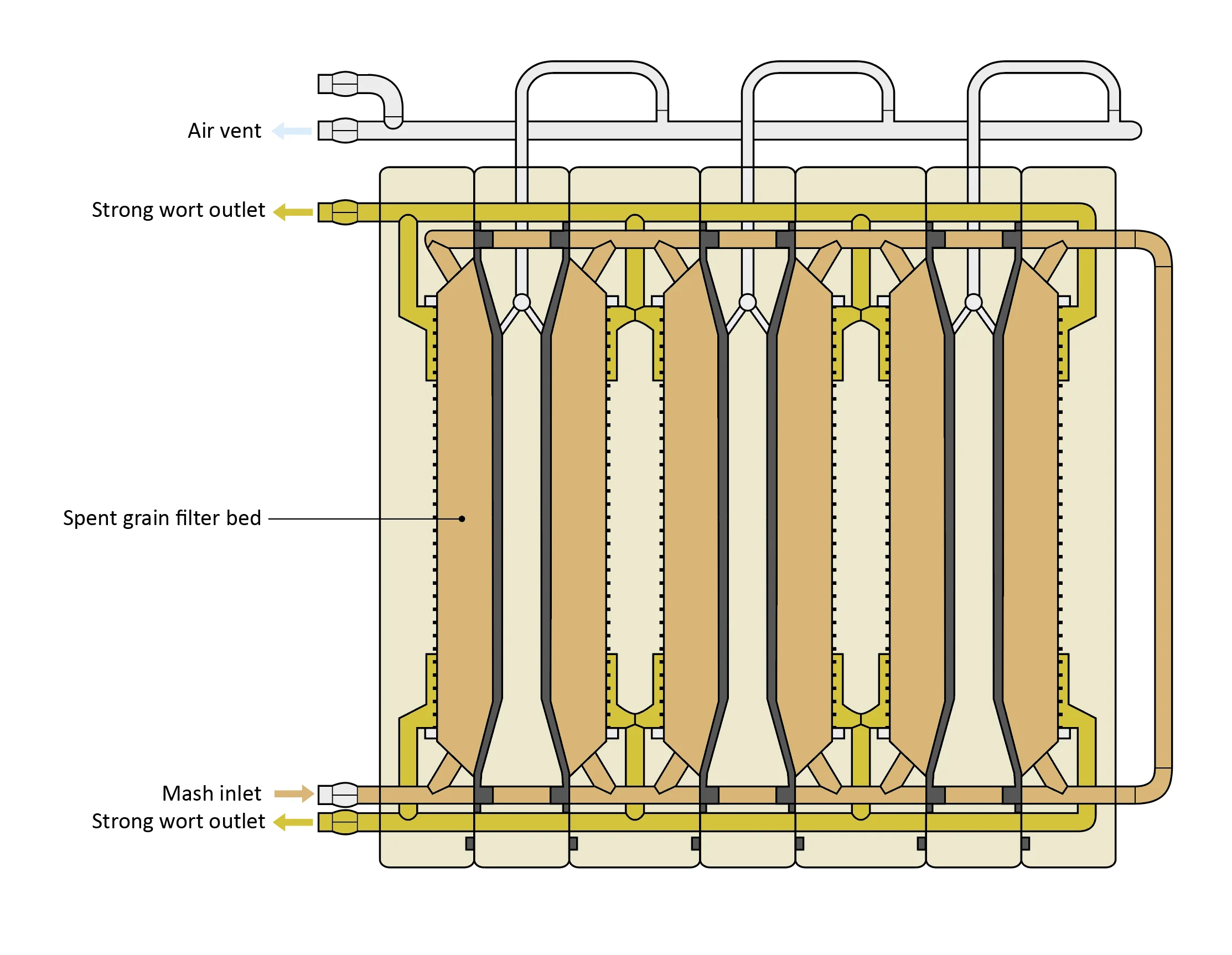
Figure: Mash Filter grain bed formation
The pumped mash slurry enters each chamber simultaneously until all the chambers are full. At this point, about 70% of the mash is still left in the mash conversion vessel. Continued pumping of the mash forces strong wort through the filter cloths, and out of the filter plate outlet ports. Strong worts collection has now started; there is no first worts recirculation. The grain continues to concentrate in the chambers, providing additional filtration to that of the filter cloths. Upon completion of mash transfer, the grain bed depth in each chamber is around 40 mm.
There is a very significant difference in grain bed depth between the lauter tun at approximately 500 mm and the mash filter at 50 mm. So, looking at the Darcy equation:
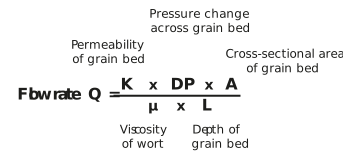
Figure: The Darcy equation for filter flow rate
The equation shows us that if we reduce grain bed depth  , the wort flow rate
 will increase. The shallower grain bed of the mash filter will allow higher wort flow.
This equation also shows us that if we increase the filter surface area  , we will get a flow increase. A shallower grain bed can only be provided by increased filter surface area. So the shallower grain bed and higher surface area provided by the mash filter both allow higher wort flows than for the lauter tun.