
Lesson 2 - Mashing Biochemistry
This lesson deals with the biochemical aspects of mashing. We will meet the main substrates and the enzymes that break them down. We will learn what enzymes are, how they operate and how they are affected by the environment of the mash. Finally, we will cover how starch is gelatinised, liquefied and saccharified to make a wort with the desired sugar spectrum.
Saccharification
As you probably guessed, saccharification means to convert into sugar. It is the most important process in mashing and determines the amount and the fermentability of the extract we produce from the mash.
Saccharification is a team effort with α-amylase, β-amylase and limit dextinase working together. α-Amylase acts randomly apart from around the α-(1,6) bonds producing a random selection of polysaccharides and the occasional disaccharide. The action of α-amylase provides more non-reducing ends for β-amylase to work on.
In the absence of α-amylase, β-amylase would typically only convert 10-15% of amylopectin to maltose. Great news if we are producing low alcohol beers but otherwise a very bad thing!
The figure below shows the action of α-amylase.
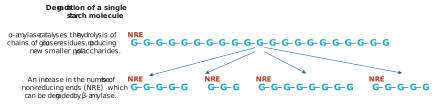
Figure: The production of more NREs
Further (significantly fewer) non-reducing ends are provided by limit dextrinase.
Theoretically speaking, if mashing were to go on indefinitely, glucose would be the only thing left of the starch. In reality, the enzymes wouldn’t survive that long, and in any case, we will have other brews waiting!
Mashing should take the minimum time to achieve a wort of the target sugar spectrum. It should go without saying that this sugar spectrum does not include starch! Starch residues (very large dextrins) can cause hazes and filtration problems. To check that no starch remains, we can conduct a starch endpoint (iodine) test using a sample from the mashing vessel. If starch is present within the sample, it will stain blue-black once iodine has been added. If starch is not present in the sample, only the red/brown colour of the iodine will remain.
Very large dextrins can give a colour change that is difficult to decipher. If these are suspected, a more sensitive test is used where the dextrins are removed and precipitated in ethanol, and the precipitate is stained with iodine. We can also check for these using a spectrophotometer to measure the absorbance at 570 nm produced by starch residues. The latter two tests would typically only be used if a problem is identified downstream.
When mashing, we do not aim for complete saccharification to fermentable sugars. We aim for a degree of fermentability depending on the specification for that brand. A successful mash should provide a wort that ferments to a target final gravity. The key thing is consistency. We will discuss the process and technology used to achieve this in the rest of this unit.