
Lesson 2 - Mashing Biochemistry
This lesson deals with the biochemical aspects of mashing. We will meet the main substrates and the enzymes that break them down. We will learn what enzymes are, how they operate and how they are affected by the environment of the mash. Finally, we will cover how starch is gelatinised, liquefied and saccharified to make a wort with the desired sugar spectrum.
Non-Starch Polysaccharides (NSP)
There are no prizes for guessing what an NSP is! Hopefully, if you did guess, you would have said they are any polysaccharide we encounter that isn’t starch. The classification NSP covers all foods, but we will restrict our discussion to those derived from cereals. If you are brewing with beans, potatoes, or insects, you will have to research those separately!
Before this lesson, you may not have heard the term NSP, but undoubtedly you would have heard of their other name, dietary fibre. NSPs are a hot topic in human nutrition as they are thought to contribute to the health of your intestines and can help to lower cholesterol.
NSPs are primarily found in the cell walls and are the cereal equivalent of an animal skeleton. Here’s a selection.
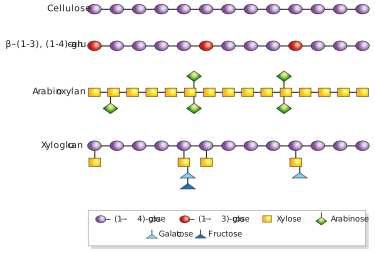
Figure: Examples of non-starch polysaccharides (NSPs)
For the purposes of classification, NSPs are split into water-soluble and water-insoluble forms. Water-insoluble NSPs include cellulose, galactomannans, xylans, xyloglucans and lignin. The water-soluble NSPs are the pectins, arabinogalactans, arabinoxylans and β-(1,3)(1,4)-D-glucans (β-glucans).
NSP naming can get confusing
Cellulose is an insoluble glucose polymer made up entirely of glucose residues connected by β-(1,4)-glycosidic bonds. Hemicellulose is a term for partially soluble polymers of glucose and other sugars. Hemicelluloses include arabinogalactans, arabinoxylans and β-glucans. In brewing, we tend to use the term pentosans rather than arabinoxylans. Pentosans are polymers of pentoses. So arabinoxylan is a name given to forms of hemicellulose and pentosans that can be insoluble and partially soluble! You can see why we said it can get confusing.
We make use of some of the above listed insoluble NSPs (principally lignin and hemicellulose) in the form of husk during wort separation and need to do all we can to avoid two of the soluble NSPs at all stages of beer production. These are β-glucans and pentosans. The bad news is that barley endosperm cell walls contain around 70-75% β-glucan, 20-25% pentosan, along with 5% protein and insoluble material (holocellulose), The good news is that they are substantially degraded during the germination stage of the malting process.
β-glucans
Like starch, β-glucans are a glucose polymer. Unlike starch, the glucose molecules that form the polymer are β isomers (hence the name). β-Glucan molecules are long and unbranched and align with each other in parallel, held in place by hydrogen bonds. The strands of β-glucan molecules are cross-linked by small proteins, increasing their structural stability.
The amount of β-glucans in malt depends on variety and the degree of modification. Even a well-modified malt made from a barley rich in β-glucans can have high β-glucan levels. Most malt specifications and certificates of analysis from suppliers will detail the β-glucan level in a standard wort produced from the malt. A maximum of 100 mg/L is typical. It is important that we set this specification because, as we will find out later in the unit, we have a limited capacity to degrade β-glucans during mashing. The structure of β-(1,3)(1,4)-D-glucan is shown in the figure below.
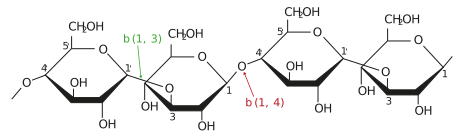
Figure: Cereal β-glucan structure
Pentosans
Pentosans are formed from pentose sugars, including arabinose and xylose (hence the term arabinoxylan). Although the amount of pentosan in barley is less than β-glucan, it is degraded less completely during the malting process, so it can still be significant. Wheat contains higher levels of pentosans (70% of wall polysaccharides), so they become much more significant in mashes containing wheat.
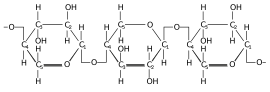
Figure: Pentosan structure
The effects of pentosans and β-glucans
We said earlier that it is a good idea to minimise the amount of pentosans and β-glucans at every stage of the brewing operation. Another term for these NSPs is gums, and that gives us a clue about the problems they cause. The horrible things they can do to our process and beer are:
-
Increase wort viscosity (slowing wort separation)
-
Reduce extract efficiency
-
Block filters
-
Form hazes and precipitates in beer
That said, eliminating them completely is not possible, and there is some evidence that they contribute to foam stability and palate fullness in beer.
After covering molecules that have a positive impact on foam, we will now move on to those that actively destroy it, lipids.