
Lesson 2 - Mashing Biochemistry
This lesson deals with the biochemical aspects of mashing. We will meet the main substrates and the enzymes that break them down. We will learn what enzymes are, how they operate and how they are affected by the environment of the mash. Finally, we will cover how starch is gelatinised, liquefied and saccharified to make a wort with the desired sugar spectrum.
Starch Gelatinisation and Liquefaction
Starch is relatively insoluble in water. This gives us a bit of a problem because that’s where we need to convert it into sugar. Fortunately, when we heat the starch molecule in the presence of water, something wonderful occurs. That something is gelatinisation.
Gelatinisation is easier to understand if we think about the action of heat on molecules. At a molecular (and even atomic) level, heat causes molecules to vibrate and move. The higher the temperature, the greater the movement and strain on the bonds within the molecule. The movement helps water enter the starch granule, breaks intermolecular bonds, and ultimately disrupts its structure.
During heating, water first enters the amorphous parts of the starch granule, causing it to swell. The water then moves from the amorphous regions into the crystalline regions. As the process continues, crystalline regions become amorphous, and the amylose chains from the amorphous regions start to dissolve in the water. The heat changes an ordered insoluble structure into a disordered one that allows water in, forming a gel (hence the name!).
In cooking, we thicken sauces by adding starch (flour) and then gelatinising it. It is also the reason we can eat spaghetti and rice without breaking our teeth!
In practice, gelatinisation takes place over a range of temperatures rather than at one single temperature. It is also important to realise that when you see a range for gelatinisation temperatures, these are the starting temperatures, not a band in which gelatinisation occurs. Think of when you boil spaghetti (wheat starch) at 100°C for 10 minutes; the spaghetti doesn’t stop going soft as soon as it gets above 54°C!
The ranges of gelatinisation temperature for various cereals are indicated in the following figure.
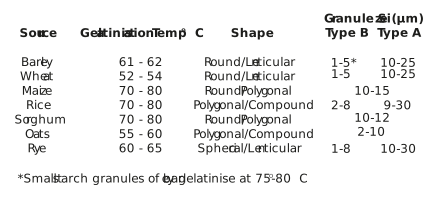
Figure: Cereal gelatinisation temperatures
As we can see, gelatinisation temperatures vary from cereal to cereal. They also vary depending on variety and indeed from harvest to harvest. The structure of the starch granule and proportions of amylose and amylopectin both affect its gelatinisation temperatures.
In the mash, following starch gelatinisation, the viscosity will rapidly decline. This is due predominantly to the ɑ-amylase catalysing the hydrolysis of the starch chains.
If only β-amylase was present, it would slowly degrade starch into maltose units, and we would see the viscosity drop more slowly.
The liquefaction of the starch is, of course, vital to extract recovery but also allows us to pump and mix the mash in the mash conversion vessel more easily. In cereal cookers undertaking the gelatinisation of rice and maize, some milled malt or heat stable exogenous α-amylase is often added to prevent the adjunct slurry from setting (gelling) and damaging the agitator.
If we do not hydrolyse the gelatinised starch and the temperature falls, the starch molecules realign themselves into a more ordered structure. This is called retrogradation. Once this occurs, enzymes can no longer access the molecules. This never happens in mashing vessels but can occur if something goes seriously wrong in the cereal cooker.
The increase in mash viscosity caused by gelatinisation without hydrolysis is sometimes mistaken for retrogradation.