
Lesson 2 - Mashing Biochemistry
This lesson deals with the biochemical aspects of mashing. We will meet the main substrates and the enzymes that break them down. We will learn what enzymes are, how they operate and how they are affected by the environment of the mash. Finally, we will cover how starch is gelatinised, liquefied and saccharified to make a wort with the desired sugar spectrum.
Exogenous Enzymes
From our discussion of mashing so far, it should be apparent that malt doesn’t always provide the exact blend of enzymes to achieve the perfect mash. There is, however, another option. Exogenous means from outside, which in the case of mashing enzymes is from a source other than barley. Commercial exogenous enzymes can allow us to give nature a helping hand in the mash.
To produce commercial enzymes, a micro-organism (bacterium or fungus) is selected on the basis of its ability to produce high yields of the enzyme. The table below shows the typical organisms used to produce the exogenous enzymes used in brewing.
Table: Typical organisms used to produce the exogenous enzymes used in brewing
|
Enzyme |
Source |
|
Protease |
Aspergillus niger |
|
α-Amylase |
Bacillus, Aspergillus |
|
β-Amylase |
Bacillus, Streptomyces, Rhizopus |
|
Glucose oxidase |
Aspergillus, Rhizopus |
|
Pullulanase/limit dextrinase |
Bacillus, Klebsiella, Aureobasidium |
|
Amyloglucosidase |
Aspergillus niger |
These organisms are grown in a suitable medium containing all the nutrients required for growth. The organisms are then transferred to a fermenter, where they produce the enzymes. Fermentation is carried out as a submerged culture (like a brewery fermentation) or solid-state fermentation (microbes grown on solid support structure). The most popular method is a submerged culture. This is due to its higher enzyme yield and lower risk of infection by unwanted organisms. Solid-state fermentations are used to a lesser extent to produce fungal enzymes like amylases, cellulases, proteases and pectinases.
Depending on the organism used, the required enzyme is either released into the medium or can remain within the organism’s cell. If the enzyme remains inside the organism, the cell first needs to be disrupted. The cell material must then be removed by precipitation and/or filtration. The removal of cell material is followed by purification of the enzymes by electrophoresis or chromatography which separate them on the basis of their charge. Some enzymes are also purified by crystallisation. It is not always possible to completely purify enzymes, and sometimes they can be contaminated with small amounts of other enzymes. For example, a commercial β-amylase enzyme product can contain small amounts of proteases.
The figure below shows the process flow for the production of exogenous enzymes from micro-organisms.
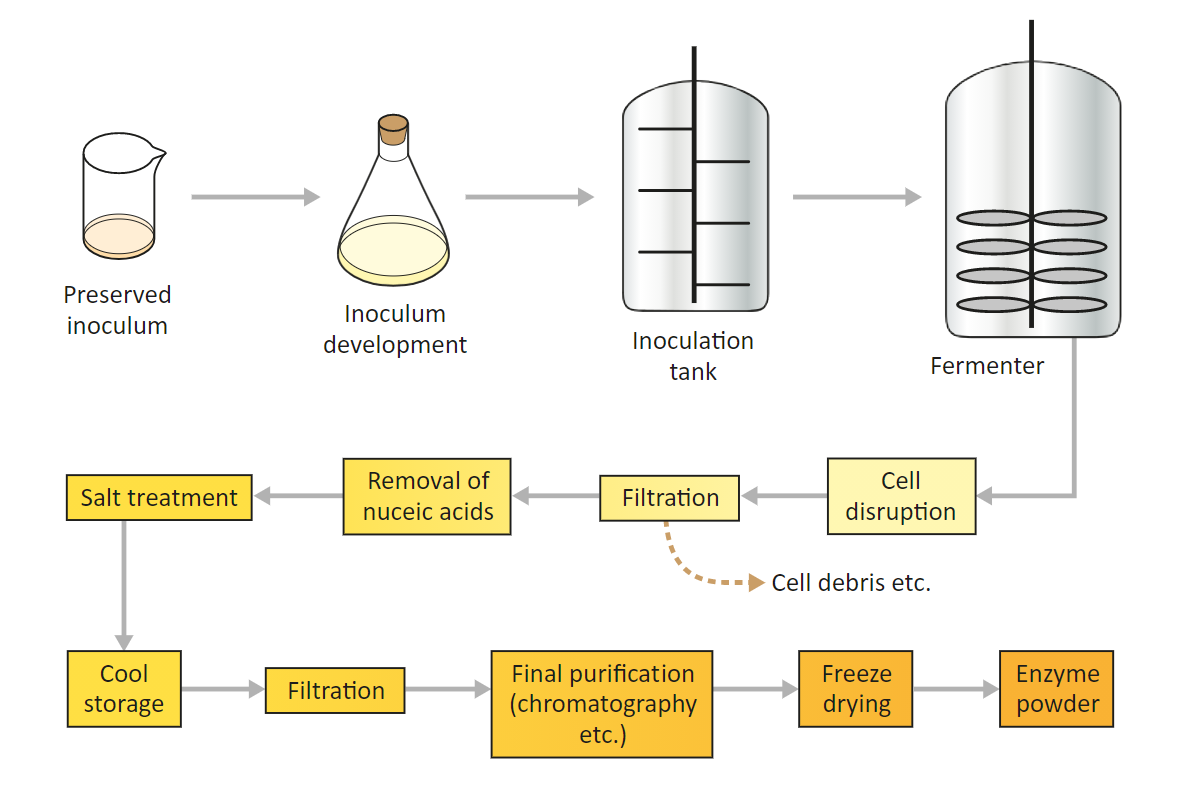
Figure: Process flow for the production of exogenous enzymes from micro-organisms
The link below provides more information about commercial enzyme production and use.
The addition of exogenous enzymes at various steps during the brewing process can make brewing easier, faster, and more consistent. They allow brewers more flexibility in the choice of raw materials due to less dependence on malt enzymes. They also provide an opportunity to create new products like gluten-reduced beer.
If there is not enough enzyme activity in the mash, there will be several undesirable consequences:
-
The extract yield will be too low
-
Wort separation will take too long
-
The fermentation process will be too slow
-
Too little alcohol will be produced
-
The beer filtration rate will be reduced
-
The flavour and stability of the beer will be inferior
To help overcome these problems, exogenous enzymes can be used to supplement the malt-derived enzymes.
Furthermore, exogenous enzymes are used to ensure better starch liquefaction with the use of adjuncts, which can dilute the original enzyme concentration from our malt. They can also be used to produce low-carbohydrate beer, to shorten beer maturation time, and to produce beer from non-traditional brewing raw materials.
The various brewing operations, where commercial enzymes can be added, are shown below:
Table: Steps of the brewing process where commercial enzymes are used
|
Operation |
Enzymes |
Enzyme action |
Function |
|
Cereal cooking or decoction |
α-Amylase |
Hydrolyse starch |
Liquefies adjunct starch Reduces viscosity |
|
β-Glucanase |
Hydrolyse glucans |
Aids in filtration |
|
|
Mashing |
α-Amylase |
Hydrolyse starch | Compensates for suboptimal levels in malt |
|
Amyloglucosidase |
Increase glucose |
Increases fermentable sugar percentage |
|
|
De-branching enzyme |
Hydrolyse α-(1,6) branch bonds |
Increases wort fermentability |
|
|
Protease |
Increase soluble protein and FAN |
Compensates for suboptimal levels in malt Improves yeast growth |
|
|
β-glucanase |
Hydrolyse glucans |
Improves extract and wort separation |
|
|
Pentosanase / Xylanase |
Hydrolyse pentosans and xylans |
Improves extraction and beer filtration |
|
|
Fermentation |
Fungal α-amylase |
Increase maltose and glucose |
Increases fermentable sugar percentage |
|
β-Glucanase |
Hydrolyse glucans |
Reduces viscosity and aids in filtration |
|
|
α-Acetolactate-decarboxylase (ALDC) |
Convert α-acetolactate to acetoin |
Prevents diacetyl formation |
|
|
Amyloglucosidase (AMG) |
Increase glucose |
Increases proportion of fermentable sugars |
|
|
Conditioning |
Protease |
Hydrolyse proteins and polypeptides |
Prevents haze formation |
|
|
Proline specific protease |
Hydrolyse proline containing proteins and polypeptides |
Produces gluten-free or gluten-reduced beer |