
Lesson 2 - Mashing Biochemistry
This lesson deals with the biochemical aspects of mashing. We will meet the main substrates and the enzymes that break them down. We will learn what enzymes are, how they operate and how they are affected by the environment of the mash. Finally, we will cover how starch is gelatinised, liquefied and saccharified to make a wort with the desired sugar spectrum.
Protein Degrading Enzymes
Proteases help provide the FAN for our yeast but left to continue their work for too long can reduce foam stability and the body of the beer. Too much FAN can also detrimentally increase beer colour and flavour and cause it to stale more rapidly.
Proteases
A protease, also called a peptidase or proteinase, is an enzyme that catalyses proteolysis. Endoproteases catalyse the hydrolysis of bonds at specific points in the protein molecule but not at the ends of the chains of amino acid residues. Exoproteases, on the other hand, catalyse the hydrolysis of bonds in the protein molecules at the end of the chains of amino acid residues. Sound familiar?
In some literature, endoproteases are called proteases and exoproteases are called peptidases.
There is a range of endoproteases active during mashing, with each acting on specific parts of the protein molecule. The concentration of endoproteases is lower than the exoproteases, and this limits the extent to which protein in the mash can be broken down.
Carboxypeptidases and aminopeptidases
These are both proteases with rather long names!
Carboxypeptidases catalyse the hydrolysis of peptide bonds in the protein molecules at the carboxyl end of the chain of amino acid residues. Aminopeptidases catalyse the hydrolysis of peptide bonds in the protein molecules at the amino end of the chain of amino acid residues. As you could have guessed, they are both classed as exoproteases.
Aminopeptidases and carboxypeptidases produce the majority of the soluble nitrogen required for yeast nutrition. Their activity is increased by the availability of sulphate ions.
With an optimum temperature of around 50°C, all protease enzymes are classed as heat sensitive. As a result of their heat sensitivity, many are denatured during kilning, so there is an insufficient supply in malt to hydrolyse significant amounts of protein in the mash. It is, therefore, important that the barley proteins are sufficiently degraded in the malting process (unless we are using exogenous proteolytic enzymes, of course).
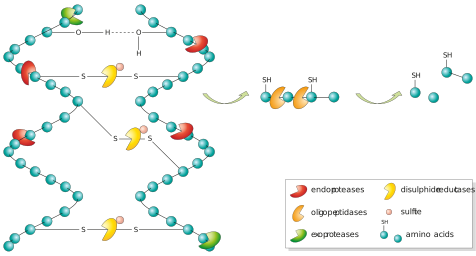
Figure: Protein degrading enzymes
β-Glucan solubilase
Although acting close to β-glucan molecules and having β-glucan in its name, β-glucan solubilase is a carboxypeptidase. β-Glucan solubilase catalyses hydrolysis of the protein cross-links between the strands of β-glucan molecules.
β-Glucan solubilase is relatively heat stable and has an optimum temperature of 60°C. This can cause problems when mashing because it releases the long chains of glucose residues into the mash at a temperature that is too high for the β-glucanase enzymes to survive. These long chains of glucose residues significantly increase the viscosity of wort and cause the problems associated with β-glucans that we described earlier. As with proteins, unless we can use exogenous enzymes, it is essential that β-glucans are extensively broken down during the malting process. The figure below shows the stages of β-glucan breakdown. This occurs in malting to a greater extent than in mashing.
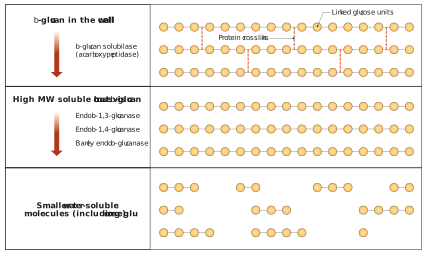
Figure: β-glucan breakdown