
Lesson 2 - Mashing Biochemistry
This lesson deals with the biochemical aspects of mashing. We will meet the main substrates and the enzymes that break them down. We will learn what enzymes are, how they operate and how they are affected by the environment of the mash. Finally, we will cover how starch is gelatinised, liquefied and saccharified to make a wort with the desired sugar spectrum.
Starch Degrading Enzymes
The starch degrading enzymes are the most important enzymes in mashing. Providing conditions in which they can thrive is key to successful mashing. Let’s find out more about our most important enzymes.
α-Amylase
α-Amylase is an endoenzyme (endo means ‘within’). It catalyses the hydrolysis of starch at any point of the molecule apart from the end of each chain.
-
It can only catalyse the hydrolysis of α-(1,4) glycosidic bonds but not those immediately next to α-(1,6) bonds.
-
It works at random but not at the end of the chains of glucose residues to produce an array of di and trisaccharides and dextrins.
-
It is a very rapid acting enzyme that reduces the viscosity of a starch solution.
Its optimum temperature is 70-75°C, and its inactivation temperature is 75-80°C. It is therefore described as heat stable.
It is primarily responsible for starch liquefaction and the extract yield and is often called the liquefaction enzyme.
β-Amylase
β-Amylase is an exoenzyme (exo means ‘from outside’) and works on the ends of the chains of glucose residues. It is slower acting than ɑ-amylase.
-
It can only catalyse the hydrolysis of α-(1,4) glycosidic bonds.
-
It catalyses the hydrolysis of α-(1,4) bonds, starting only from the non-reducing end of the starch chain. It only produces the disaccharide maltose.
-
It cannot catalyse the hydrolysis of α-(1,4) glycosidic bonds immediately next to α-(1,6) bonds.
The optimum temperature of β-amylase is 63-65°C. Its inactivation temperature is 68-70°C. As it is inhibited and inactivated at lower temperatures than α-amylase, it is called a heat labile enzyme.
As β-amylase produces maltose, it is called the enzyme of saccharification, and its activity defines wort fermentability. The figure below shows β-amylase in action.
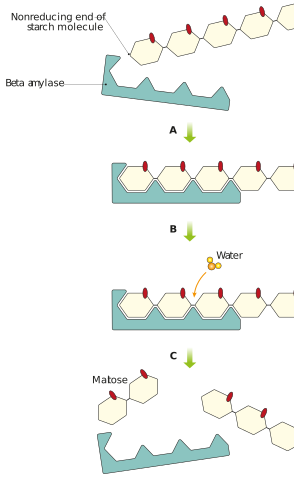
Figure: β-amylase in action