
Lesson 2 - Mashing Biochemistry
This lesson deals with the biochemical aspects of mashing. We will meet the main substrates and the enzymes that break them down. We will learn what enzymes are, how they operate and how they are affected by the environment of the mash. Finally, we will cover how starch is gelatinised, liquefied and saccharified to make a wort with the desired sugar spectrum.
Mashing Enzymes
Without enzymes, we could not brew or, for that matter, survive. Before we get into the specifics of mashing enzymes, let’s build a little foundational knowledge of these wonderful little proteins.
Brewing literature almost always uses poetic license when describing enzyme action. Enzymes are said to attack, cleave, break down and split bonds like little pairs of scissors when in reality, they never touch the bond. Enzymes enable reactions to occur more easily, they don’t perform them.
Enzymes are biological catalysts that increase the rates of specific chemical reactions. They work by reducing the amount of energy required for a reaction to occur. Much of this effect is due to the enzyme positioning the substrates in an orientation that favours the reaction. The enzymes and substrates form a complex before the reaction occurs. This means they need to fit together for anything to happen. Therefore, specific enzymes only work on specific substrates, catalysing specific reactions. This relationship is illustrated by the lock and key model shown below.
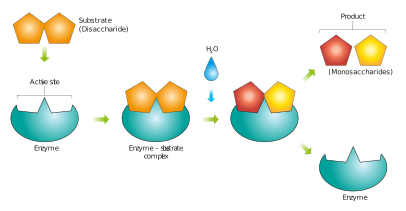
Figure: Lock and key model of enzyme action
The ability of the enzyme to form a complex with the substrate, as is the case with a key fitting a lock, depends on its shape. Conditions that affect the shape of the proteins making up the enzyme affect its ability to catalyse reactions. High temperatures, excessively high or low pHs and the absence of cofactors can change the shape of the enzyme and reduce its effectiveness.
Above a certain temperature (or beyond a specific pH range), the chemical structure (shape) of the enzyme can be permanently changed, and can no longer catalyse reactions. This is called denaturation.
Many enzymes need cofactors to operate. Cofactors are typically metal ions. A mashing example is ɑ-amylase which needs calcium ions. An increase in calcium ions up to a certain level also stabilises ɑ-amylase against the effects of heat. As well as cofactors, some enzymes need coenzymes. These are organic molecules that assist the enzyme in catalysing the reaction.
There are four classes of mashing enzymes found in barley. They catalyse:
-
The hydrolysis of starch
-
The hydrolysis of proteins
-
The hydrolysis of non-starch polysaccharides
-
The hydrolysis and oxidation of lipid compounds and fatty acids
The word hydrolysis comes from the ancient Greek word hydro, meaning water and lysis, meaning to loosen or unbind. Hydrolysis is the breaking of a bond with the addition of water. It is the opposite of the condensation reaction we met earlier.
The key to getting enzymes to work best for us in the mashing vessel is controlling temperature and pH, so they are optimum for their operation. We will find out more about the effect of temperature and pH next.