
Lesson 2 - Mashing Biochemistry
This lesson deals with the biochemical aspects of mashing. We will meet the main substrates and the enzymes that break them down. We will learn what enzymes are, how they operate and how they are affected by the environment of the mash. Finally, we will cover how starch is gelatinised, liquefied and saccharified to make a wort with the desired sugar spectrum.
Polyphenols
Polyphenols have a generally bad reputation in brewing. Most of the polyphenols found in beer are derived from malt and therefore extracted during mashing and wort separation. Let’s find out some more about polyphenols and how they are affected by mashing.
The name polyphenol comes from the Greek ‘polus’, meaning ‘many’. A phenol is formed by attaching a hydroxyl (OH) group (like that in alcohols) to a phenyl ring, and thus the -ol suffix. The fact that single molecules are given the name poly can get confusing when we are talking about a polyphenol polymer!
Polyphenols are made up of two or more phenol rings. They range from relatively small molecules to very large ones (polymers of polyphenols). The figure below shows the structure of tannic acid, which is a type of polyphenol and is used as a beer stabilising agent.
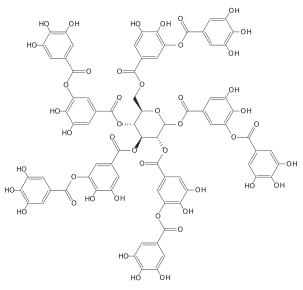
Figure: Tannic acid structure
Phenolic material in beer and wort may be divided into four classes in increasing size:
1. Simple phenol-based molecules (derived from hydroxyl benzoic or cinnamic acid), mostly from malt
2. Flavanols (also called flavan-3-ols) with a more complex structure made up of phenol-based molecules (catechin, epicatechin, gallocatechin, and epigallocatechin)
3. Proanthocyanidins (also called anthocyanogens, flavanoids and polymeric flavanols), that are dimers and trimers of the flavanols
4. Complex flavanols that only exist in water soluble association with polypeptides
Given that polymer means formed from many molecules, it shouldn’t come as a surprise that dimer and trimer mean formed from two and three molecules, respectively!
Polyphenols combine with proteins to form trub during wort boiling and haze in beer. The polyphenols active in haze formation are the flavanols and their derivatives, which make up around 10% of all beer polyphenols. The most significant polyphenols in haze formation, are proanthocyanidins. The figure below shows the structure of beer flavanols and proanthocyanidins.
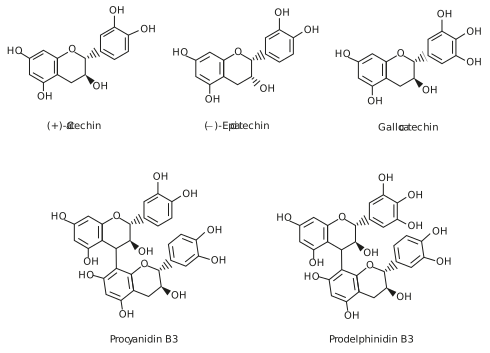
Figure: Beer flavanols and proanthocyanidins
The two proanthocyanidins shown are particularly important for haze formation.
Polyphenols are easily oxidised. There are two schools of thought about this in brewing. One is that this is a good thing because polyphenols remove the oxygen that might otherwise damage beer flavour. The other is this is a bad thing as they store the oxygen and pass it on to form the stale off flavours at a later stage. There is evidence to support both views. One aspect of polyphenols that is good news for flavour stability, is their ability to form complexes with metal ions that can catalyse flavour staling reactions, thus preventing them from doing so.
Polyphenols are also said by some to impart an astringent palate to beer, but there is also evidence that some polyphenols can increase palate fullness. It is possible that there are good and bad polyphenols in this regard.
Most of the polyphenols in beer and all of the polyphenols encountered in mashing (unless you are, for some reason adding hops to the mash) come from malt. Polyphenols in malt are concentrated in the husk and the pericarp, and testa. Higher kilning temperatures make these polyphenols easier to extract. The mashing process both extracts and breaks down polyphenols. Milling and mashing practices that increase the dissolution of the husk fraction, therefore, extract more polyphenols. Higher temperatures such as those used in decoction mashing also increase their extraction.
This concludes our look at substrates. Now we can move on to cover the stars of the mashing show, the enzymes.