
Lesson 2 - Mashing Biochemistry
This lesson deals with the biochemical aspects of mashing. We will meet the main substrates and the enzymes that break them down. We will learn what enzymes are, how they operate and how they are affected by the environment of the mash. Finally, we will cover how starch is gelatinised, liquefied and saccharified to make a wort with the desired sugar spectrum.
Lipids
The term lipid describes a set of macromolecules that are very poorly soluble in water and, for the most part, hydrophobic. Lipids include triglycerides (fats and oils), waxes, phospholipids, and steroids.
As we might expect (by appreciating the effect of consuming them excessively), the main biological function of lipids is storing energy. They are also used as precursors to hormones, for protection and lubrication and as structural components of cell membranes. The most plentiful lipids encountered in mashing are:
-
Triglycerides – three fatty acids connected to a molecule of glycerol (there are also mono and di glycerides with one and two fatty acids, respectively)
-
Phospholipids – composed of a hydrophilic head with a phosphate group and two hydrophobic fatty acid tails
-
Sterols – a gonane molecule with a hydroxyl (OH) group attached
The figure below shows an example of each type along with a free fatty acid.
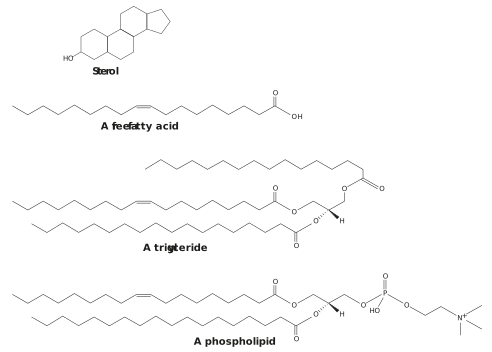
Figure: Forms of lipids
As well as making up glycerides and phospholipids, fatty acids are found on their own and are called free fatty acids. Fatty acids are chains of carbon atoms terminating in a carboxyl group. If every carbon in the chain has the maximum number of hydrogen atoms attached, it is called a saturated fatty acid; if not, it is called an unsaturated fatty acid. The two types are shown in the figure below.
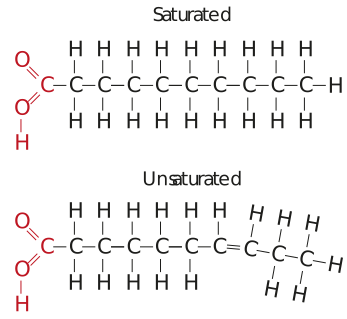
Figure: Saturated and unsaturated fatty acids
Saturated fatty acids make up fats, while unsaturated fatty acids make up oils. The straighter shape of the saturated fatty acid molecule is what makes fats solid.
Above a certain level, lipids are detrimental to beer. They are thought to:
-
Reduce foam potential
-
Reduce flavour stability
-
Play a part in the cause of gushing (over foaming when opened) in beer
-
Varying fatty acid levels causes inconsistent ester formation during fermentation
A small amount of lipid material is, however, beneficial. Unsaturated fatty acids and sterols benefit yeast, improving fermentation performance, yeast viability and tolerance of alcohol.
Malted barley contains around 3% lipids by weight, while wheat and rye are slightly lower at around 2%. The amounts vary slightly with the variety of each cereal. The majority of these lipids are triglycerides with a few sterols. The lipids in barley are concentrated in the aleurone and embryo of the grain, while some fatty acids are associated with the helices of amylose in the starch granules of the endosperm. That said, because the endosperm is so large it contains the majority of the lipid material in the grain.
Were we to extract all of these lipids during mashing, we would be in trouble. Fortunately, as we discovered at the start of this section, they are mostly insoluble in water, so only a minor proportion make it into the wort. Less than 5% of malt lipids make it into wort, the amount extracted depends on how we mash. Of those that do make it into the wort, next to none make it into the beer as they are lost throughout the brewing process. While triglycerides are the most plentiful lipid in malt, in wort free fatty acids predominate because they are soluble. Lipase enzymes from malt catalyse the hydrolysis of malt triglycerides to form free fatty acids.
The extraction of lipids during mashing is increased by:
-
Using finer grist
-
Increased agitation
-
Producing turbid (cloudy) worts
-
Thinner mashes (high water: grist ratios)
The composition of fatty acids in the wort is affected by the variety of malt used and the activity of the enzymes catalysing their release during mashing. This activity depends on the temperature of the mash, with different enzymes working optimally at different temperatures. Much more on this later.
Mashing, lipids, and beer staling
While it might seem odd, what we do very early in the brewing process has a significant impact on how quickly the finished beer goes stale, and lipids can be to blame. One particular unsaturated fatty acid (linoleic acid) is thought to have a major role in beer staling. Linoleic acid is oxidised during mashing forming a precursor to E-2-nonenal. Once in the package, the precursor is converted to E-2-nonenal, giving the beer a stale, cardboard-like aroma. The oxidation during mashing happens spontaneously (autooxidation) and is also catalysed by enzymes from the malt called lipoxygenase (LOX). To minimise the oxidation of lipids during mashing, we can:
-
Mash in at high temperatures (> 65°C) to reduce LOX activity
-
Mash at a low pH (around 5.1)
-
Mill more coarsely to reduce LOX availability when oxygen levels in the mash might be higher
-
Condition malt with 80°C water to deactivate LOX (using steep conditioning which we covered in the Milling Technology lesson)
-
Mash in as rapidly as possible
-
Mash at as high a temperature as possible (the solubility of oxygen in wort/mash declines as temperature rises)
-
Mill and mash in an oxygen-free environment
-
Use the antioxidant sulphur dioxide in the mash
-
Use a variety of barley with null LOX activity
The first three are not realistic options as they will significantly reduce extract efficiency, but we can still aim for a higher temperature and lower pH within a sensible range. Likewise, there is a limit to how high our mashing in temperature can be without affecting enzyme function, so this option is also limited.