
Lesson 2 - Mashing Biochemistry
This lesson deals with the biochemical aspects of mashing. We will meet the main substrates and the enzymes that break them down. We will learn what enzymes are, how they operate and how they are affected by the environment of the mash. Finally, we will cover how starch is gelatinised, liquefied and saccharified to make a wort with the desired sugar spectrum.
Ends (Termini) of Amylose and Amylopectin
You will remember that we described amylopectin as branched or ramified and amylose as straight and helical. This difference in shape leads to a significant difference in how the molecules are broken down during mashing. The key difference is in the number of ends and type of ends!
We can represent amylose as a chain, and being a chain, it has two ends.
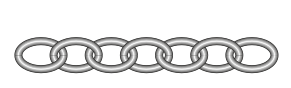
Figure: A chain structure
Due to its branched structure, amylopectin has many ends, as you can see from the figure of another famously branched structure.

Figure: A tree structure
In biochemistry, these ends are called termini (plural) or terminus (singular) but also just ends.
Reducing and non-reducing ends
You should remember from the adjuncts lesson the concept of a reducing sugar and how, on account of its free aldehyde group, glucose can reduce other compounds. As this lesson is about biochemistry, we can go into slightly more detail about this here. Reactions where a compound is reduced, are called redox reactions. The reason for this name is that it is not possible for one compound to reduce another without itself being oxidised. So, in the process of doing the reducing, the aldehyde group on the glucose molecule is oxidised, changing into a carboxyl group. This is shown in the figure below.
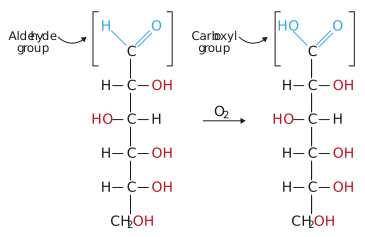
Figure: Oxidation of an aldehyde group into a carboxyl group
When an α-(1,4) glycosidic bond is formed, the carbon that was part of the aldehyde group is part of the bond, so the reducing properties are lost. This means that one end of a chain of glucose residues formed from α-(1,4) glycosidic bonds retains its reducing power. The other end of the chain where the carbon that was part of the aldehyde group is part of the last bond is a non-reducing end. This is shown in the figure below.
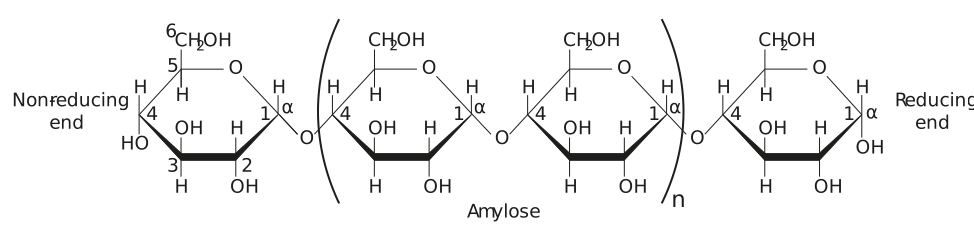
Figure: Reducing and non-reducing ends of amylose
If another molecule of glucose was bound to the reducing end of this molecule, it would become the new reducing end.
So, what does this mean for our two forms of starch?
1. Amylose – as you would expect, there is one non-reducing end and one reducing end.
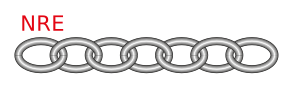
Figure: Amylose chain
2. Amylopectin – here, there are numerous non-reducing ends and only one reducing end. If we look again at the amylopectin structure, we can see that on the chain from α-(1,6) glycosidic bond, glucose residues are added to the non-reducing end of the last glucose residue meaning that the reducing end is lost in the bond. This means the last glucose residue on the chain from the α-(1,6) glycosidic bond has its non-reducing end exposed.
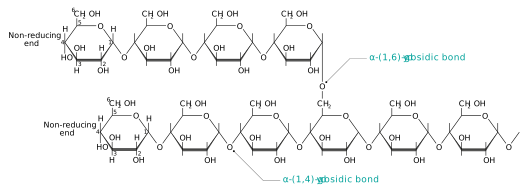
Figure: Amylopectin with non-reducing ends on the left
So, going back to our rootless tree representation of the molecule, the non-reducing ends are at the tips of each branch, and the reducing end is the bottom of the trunk.
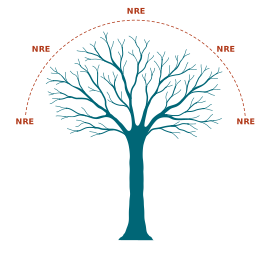
Figure: Amylopectin depicted as a tree
Why have we covered the ends of the starch molecules in such detail? This is because β-amylase, the enzyme that produces most of the maltose in the mash, can only approach the starch molecule from the non-reducing end. The fewer the non-reducing ends, the slower the saccharification of the starch.
By way of a summary, let’s compare the two components of starch.
Table: Comparison of amylose and amylopectin
|
Amylose |
Amylopectin |
|
Straight, helical molecule |
Branched molecule |
|
Minor component of starch |
Major component of starch |
|
Insoluble |
Soluble |
|
Stains blue with iodine |
Stains reddish-brown with iodine |
|
α-(1,4) glycosidic bonds |
α-(1,4) and α-(1,6) glycosidic bonds |
|
Resistant to digestion by humans |
Readily digested by humans |
|
Single non-reducing end |
Numerous non-reducing ends |