
Lesson 2 - Mashing Biochemistry
This lesson deals with the biochemical aspects of mashing. We will meet the main substrates and the enzymes that break them down. We will learn what enzymes are, how they operate and how they are affected by the environment of the mash. Finally, we will cover how starch is gelatinised, liquefied and saccharified to make a wort with the desired sugar spectrum.
Amylopectin – The Branched One
As we said earlier, amylopectin is quite different to amylose. Let’s find out more.
Any cereal starch that is not amylose is amylopectin, therefore it makes up 67-81% (by weight) of most starches. Amylopectin is a much larger molecule than amylose with molecular weights of 2x10⁶ to 4x10⁸, typically consisting of 2,000-200,000 glucose residues.
The branched (or, to give it its scientific name, ramified) nature of amylopectin is similar to that of a tree (without roots). Multiple main branches grow from the trunk, from which many further branches grow. Branching takes place with α-(1,6) bonds occurring every 24 to 30 glucose residues. In total, around 6% of glucose residues have α-1,6 bonds. The figure below shows the α-(1,4) and α-(1,6) glycosidic bonds in amylopectin.
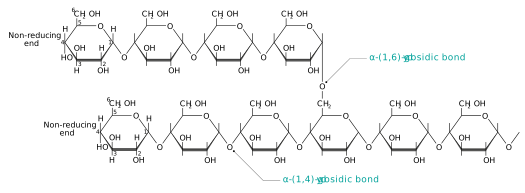
Figure: α-(1,6) and α-(1,4) glycosidic bonds in amylopectin