
Lesson 2 - Mashing Biochemistry
This lesson deals with the biochemical aspects of mashing. We will meet the main substrates and the enzymes that break them down. We will learn what enzymes are, how they operate and how they are affected by the environment of the mash. Finally, we will cover how starch is gelatinised, liquefied and saccharified to make a wort with the desired sugar spectrum.
Amylose – The Straight (and helical) One
Considering they are both made of the same molecules and classified together, the two components of starch are quite different. We start our discussion of starch molecules with amylose, the linear (well, linear and helical) one.
Amylose typically makes up 18-33% of starch (by weight). The actual percentage varies from cereal to cereal. It is predominantly located in the interior of the starch granules. The amylose molecule is an unbranched helical chain of glucose units with a molecular weight of 26-31x104. Each turn of the helix contains six glucose residues. In the chain, each glucose residue is linked to the next carbon by α-(1,4) glycosidic bonds.
If you are wondering why we have started calling the glucose molecules residues, it is because when bound in a polymer, they are no longer complete molecules. When each glycosidic bond is formed between the glucose molecules, a molecule of water is lost. They are therefore no longer complete glucoses, just residues of glucose.
In an α-(1,4) glycosidic bond, the 1-carbon atom on one glucose residue is bonded to the 4-carbon atom on the next glucose residue. We can see the α-(1,4) glycosidic bond in the figure below. We have also numbered the carbons so you can see where they get their name.
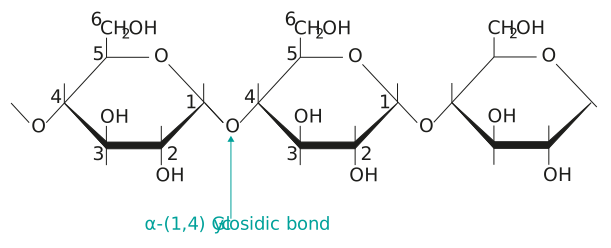
Figure: The α-(1,4) glycosidic bond with carbons numbered
A glycosidic bond is a term used for a covalent bond joining sugar molecules which are also called glycosides.
Another way to show the numbering convention for glucose carbon atoms is to represent the molecule as a line of carbon atoms. The carbons are numbered top to bottom, starting after the aldehyde (CHO) end.
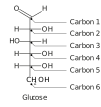
Figure: Linear representation of the glucose molecule showing carbon numbers
Both the ring and line representation of the glucose molecule do not reflect how the molecule looks in reality. Showing it as a chair-like structure is slightly better, but a 3D model is required to fully appreciate the shape.
We now understand why it’s called a (1,4) glycosidic bond, but why is it called an α-(1,4) glycosidic bond? This is due to the isomeric forms of the glucose molecule.
Isomers have identical molecular formulas but different arrangements of the atoms in space. They also often have very different properties. Glucose can exist as both an ɑ and β isomer based on the relative positions of the groups of atoms connected to carbon atom number 1. The two isomers are shown in the figure below.
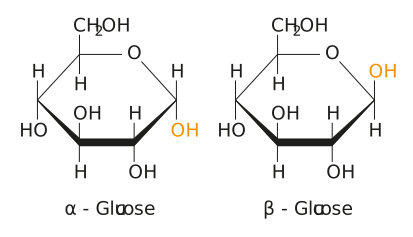
Figure: α and β glucose isomers
When a glycosidic bond (also called a glycosidic linkage or glycosidic link) is formed, a molecule of water is lost. For this reason, it is called a condensation reaction. When an α-(1,4) glycosidic bond is made, the hydroxyl (OH) group shown below carbon number 1 (the hemiacetal group) on the glucose molecule to the left is removed to form water with the hydrogen (H) from carbon 4 of the other glucose molecule. An α-(1,4) glycosidic bond is shown in the figure below, showing amylose.
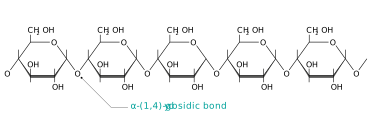
Figure: Amylose and the α-(1,4) glycosidic bond
When a β-(1,4) glycosidic bond is formed, the hydroxyl group shown above carbon number 1 on the glucose molecule to the left is removed to form water with the hydrogen from carbon 4 of the other glucose molecule. A β-(1,4) glycosidic bond is shown in the figure below.
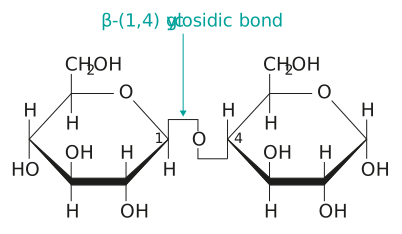
Figure: A β-(1,4) glycosidic bond
Remember that the ring representation of the glucose molecule is not entirely accurate? What is shown (and described) as the hydroxyl groups above and below carbon number 1 is actually above and below the plane of the glucose molecule.
Although we don’t find β-glycosidic bonds in starch, they are found in cellulose and the β-glucans that we will cover later.
Properties of amylose
The properties of amylose are in part due to its helical structure. The tight packing of the molecule means that it is insoluble in cold water and has a higher density than amylopectin. Amylose is known as a resistant starch, as it is more resistant to digestion in human digestive systems than amylopectin. Again, this indigestibility is due to its tight helical structure.