
Lesson 6 - Milling Technology
This lesson deals with the principles of design and operation of the various mill types. It also explains the criteria used for their selection.
Hammer Mill
We covered hammer mills in the Milling Principles lesson, so we will limit the discussion here to the range of technologies available and the advantages and disadvantages of hammer mills.
Vertical hammer mills
In vertical hammer mills, the rotor is positioned vertically in the mill and beaters move horizontally. The grist passes through a screen at the side of the comminution chamber. Some operate without the need for aspiration, which saves energy. They have a smaller footprint than horizontal mills but their throughput is lower. They also produce less noise. That said they are still noisier than roller mills. The figure below shows a vertical hammer mill.
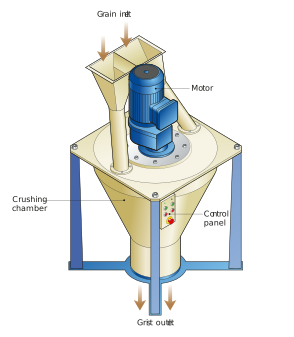
Figure: Vertical hammer mill
Horizontal hammer mills
Horizontal hammer mills have a horizontal rotor and grain is comminuted with beaters rotating in the vertical plain. They have a higher throughput than vertical mills and so are more suited to large breweries. The arrangement of striking/cutting plates and screens varies from model to model, but in all machines, the area of the comminution chamber that isn’t striking/cutting plate, is screen. The figure below shows a horizontal hammer mill.
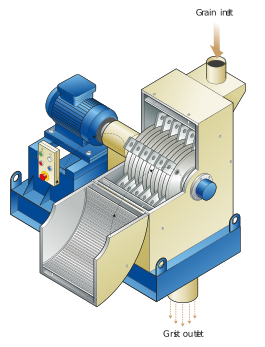
Figure: Horizontal hammer mill
Meura Carbomill
Hammer mills produce very small grist particles. This increases the area available for oxidation. The operation of hammer mills also causes an increase in temperature in the grain, which can increase the rate of grain lipid oxidation. The Carbomill uses CO2 to exclude oxygen, which reduces the potential for oxidation. The sealed grist case is part of the Carbomill assembly and this is filled with CO2 before the mill is started. When the mill starts, the CO2 from the grist case is drawn through the mill. Additional CO2 is supplied to the grist case to replace the CO2 drawn through the mill. The Carbomill uses 3-4 kg of CO2 per t of malt processed. The added benefit of the use of CO2 is that explosions are prevented. The system can also operate using nitrogen. The figure below shows the Carbomill set-up.
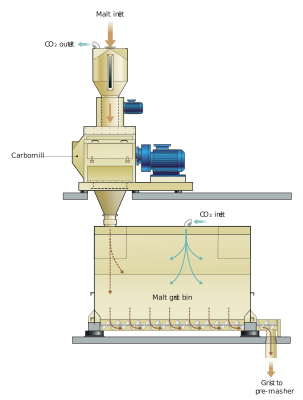
Figure: Carbomill
Advantages of hammer mills:
-
Can mill anything softer than the beaters!
-
Low maintenance costs compared to equivalent dry roller mills
-
Best extract efficiency of all mill types
Disadvantages of hammer mills:
-
Highest energy requirements of all mill types, at 4.4 kWhr/t of malt
-
Noisiest mill type (most require soundproof enclosure)
-
Greatest risk of oxidation if not purged with CO2 or nitrogen
-
Greatest risk of polyphenol and lipid extraction in the brewhouse
-
Greatest risk of LOX activity in the mash due to comminution of acrospire
-
Black malt and roasted barley are too friable to mill, producing only dust
-
Can only supply mash filters