
Lesson 6 - Milling Technology
This lesson deals with the principles of design and operation of the various mill types. It also explains the criteria used for their selection.
Two-Roller Dry Mill
There are more two-roller dry mills in the world than any other type of mill. This is because they are the simplest and have the lowest cost, and so are found in most small breweries. They are also typically used by producers of pre-milled malt. The figure below is an artist’s impression of a two-roller dry mill.
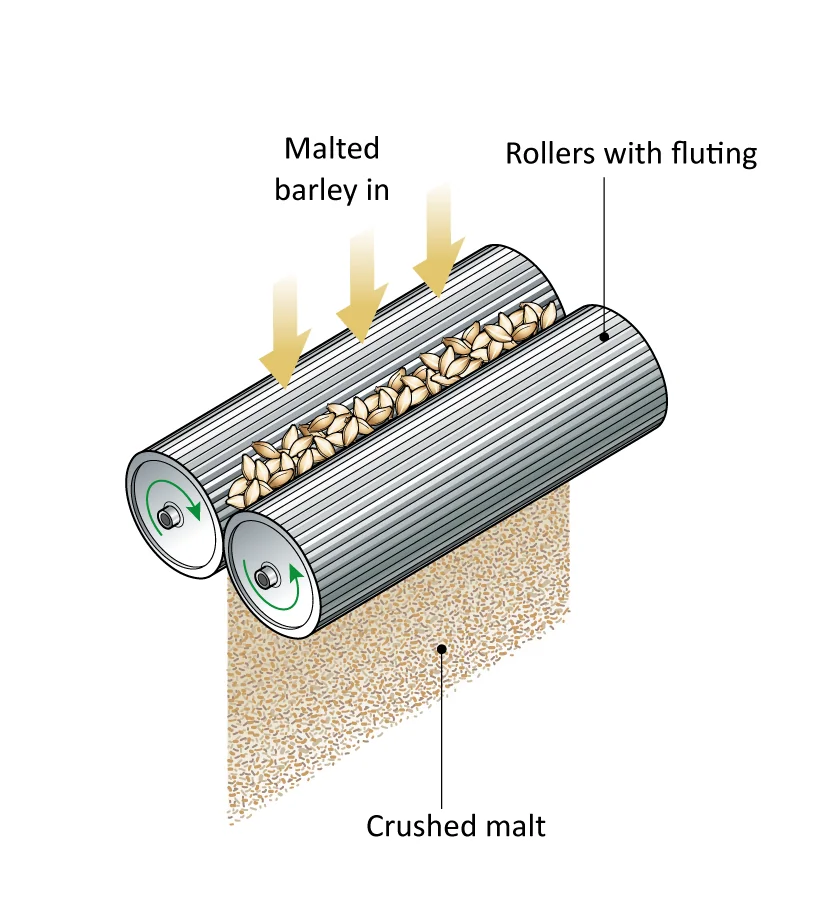
Figure: The two-roller mill
They have a single pair of crushing rollers, typically with a mill gap of 0.6-1 mm, producing grist at a rate of 1.5-2.5 kg/h per mm of roller length. Roller lengths can range from 40 to 1500 mm, but most are at around 500 mm. In some designs, a feed roller distributes the grain over the length of the rollers, but in most cases, the malt is fed by gravity over a feed plate which separates the grains to a stream of single corns. The rotational speed of rollers varies from 180 to 600 rpm.
As there is only one pair of rollers, two-roller mills are only suited to milling well-modified malt. Non-friable parts of poorly modified and inhomogeneously modified malt will pass through the mill largely uncrushed.
There is very little control of the particle size distribution of the grist produced by two-roller mills. The gap between the rollers and the level of modification of the malt will determine the standard size. If the gap is set too narrow, slow wort separation will result. Two-roller mills are best suited to working with mash tuns as a coarse grind is the easiest to achieve successfully.
Some breweries use two-roller mills to separately mill adjuncts or speciality malts. This is because the mill used for base malts is not suited to processing specific adjuncts or speciality malts, and because their particle size distribution is of less importance.
Three-roller mills, where an additional roller was added to provide two stages of milling, were once made. However, they did not provide significant benefits over two-roller mills. They are very rare, if not extinct, today.