
Lesson 6 - Milling Technology
This lesson deals with the principles of design and operation of the various mill types. It also explains the criteria used for their selection.
Full Steep Wet Mill
The full steep wet mill was the first type of wet mill to be developed and provides the greatest extent of husk hydration of all mills.
The mill includes a malt hopper that holds the malt ahead of milling. The malt hopper is filled with water to steep (soak) the malt. This increases the moisture content of the husk, with the endosperm also taking up some water.
The malt is steeped for a period before milling starts. The time taken and the temperature of the steep water depends on the degree of modification and the moisture of the malt. Excessive steeping can lead to a reduction in enzyme activity and the production of cloudy worts. This is especially the case for well- or over-modified malts. Times range from 10-35 min and temperatures range from 30-50°C. After steeping, the malt moisture can be as high as 25-30% and the grains swell by 35-40%. This means that the grain is not so much comminuted as squashed flat. The endosperm is squeezed out of the husk as it is flattened. The husk is so pliable that it remains pretty much intact.
Conditions in the mill can cause metal corrosion, therefore high quality cast chrome steel is used for the rollers. The surface of the rollers is fluted in such a way that it creates a crushing and rubbing effect, helping to gently remove the husk. Most mills have only two rollers with a diameter of 400 mm. The milling gap is usually 0.3 to 0.4 mm (if there are two pairs, the first pair of rollers has a gap of 0.8 mm) with the rollers rotating at 440 rpm.
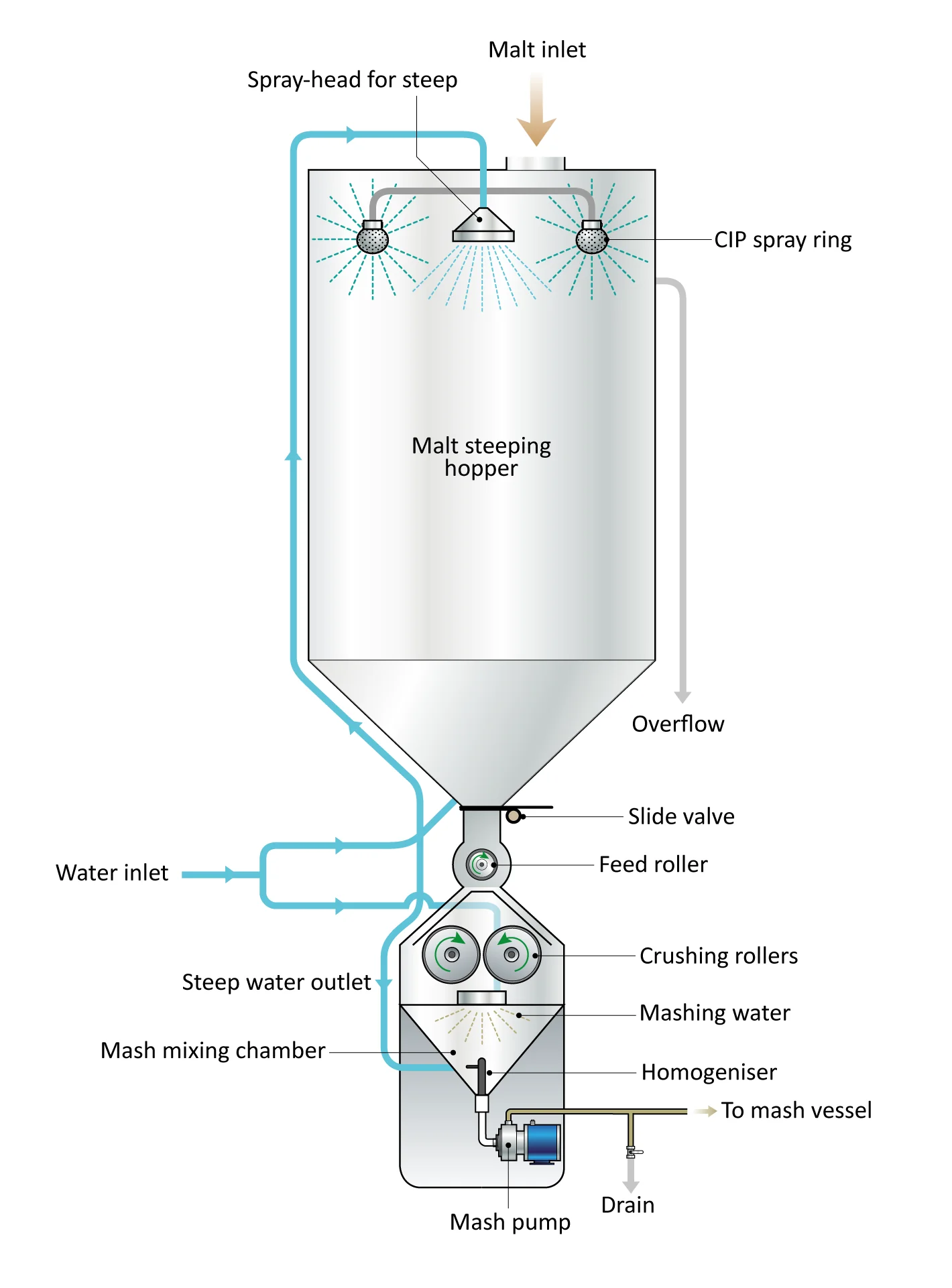
Figure: The full steep wet mill
Full steep wet mills are typically operated in five steps:
-
Steeping the malt in the hopper
-
Emptying the steep tank of water into the mash conversion vessel or the drain
-
Milling and mashing (mashing in)
-
Flushing the mill into the mash conversion vessel with mashing water
-
Cleaning (CIP)
The malt is steeped in the hopper and then the water is drained, either to the mash conversion vessel ‒ or sometimes (rarely) directly to drain. Additional mashing water is supplied after the crushing rollers. This mixes with the crushed malt in the mashing chamber, before being pumped to the mash conversion vessel by a mash transfer pump. The mills are sized to operate at the rate required to mash in to the mash conversion vessel and achieve the specified number of brews per day.
The fact that the husks remain intact means that the filtration bed for wort separation is less dense, more porous, and more permeable than is the case for dry milled grist. This allows higher lauter tun loadings (measured as the amount of grist, in kg/m² of vessel floor space) to be employed without negatively affecting run-off rates or wort clarity. It also minimises the extraction of polyphenols from the husk. Another benefit over dry mills is a faster conversion time. Because the grain is partially hydrated before milling, the conversion process starts sooner.
These mills are not easy to operate consistently, and as a result, effective automation is difficult to achieve. Another significant disadvantage is that they are not able to comminute unmodified endosperm fragments, so hard ends pass through the mill intact. Four-roller versions are better than two-roller models but are still not as effective as a six-roller dry mill. They are also unable to process less friable adjuncts such as maize or rice grits effectively.
As the hydration of the grist is already complete when mash arrives in the mash conversion vessel, proteolysis is more extensive than is the case with dry milling. Therefore, with well-modified malt, there is a risk of a reduction in beer foam stability and potentially in body due to excessive proteolysis.
If there are delays in the brewhouse programme, the malt in the steeping hopper will deteriorate, particularly in very warm climates. Malt enzymes become ineffective and the microbes on the grain can sour the malt and mash. Delays longer than an hour can result in the need to dispose of the grain.
Although they are flushed after use, organic material remains in the mill and biofilms can form. Wet mills need to be regularly cleaned in place to prevent microbial growth that can lead to off-flavours and potentially apparent total N-nitroso compounds ATNCs in beer.
They are typically cleaned in place in combination with the mash conversion vessel, meaning that both are out of action for longer than is the case with dry mills.
Advantages of full steep wet mills:
-
Improved lautering
-
Reduced polyphenol extraction
-
Reduced damage to acrospire so reduction in LOX activity
-
Decreased conversion time
-
Low mash oxidation when used with deoxygenated water and CO2 flushing
-
Reduced risk of explosion versus dry mills
Disadvantages of full steep wet mills:
-
Difficult to keep clean
-
Require frequent CIP
-
Highest water use and effluent generation of all mill types
-
Plansifter for grist analysis cannot be used
-
Operating conditions can cause corrosion
-
Increased risk of malt and mash souring with plant stoppages
-
Cannot mill some adjuncts and under-modified malts
-
Difficult to operate consistently
As we can see, there are a lot of disadvantages to full steep wet mills, and unsurprisingly, they are no longer manufactured. The mill we will cover next is designed to realise their advantages while mitigating or minimising their disadvantages. We discuss the steep conditioned mill next.