
Lesson 6 - Milling Technology
This lesson deals with the principles of design and operation of the various mill types. It also explains the criteria used for their selection.
Underwater Milling
Underwater milling allows the best control of oxygen pick-up, but only allows for very fine comminution. There are two technologies that work on this principle, one is the Meura Hydromill™ and the other is the DISPAX-REACTOR® (Please note, this is mentioned for illustrative purposes only and is not a recommendation or endorsement of the particular supplier’s product).
Meura Hydromill™
The Meura Hydromill™ is an underwater disc mill. Water and malt are metered into a steep tank (also called buffer column) above the mill and the suspension of grains in water is metered into the mill by a rotary valve. The mill itself (also called a pulveriser) consists of a rotating disc that rotates against a fixed disc at a peripheral speed of 40 m/s (1,275 rpm). The surfaces of both discs are covered in teeth that get progressively smaller and closer together from the centre to the perimeter. The disc faces are shown in the figure below.
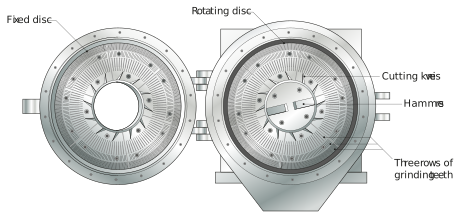
Figure: Discs of the Hydromill™
The malt and water enter at the centre of the disc and the spinning of the disc causes them to flow to the perimeter. As grain travels outwards, it is sheared between the discs with teeth, grinding it down into very small particles. The rotation of the mill acts like a pump, pushing the mash to the mashing vessel. After all the grain has been milled, the system is flushed with mashing water into the mashing vessel. The rotating disc can be moved in or out to adjust the milling gap, but the particle size distribution produced is only suitable for mash filters.
Rotary valves are used between the wet and dry parts of the system, so the dry parts remain dry. As a result, only the steep tank and mill itself will need to be cleaned in place. They can be cleaned independently of the mashing vessel. The figure below shows the elements of the system.
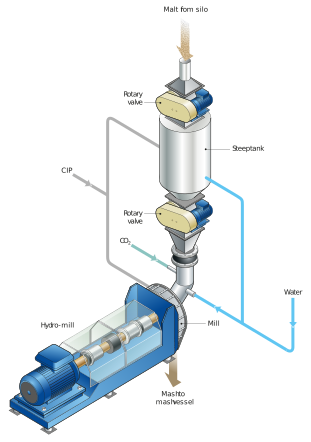
Figure: Underwater disc mill
DISPAX®
The DISPAX® is a three-stage, high shear machine normally used for dispersing solids in liquids and other mixing duties in food production. The water and malt are combined in a holding tank before being vortexed at very high turbulences through three increasingly small gaps which shear apart the grains. The rotor turns at 21 m/s, subjecting the grains to extreme forces which, combined with the shearing through the gaps in the machine, achieve a very fine comminution. As with the Hydromill™, the grist is only suited to the mash filter. Also similar to the Hydromill™, the mill operates like a pump to supply mash to the mashing vessel. The DISPAX® is no longer offered by the supplier for brewing applications.
Both the DISPAX® and the Hydromill™ are used with deoxygenated water and can be purged with CO2 to minimise oxygen pick-up. They can effectively mill all types of malt and all levels of modification, as well as all types of adjuncts. They both have very large motors and so they consume a lot of energy. They are, however, easier to CIP than other forms of wet mills, and milling underwater means that there is no risk of explosions!