
Lesson 6 - Milling Technology
This lesson deals with the principles of design and operation of the various mill types. It also explains the criteria used for their selection.
Six-Roller Mill
Six-roller mills are the mill of choice for many large breweries operating lauter tuns. They can operate on dry malt and malt that has been conditioned in a conditioning screw. They are the most complex dry mill in design and operation, but they offer the greatest flexibility in terms of the grain they can process effectively.
Six-roller mills have three sets of crushing rollers. Oscillating or inclined screens between the rollers separate the components of the grist by size. The number and location of the screens depend on the design of the mill. The first pair of rollers breaks up the kernel, the second pair mills out the endosperm, and the third pair comminutes the coarse grits.
In the design shown in the figure below, malt enters the mill via the feed roll and is crushed by the first pair of rollers, and then by the second set of rollers. The grist from the second set of rollers is split into two equal streams, which pass to two identical sets of screens. The large husk particles will not pass through the screens and so are carried along, passing out of the mill. Coarse grits and flour pass down through the screens and move as a single stream to a finer reciprocating screen. Flour is able to pass through this screen and leave the mill, while coarse grits are carried along it and sent to the third set of rollers to be comminuted.
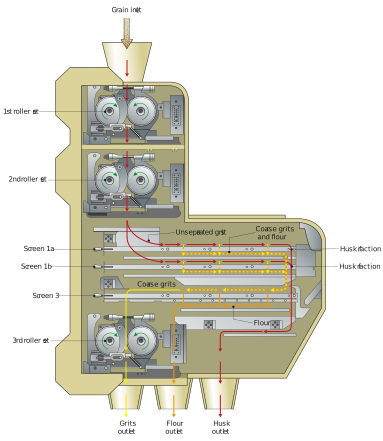
Figure: Six-roller mill with screens between the second and third set of rollers
This design is compact but provides a large surface area for screening. The upper and lower screens reciprocate in opposite directions, which minimises the vibration of the mill.
In another design (shown below), there are screens between each set of rollers.
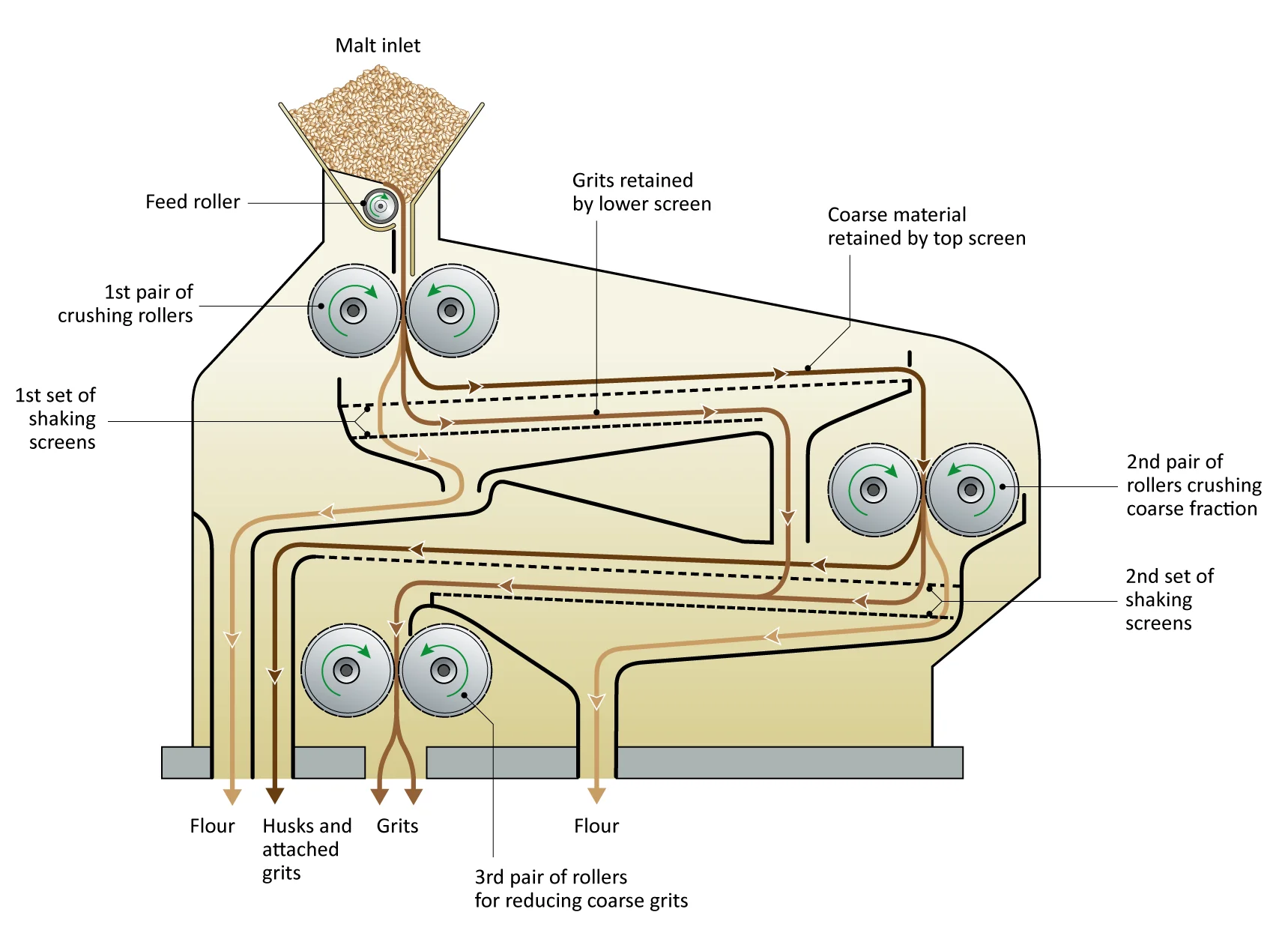
Figure: Six-roller mill with two sets of screens
The first set of screens has two screening stages. The first stage has larger holes than the second stage. The flour from the grist leaving the first rollers falls through both stages and is directed towards the flour outlet. Grits pass through the first stage, but not the second, and are sent to the third set of rollers. Coarse material (normally hard ends from under-modified malt) does not pass through either stage of the screen and is instead sent to be processed by the second pair of rollers.
The second screen processes the grist from the second rollers using two screening stages with progressively smaller holes. Husk from the second rollers does not pass through either screening stage and is directed to the husk outlet. Grits pass through the first screening stage and are directed to the third pair of rollers for comminution. Flour from the second pair of rollers falls through both screening stages and leaves via the flour outlet.
In this mill design, the screens are either inclined or oscillate at 6-12 Hz.
The table below shows the gaps recommended for six-roller mills both with and without conditioning, supplying grist for use in a lauter tun.
Table: Recommended mill gaps for dry and conditioned malt
|
Malt type |
First roller gap (mm) |
Second roller gap (mm) |
Third roller gap (mm) |
|
Dry |
1.6-2.0 |
0.6-1.1 |
0.2-0.4 |
|
Conditioned |
1.4-1.9 |
0.5-1.0 |
0.2-0.4 |
Six-roller mills can produce grist at a rate of 2-10 kg/h per mm of roller length. Some modern six-roller mills have speed controllers on each set of rollers in order to help regulate the speed of crushing and the degree of shear. Mill gap adjustment is also undertaken automatically on some models, and they are able to record and report their operating settings via dedicated software. Some also have automatic purging and blanketing with CO2 to reduce the risk of grist oxidation and explosions.
Advantages of six-roller mills:
-
Able to process more poorly modified malts than wet and dry two- and four- roller mills
-
Excellent control of grist particle size distribution
-
A plansifter can be used for grist analysis
-
Better extract efficiency than dry two- and four-roller mills
-
Easier to keep clean than wet mills
-
Lower energy requirement than hammer or wet mills at 2.2 kWhr/t of malt
Disadvantages of dry six-roller mills:
-
Poorer control of husk particle size than wet mills
-
Produces more dust than wet mills, increasing risk of explosions, extract loss, and staff exposure to dust
-
Lower lauter tun loadings than wet mills
-
Like all dry mills, they require a pre-masher and grist case